Tirzepatide or Semaglutide for PCOS: What We Know
Both medicines may help with weight management, but evidence that either treats PCOS itself is limited, and the PCOS-specific evidence differs between them.
For PCOS, there isn’t enough direct evidence to say tirzepatide or semaglutide is the better choice. Semaglutide has limited PCOS-specific research; a recent evidence review found no PCOS-specific evidence for tirzepatide. Weight-loss findings from broader populations don’t establish benefits for cycles, hormones, or fertility in people with PCOS. Treatment choice depends on your goals, health, and pregnancy plans. 2
The short comparison
If you’re weighing these medicines because of PCOS, the clearest distinction is how much has actually been studied in people with PCOS. A 2026 evidence review describes semaglutide data as sparse and reports no PCOS-specific evidence for tirzepatide. It also says liraglutide, a different medicine in the same broader treatment area, has the densest PCOS-specific evidence. That doesn’t make semaglutide a proven PCOS treatment; it shows why the evidence for each medicine shouldn’t be treated as interchangeable. 2
Both medicines have been studied for weight management in broader populations. A systematic review summarized weight-loss results for semaglutide and tirzepatide across studies involving different conditions and populations, including some people with PCOS. Those broader results can help explain why the medicines are considered for weight management, but they don’t tell us which works better for PCOS or whether either improves PCOS-related cycles, androgen symptoms, or fertility. The review summary doesn’t provide a direct PCOS-only comparison of the two. 1
Weight loss is not the same as treating PCOS
PCOS can involve metabolic and reproductive concerns, and they don’t always show up in the same way for every person. The proposed link between weight loss and better PCOS outcomes is biologically plausible: the evidence review describes connections among adiposity, insulin resistance, and PCOS. But a plausible pathway isn’t proof that a particular medicine reliably improves a specific PCOS outcome. 2
That distinction matters if your main goal is more predictable periods, relief from androgen-related symptoms, or pregnancy. A review of the PCOS evidence reports only sparse data for semaglutide and calls for better-designed PCOS-specific trials. It describes tirzepatide’s PCOS use as extrapolation from obesity and diabetes research, not an established PCOS treatment. So weight change alone shouldn’t be taken as evidence that cycles or fertility will improve. 2
PCOS care can address different goals separately. The evidence review discusses lifestyle intervention and metformin among existing approaches, while emphasizing that care needs to account for the person’s metabolic and reproductive concerns. Ask which goal a proposed medicine is meant to address, and what other options fit that goal. A weight-management medicine shouldn’t automatically replace care focused on cycle symptoms or fertility. 2
Pregnancy plans change the discussion
Neither medicine should be treated as a fertility medicine. Reviews describe possible reproductive benefits from weight and metabolic changes, but the available evidence does not establish that semaglutide or tirzepatide will help you conceive. Pregnancy safety evidence is limited, so if you’re pregnant, breastfeeding, or planning to try to conceive, discuss the timing of treatment and stopping it with your prescriber before making a change. 23
There’s an additional contraception question with tirzepatide: delayed stomach emptying may affect oral contraceptive reliability when treatment is started or increased. Ask whether you need a backup or non-oral contraceptive option during those periods. Don’t assume this concern applies in the same way to semaglutide; discuss the specific medicine you’re taking. 34
Questions that make the choice clearer
You might ask:
- Is my main goal weight management, metabolic health, cycle symptoms, or fertility?
- What evidence supports this medicine for that specific goal in people with PCOS?
- What PCOS care would continue alongside it, including options such as lifestyle support or metformin?
- How would a current or future pregnancy plan affect whether and when I use it?
- If I take tirzepatide and use oral contraception, do I need another contraceptive measure when treatment starts or is increased?
The practical takeaway: compare these medicines for the goal you actually have, rather than assuming that results in general weight-management studies answer a PCOS-specific question.
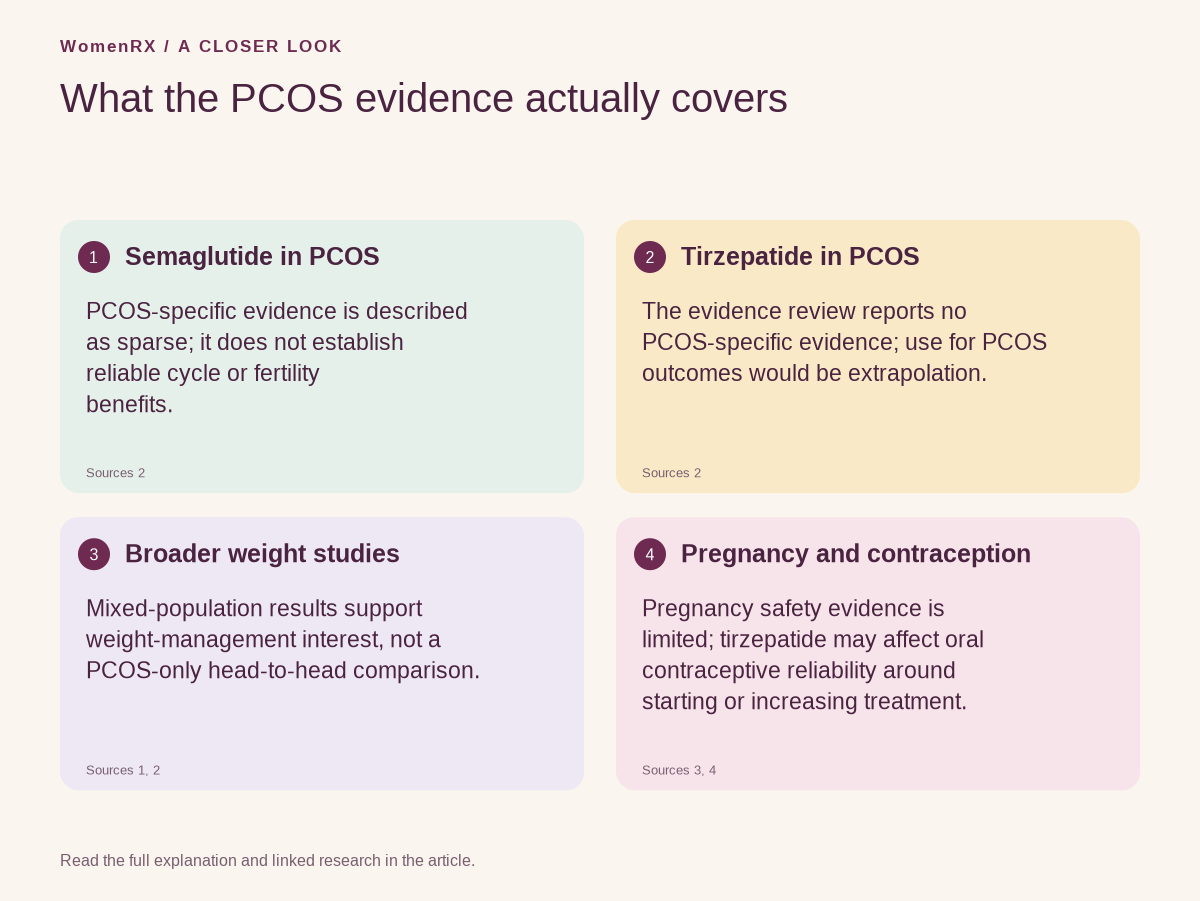
What the PCOS evidence actually covers
Semaglutide in PCOS: PCOS-specific evidence is described as sparse; it does not establish reliable cycle or fertility benefits.2
Tirzepatide in PCOS: The evidence review reports no PCOS-specific evidence; use for PCOS outcomes would be extrapolation.2
Broader weight studies: Mixed-population results support weight-management interest, not a PCOS-only head-to-head comparison.12
Pregnancy and contraception: Pregnancy safety evidence is limited; tirzepatide may affect oral contraceptive reliability around starting or increasing treatment.34
Read the figure as text
These distinctions separate findings in broader weight-management research from evidence about PCOS-specific outcomes.- Semaglutide in PCOS: PCOS-specific evidence is described as sparse; it does not establish reliable cycle or fertility benefits.2
- Tirzepatide in PCOS: The evidence review reports no PCOS-specific evidence; use for PCOS outcomes would be extrapolation.2
- Broader weight studies: Mixed-population results support weight-management interest, not a PCOS-only head-to-head comparison.12
- Pregnancy and contraception: Pregnancy safety evidence is limited; tirzepatide may affect oral contraceptive reliability around starting or increasing treatment.34
More questions, answered
Which has more evidence specifically in PCOS?
The evidence review describes semaglutide research in PCOS as sparse and reports no PCOS-specific evidence for tirzepatide. That difference does not establish semaglutide as an effective PCOS treatment or show that it is the better choice for an individual. 2
Could either medicine improve fertility?
It’s possible that weight or metabolic changes could affect reproductive health, but current evidence does not establish that semaglutide or tirzepatide improves fertility in people with PCOS. If pregnancy is a goal, discuss treatment timing and pregnancy safety before starting or continuing either medicine. 23
Sources you can check
- Approved weight loss drugs for obesity with a thorough emphasis on GLP-1 agonist medications: A systematic review.Gunasekaran P, Inban P, Agrawal A, Thai A, Aravazhi PS, Tariq H, Prajjwal P, John J. · Disease-a-month : DM · 2026Return to first citation
- Incretin-Based Anti-obesity Medications in Polycystic Ovary Syndrome: The Evidence Map.Jensterle M, Janez A. · Drugs · 2026Return to first citation
- GLP-1 Receptor Agonists and Fertility: What Is Known So Far?Becker AS, Castilhos JP, Shugair SAS, Colombo T, Hentschke M-. · JBRA assisted reproduction · 2026Return to first citation
- What obgyns need to know about GLP-1 receptor agonists.Chauhan I. · Current opinion in obstetrics & gynecology · 2026Return to first citation