Semaglutide or tirzepatide for PCOS? What to weigh
Both can support weight loss, but the PCOS-specific evidence is much thinner than the broader weight-management evidence.
For PCOS, neither medicine has strong evidence as a treatment for the syndrome itself. Both have shown substantial weight-loss effects in broader weight-management research, and one review reports greater weight loss with tirzepatide in phase 3 trials; that doesn’t establish which is better for you or for PCOS. Ask about your treatment indication, pregnancy plans, contraception, and which outcomes you’ll monitor. 3 5
Start with the goal, not the brand
Semaglutide and tirzepatide are medicines used in weight and metabolic care, but the evidence for losing weight is not the same as evidence for treating PCOS. A review of PCOS research describes semaglutide-specific findings as sparse and reports no PCOS-specific evidence for tirzepatide. So a clinician may discuss one for weight management, but that is different from having proof it will improve PCOS symptoms or fertility. 3
It also helps to name the exact product being discussed. The same medicine can be sold under different brand names and for different uses; ask which formulation and treatment indication your clinician has in mind. A PCOS diagnosis by itself doesn’t tell you which product, if any, is appropriate. 4
What the comparison can, and can’t, tell you
In broader obesity research, both medicines have shown substantial weight-loss effects. A 2026 review of phase 3 trials reports greater weight-loss efficacy with tirzepatide than semaglutide. That comparison is about weight outcomes in general treatment populations, not proof that tirzepatide works better for PCOS symptoms, menstrual cycles, or fertility. 2 5
For PCOS-specific outcomes, the evidence is less settled. The available review describes limited semaglutide data and no PCOS-specific tirzepatide evidence. It also notes that the more substantial PCOS research is for liraglutide, a different medicine. Findings for liraglutide or for GLP-1 medicines as a broad group shouldn’t be treated as proof of the same effects from semaglutide or tirzepatide. 3 4
That distinction matters if your main goal is a more regular cycle, fewer androgen-related symptoms, or pregnancy. Weight or metabolic changes may be relevant to your overall care, but they don’t establish that either medicine will improve those particular outcomes. A review of incretin medicines in PCOS identifies reproductive outcomes as an important evidence gap. 3
Make the visit about your own outcomes
Before deciding, agree on what you’re hoping will change and how you’ll tell whether treatment is helping. You might ask:
- Why this medicine and formulation? Is the proposed reason weight management, diabetes care, or both? How does that fit your health history and current treatment goals?
- What result matters most to me? Separate a weight-related goal from PCOS goals such as cycle patterns or fertility. Ask what the evidence supports for each rather than assuming one predicts the other.
- What will we monitor? Discuss weight and relevant metabolic measures, along with tolerability and any PCOS symptoms you want to follow. Body weight alone cannot describe every aspect of health. 1 2
- What would make us reassess? Agree on how you’ll review benefits, side effects, and whether the plan still fits your priorities.
A useful goal might be a metabolic improvement you and your clinician can track, alongside a separate conversation about menstrual or reproductive goals. That keeps a weight result from being mistaken for proof that PCOS itself has improved.
If pregnancy is possible or planned
Talk about pregnancy plans before starting, even if you aren’t trying to conceive right now. Reviews advise against use during pregnancy because human pregnancy-safety evidence is limited, and recommend stopping before trying to conceive. The exact interval before conception should be confirmed for the specific medicine: published reviews give slightly different timing recommendations for semaglutide and tirzepatide. 4 6
Tirzepatide may also affect how well oral contraceptives are absorbed when treatment starts or the dose changes. A review summarizing manufacturer guidance describes using backup contraception during those periods; ask your prescriber or pharmacist for the current product-specific instructions and an option that fits you. 5
Don’t count on treatment as a fertility medicine. Some broader GLP-1 research reports reproductive signals in women with PCOS, but the findings don’t establish that semaglutide or tirzepatide improves your chance of pregnancy. If pregnancy is a near-term goal, make that part of the treatment decision rather than treating it as a later detail. 3 4
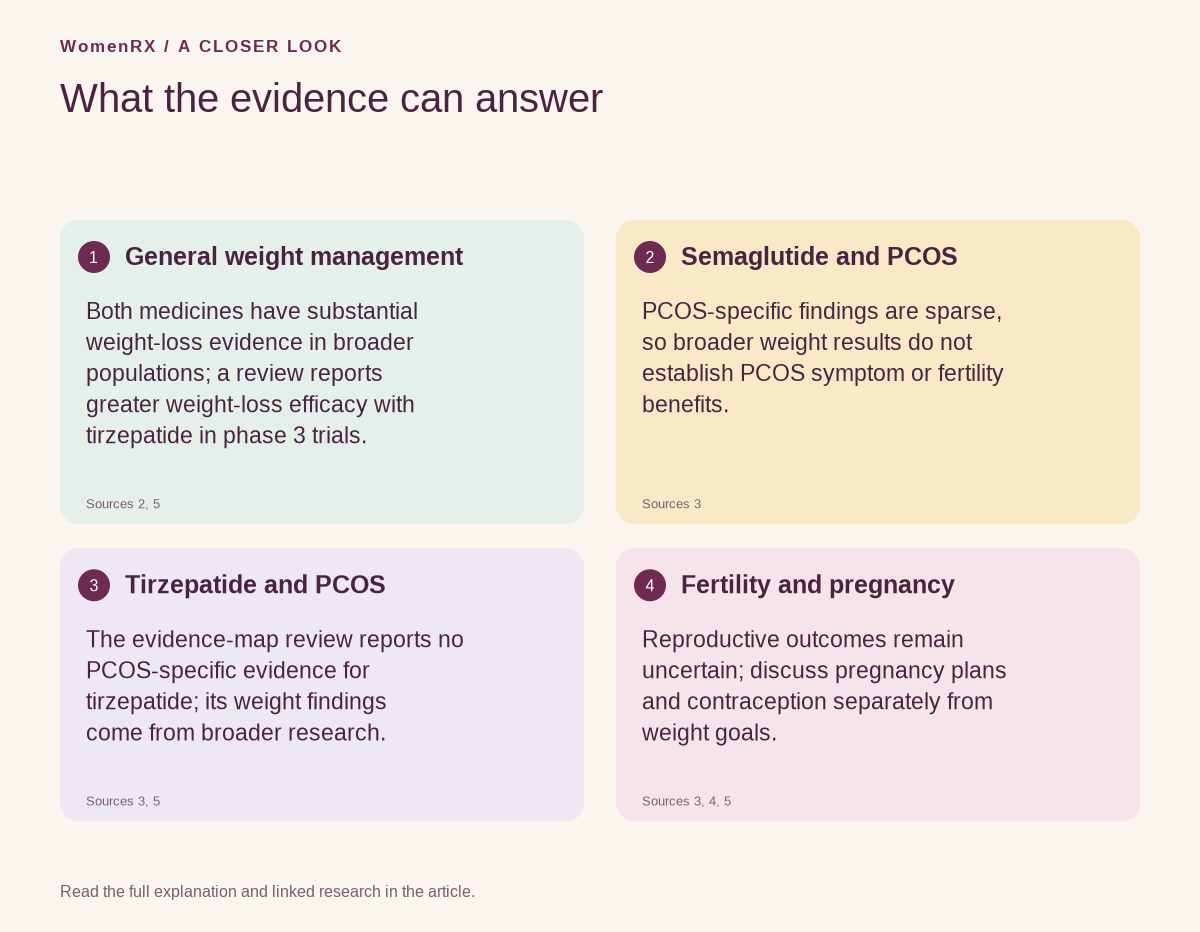
What the evidence can answer
General weight management: Both medicines have substantial weight-loss evidence in broader populations; a review reports greater weight-loss efficacy with tirzepatide in phase 3 trials.25
Semaglutide and PCOS: PCOS-specific findings are sparse, so broader weight results do not establish PCOS symptom or fertility benefits.3
Tirzepatide and PCOS: The evidence-map review reports no PCOS-specific evidence for tirzepatide; its weight findings come from broader research.35
Fertility and pregnancy: Reproductive outcomes remain uncertain; discuss pregnancy plans and contraception separately from weight goals.345
Read the figure as text
Weight-loss findings and PCOS-specific findings answer different questions. This comparison shows where evidence is broader and where it remains limited.- General weight management: Both medicines have substantial weight-loss evidence in broader populations; a review reports greater weight-loss efficacy with tirzepatide in phase 3 trials.25
- Semaglutide and PCOS: PCOS-specific findings are sparse, so broader weight results do not establish PCOS symptom or fertility benefits.3
- Tirzepatide and PCOS: The evidence-map review reports no PCOS-specific evidence for tirzepatide; its weight findings come from broader research.35
- Fertility and pregnancy: Reproductive outcomes remain uncertain; discuss pregnancy plans and contraception separately from weight goals.345
More questions, answered
Does losing weight with either medicine mean my PCOS is improving?
Not necessarily. Weight change and PCOS-specific outcomes are different measures. Decide which symptoms or metabolic results matter to you, and review them separately; current reviews describe limited semaglutide-specific PCOS evidence and no PCOS-specific tirzepatide evidence. 3
Could treatment affect my birth control?
Tirzepatide may affect oral contraceptive absorption when you start treatment or change the dose. Ask about current product-specific backup guidance and whether a non-oral option better fits your needs. 5
Sources you can check
- Body Weight: MedlinePlusAccessed 2026-09-25Return to first citation
- Approved weight loss drugs for obesity with a thorough emphasis on GLP-1 agonist medications: A systematic review.Gunasekaran P, Inban P, Agrawal A, Thai A, Aravazhi PS, Tariq H, Prajjwal P, John J. · Disease-a-month : DM · 2026Return to first citation
- Incretin-Based Anti-obesity Medications in Polycystic Ovary Syndrome: The Evidence Map.Jensterle M, Janez A. · Drugs · 2026Return to first citation
- GLP-1 Receptor Agonists and Fertility: What Is Known So Far?Becker AS, Castilhos JP, Shugair SAS, Colombo T, Hentschke M-. · JBRA assisted reproduction · 2026Return to first citation
- What obgyns need to know about GLP-1 receptor agonists.Chauhan I. · Current opinion in obstetrics & gynecology · 2026Return to first citation
- The effects of glucagon-like peptide-1 receptor agonists on fertility, contraception, and pregnancy: clinical perspectives.Dilbaz B, Ateş Ç. · The European journal of contraception & reproductive health care : the official journal of the European Society of Contraception · 2026Return to first citation