Mounjaro vs. Ozempic for Weight Loss: What to Compare
They contain different active ingredients, and the weight-management brands are Zepbound and Wegovy, not Mounjaro and Ozempic.
Mounjaro contains tirzepatide; Ozempic contains semaglutide. In the US, their weight-management brand counterparts are Zepbound and Wegovy, respectively, with different approved uses from Mounjaro and Ozempic. A review reports greater weight-loss efficacy with tirzepatide in phase 3 trials, but that doesn’t establish a universal best choice. Pregnancy plans, breastfeeding, other health conditions, access, and personal preferences also matter. 3 5 6
First, compare the active ingredients and the right brands
Mounjaro and Ozempic aren’t two versions of the same medicine. Mounjaro contains tirzepatide; Ozempic contains semaglutide. They’re related medicines, but they have different active ingredients. 5
There’s also a brand-name distinction that matters when weight management is the goal. In the US, the review identifies Zepbound as the tirzepatide brand approved for weight management and Wegovy as the semaglutide brand approved for weight management. Mounjaro and Ozempic are diabetes brands. So a conversation about treatment for obesity should clarify which active ingredient and which brand’s approved use are being considered, rather than treating Mounjaro and Ozempic as like-for-like weight-loss products. 5
What the comparison says about weight loss
Both medicines are recognized options for weight management. The American College of Physicians’ 2026 guideline suggests semaglutide or tirzepatide, alongside lifestyle modifications, for nonpregnant adults with obesity. It also suggests them for adults with overweight and certain weight-related conditions, such as type 2 diabetes, high blood pressure, dyslipidemia, sleep apnea, or cardiovascular disease. The recommendation is conditional, not a declaration that one medicine is right for everyone. 6
A 2026 review says tirzepatide showed greater efficacy than semaglutide in phase 3 trials. That’s a useful signal, but it doesn’t establish the size of an individual’s benefit or determine which treatment is right for her. 3
That distinction matters: a result from a trial or summary is not a promise about your own outcome. Nor do these findings show that weight-loss results differ for women as a group. Ask which trial or treatment context a comparison refers to, and how closely it matches the product and goals being discussed.
The practical choice is more than a scale result
The ACP guideline recommends discussing benefits and harms alongside costs, access and availability, other health conditions, goals, preferences, and contraindications or warnings. Those factors can change what makes sense even when two medicines are both evidence-supported options. 6
For example, if you have type 2 diabetes as well as a weight-management goal, clarify whether the proposed treatment and brand are being chosen for diabetes care, weight management, or both. If coverage or availability differs, ask what alternatives are appropriate rather than assuming the familiar brand is the only option. And if a previous medication didn’t meet your goals, discuss whether switching is reasonable and what outcome would count as a useful response. 5 6
Pregnancy and breastfeeding change the conversation
If you’re pregnant, trying to conceive, or breastfeeding, raise that early. A review advises avoiding these medicines during pregnancy because human safety information is limited and fetal risks have been seen in animal studies. It also notes that people planning pregnancy need to discuss stopping treatment in advance. The right timing is medicine-specific, so don’t use a general comparison to set your own stop date. 4 5
For semaglutide tablets, US prescribing information says available pregnancy data aren’t sufficient to assess the risk of major birth defects or other adverse outcomes; animal studies raise potential fetal-risk concerns. 1 For Ozempic specifically, the injectable product’s label says there are no data on semaglutide in human milk, effects on a breastfed infant, or effects on milk production. 2
If you’re breastfeeding or planning to, discuss the specific medicine and your feeding plans rather than assuming that information for semaglutide applies to tirzepatide. 2
Questions that make the comparison clearer
You might ask: Which active ingredient and brand are you proposing, and what is its approved use? What evidence supports that option for someone with my health conditions and goals? How do access and coverage affect the choices? If pregnancy is possible or planned, what should we discuss about contraception and stopping treatment? If I’m breastfeeding, what is known about this specific medicine?
Those questions keep the decision focused on the treatment in front of you, not just on which brand name is more familiar.
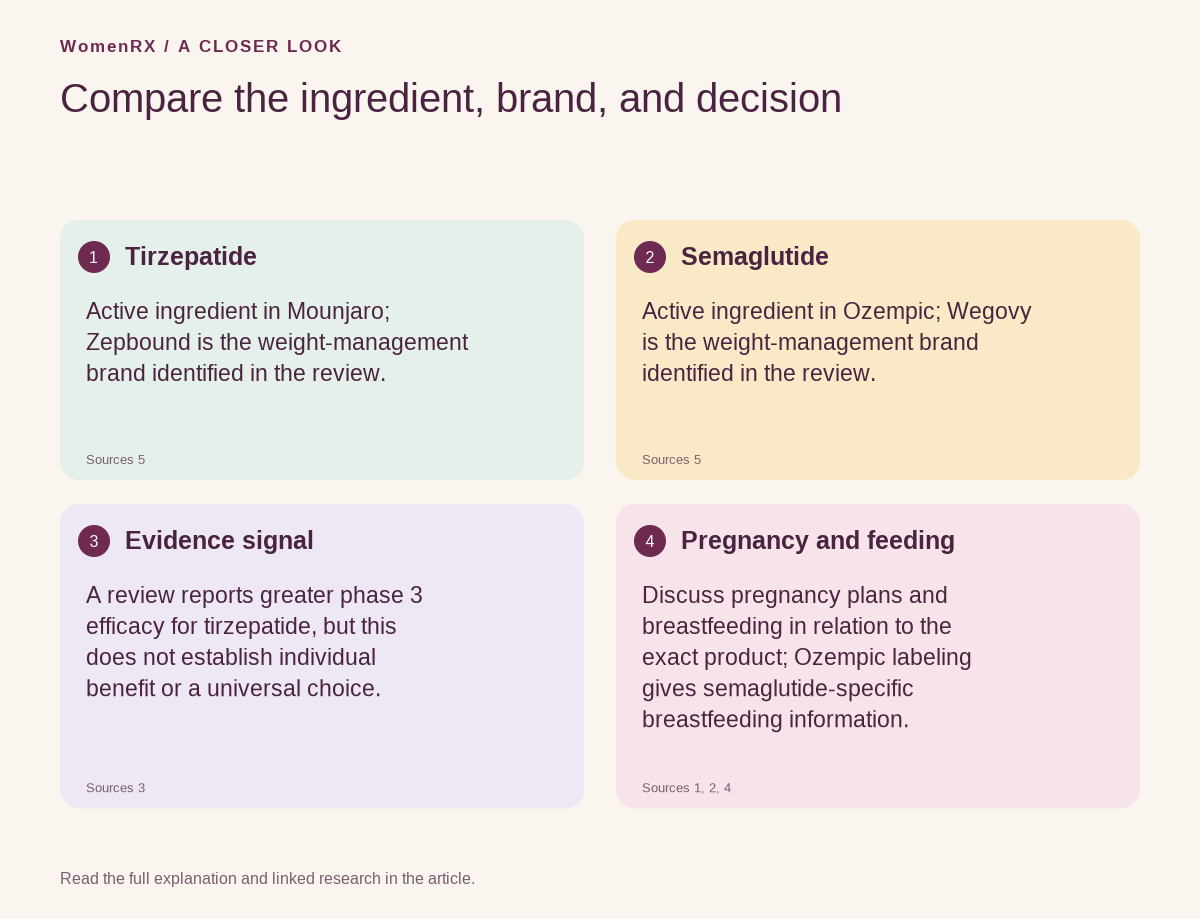
Compare the ingredient, brand, and decision
Tirzepatide: Active ingredient in Mounjaro; Zepbound is the weight-management brand identified in the review.5
Semaglutide: Active ingredient in Ozempic; Wegovy is the weight-management brand identified in the review.5
Evidence signal: A review reports greater phase 3 efficacy for tirzepatide, but this does not establish individual benefit or a universal choice.3
Pregnancy and feeding: Discuss pregnancy plans and breastfeeding in relation to the exact product; Ozempic labeling gives semaglutide-specific breastfeeding information.124
Read the figure as text
The names, evidence, and personal considerations answer different parts of the choice.- Tirzepatide: Active ingredient in Mounjaro; Zepbound is the weight-management brand identified in the review.5
- Semaglutide: Active ingredient in Ozempic; Wegovy is the weight-management brand identified in the review.5
- Evidence signal: A review reports greater phase 3 efficacy for tirzepatide, but this does not establish individual benefit or a universal choice.3
- Pregnancy and feeding: Discuss pregnancy plans and breastfeeding in relation to the exact product; Ozempic labeling gives semaglutide-specific breastfeeding information.124
More questions, answered
Are Mounjaro and Ozempic the same medicine?
No. Mounjaro contains tirzepatide, while Ozempic contains semaglutide. They are different active ingredients. 5
Which brand names are used for weight management?
The review identifies Zepbound as the tirzepatide brand and Wegovy as the semaglutide brand approved for weight management in the US. Mounjaro and Ozempic are diabetes brands. 5
Sources you can check
- OZEMPIC (ORAL SEMAGLUTIDE) TABLET RYBELSUS (ORAL SEMAGLUTIDE) TABLET [NOVO NORDISK PHARMACEUTICAL INDUSTRIES, LP] | US prescribing information and patient instructionsAccessed 2026-09-25Return to first citation
- OZEMPIC (SEMAGLUTIDE) INJECTION, SOLUTION [A-S MEDICATION SOLUTIONS] | US prescribing information and patient instructionsAccessed 2026-09-25Return to first citation
- What obgyns need to know about GLP-1 receptor agonists.Chauhan I. · Current opinion in obstetrics & gynecology · 2026Return to first citation
- The effects of glucagon-like peptide-1 receptor agonists on fertility, contraception, and pregnancy: clinical perspectives.Dilbaz B, Ateş Ç. · The European journal of contraception & reproductive health care : the official journal of the European Society of Contraception · 2026Return to first citation
- GLP-1 Receptor Agonists and Fertility: What Is Known So Far?Becker AS, Castilhos JP, Shugair SAS, Colombo T, Hentschke M-. · JBRA assisted reproduction · 2026Return to first citation
- Pharmacologic Treatments With Lifestyle Modifications in Nonpregnant Adults With Overweight or Obesity in Outpatient Settings: A Living Clinical Guideline From the American College of Physicians (April 2026).Qaseem A, Cross JT, Harrod CS, Owens DK, Balk EM, Crandall CJ, Clinical Guidelines Committee of the American College of Physicians, Fitterman N, Gibson M, Lewis J, Mackey K, Miller... · Annals of internal medicine · 2026Return to first citation