Is “Ozempic Face” a Drug Effect or Weight Loss?
Facial fullness can change with significant weight loss, but current evidence can’t separate that effect from a direct action of GLP-1 medicines on the face.
“Ozempic face” is an informal label for facial hollowing, looser-looking skin, or more visible wrinkles, not a medical diagnosis. Significant weight loss can reduce facial fat and make these changes more noticeable. Studies of people using GLP-1 medicines don’t yet establish how much is caused by the medicines themselves rather than by the amount or pace of weight loss. 4
What people mean by the term
“Ozempic face” is a media and cosmetic label for changes such as less fullness in the cheeks or temples, hollowness around the eyes, looser-looking skin, or more noticeable wrinkles. It isn’t a diagnosis, and the phrase can make a familiar effect of weight loss sound like a unique drug reaction. 4
What weight loss can change
Facial fat helps shape the cheeks, temples, and area around the eyes. Losing body fat can reduce fullness in these areas; if weight loss is substantial or happens quickly, skin may also look looser and lines more pronounced. Age-related changes can affect facial volume and skin, too, so a change in appearance may have more than one contributor. 4
That gives a plausible explanation for facial changes during treatment, but it doesn’t prove a medication-specific effect. A review describes imaging studies of people before and after GLP-1 treatment, while also noting that research directly measuring the medicines’ effects on facial features is limited. Before-and-after observations can show that a change occurred during treatment, but they can’t by themselves tell whether the cause was the medicine, weight loss, aging, or a combination. 4
What the research can and can’t say
Some research has documented facial changes in people taking GLP-1 medicines, but that isn’t the same as showing that these medicines directly remove facial fat. To separate a drug effect from weight loss, studies would need to compare people with similar weight changes who did and didn’t take the medicines, using consistent facial measurements. The evidence summarized in a 2025 review doesn’t establish that distinction. 4
Nor does it establish that women have a distinct risk, or that menopause changes the likelihood of facial volume loss. A small case series involving 15 women examined cosmetic treatments after GLP-1-related weight loss; it can describe those participants’ treatment experience, but it can’t show that women are affected differently from men. 3
A practical way to think about your own changes
If your face looks less full while your body weight is also falling, weight-loss-related fat changes are one reasonable explanation. That doesn’t tell you whether the medicine contributed directly. You can raise the change with the clinician managing your treatment and discuss how it fits with your weight trajectory and overall health goals.
If you’re losing weight without trying, don’t assume the medicine or facial changes explain it. Unexpected weight loss should be discussed with a healthcare provider. 1
Be cautious about promises to restore lost facial volume with a cream. In one 12-week study, 33 adults experiencing rapid weight loss were given the same topical cream, and 29 completed the study. Because there was no comparison group, the findings can’t establish how much change the cream caused or whether it restored lost facial fat. 2
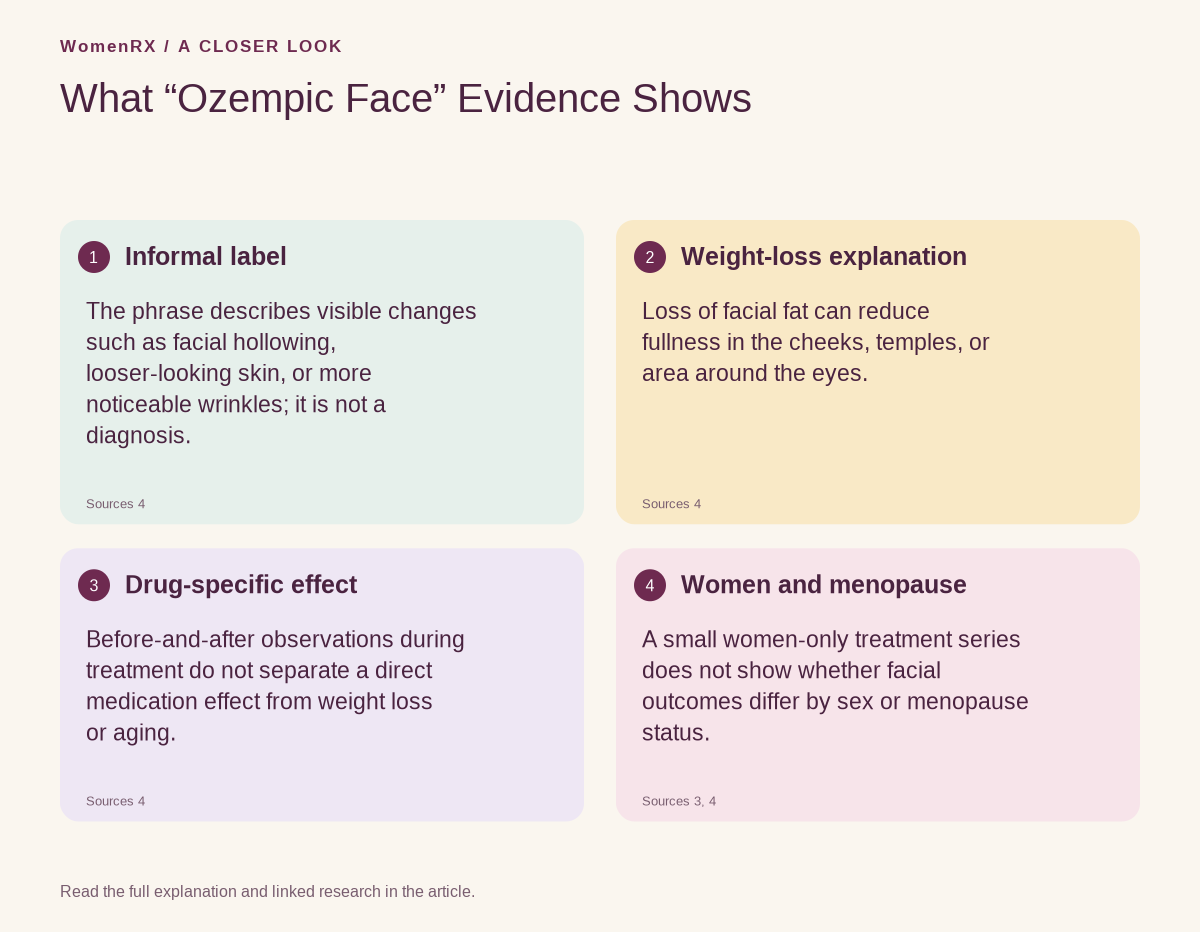
What “Ozempic Face” Evidence Shows
Informal label: The phrase describes visible changes such as facial hollowing, looser-looking skin, or more noticeable wrinkles; it is not a diagnosis.4
Weight-loss explanation: Loss of facial fat can reduce fullness in the cheeks, temples, or area around the eyes.4
Drug-specific effect: Before-and-after observations during treatment do not separate a direct medication effect from weight loss or aging.4
Women and menopause: A small women-only treatment series does not show whether facial outcomes differ by sex or menopause status.34
Read the figure as text
Separate the informal label from plausible weight-loss changes and from effects research has not established.- Informal label: The phrase describes visible changes such as facial hollowing, looser-looking skin, or more noticeable wrinkles; it is not a diagnosis.4
- Weight-loss explanation: Loss of facial fat can reduce fullness in the cheeks, temples, or area around the eyes.4
- Drug-specific effect: Before-and-after observations during treatment do not separate a direct medication effect from weight loss or aging.4
- Women and menopause: A small women-only treatment series does not show whether facial outcomes differ by sex or menopause status.34
Sources you can check
- Body Weight: MedlinePlusAccessed 2026-09-25Return to first citation
- Topical Volumizing Cream Improves Facial Volume and Skin Health in Adults With Rapid Weight Loss From Pharmacologic (GLP-1/GIP Agonists), Surgical, or Behavioral Interventions.Nguyen N, Aguilar A, Afzal N, Lee A, Akram W, Duong MN, Sivamani RK. · Journal of cosmetic dermatology · 2026Return to first citation
- Aesthetic Use of Poly-L-Lactic Acid and Hyaluronic Acid Fillers in Medication-Driven Weight Loss Due to GLP-1 Receptor Agonists: Real-World Case Series from Latin America.Avelar LET, Sarlos P, Guarnieri C, Alvarez PP, Rojas GA, Rossiere N, Toro VA, Kamamoto C, Gomes RT, Nogueira A, Miot HA. · Clinical, cosmetic and investigational dermatology · 2026Return to first citation
- Functional and Aesthetic Periorbital, Ocular Adnexal and Ocular Surface Changes Linked to GLP-1 Receptor Agonists.Kapantais D, Tsoutsanis P. · Journal of clinical medicine · 2025Return to first citation