Tirzepatide or semaglutide: what should you compare?
Tirzepatide led to greater average weight loss in a direct trial, but the right choice also depends on which formulation you’re considering and what fits your life.
In a 72-week head-to-head trial, average weight change was −20.2% with tirzepatide and −13.7% with semaglutide. 6 The participants had overweight or obesity and did not have type 2 diabetes. 5 That result favors tirzepatide for average weight loss in the group studied, but it doesn’t predict your result or establish which medicine is better specifically for women.
Start with the comparison that assigned people to each medicine
The most useful weight-loss comparison is the direct SURMOUNT-5 trial: participants received either injectable tirzepatide or injectable semaglutide. A review reports average weight changes at 72 weeks of −20.2% and −13.7%, respectively. 6 The trial population had obesity, or overweight with an obesity-related complication, and did not have type 2 diabetes. 5
The treatments were studied at maximum tolerated doses: tirzepatide 10 or 15 mg and injectable semaglutide 1.7 or 2.4 mg in the head-to-head comparison. 3 That detail matters if you see a trial percentage and picture it as the result of one fixed dose. It’s a group average from a particular treatment approach, not a promise about the dose you’ll tolerate or the weight you’ll lose.
Weight change isn’t every outcome. A review of the clinical evidence notes that completed head-to-head cardiovascular outcome trials directly comparing tirzepatide with semaglutide were lacking. Greater weight loss in SURMOUNT-5 therefore shouldn’t be read as proof that tirzepatide better prevents heart attacks or strokes. 4
Keep the oral comparison in a separate column
You may also encounter a study comparing injectable tirzepatide with oral semaglutide. That analysis used separate trials, with weekly injectable tirzepatide at studied doses of 5, 10, or 15 mg and daily oral semaglutide at 50 mg. Researchers adjusted for measured differences between the trial populations, including sex. They did not randomly assign people within one trial to those two treatments. 3
An indirect comparison can be informative, but differences in participants and study methods can remain after adjustment. It also answers a different question from SURMOUNT-5, which compared two injections. Before relying on a headline result, check which form of semaglutide it describes.
Compare side effects without mixing trial percentages
Stomach and bowel effects deserve a place in the decision. Gastrointestinal events predominated in the studies assessed by a comparative review. 6 In Zepbound’s separate placebo-controlled weight-reduction trials, commonly reported reactions included nausea, diarrhea, vomiting, and constipation. 2
Those Zepbound percentages shouldn’t be placed beside percentages from a separate Wegovy trial as though the two groups were directly comparable. The more useful question is what side effects were seen when the injections were tested against each other, and how you would handle a treatment that disrupts eating, work, or daily routines.
Where do women’s needs change the conversation?
Women were well represented in a pooled Wegovy adult safety population: 71% of its 2,116 participants were female. 1 But that figure isn’t a women-only head-to-head result. Nor does adjusting the indirect analysis for sex show that one medicine works better for women. 3 The cited comparisons don’t establish that being in your cycling years, perimenopause, or postmenopause predicts which treatment will work better.
Pregnancy planning is a separate, practical consideration. Wegovy’s prescribing information describes adverse pregnancy-related findings in animal studies of semaglutide; those findings don’t give a numerical estimate of risk in pregnant people or establish a pregnancy-safety comparison with tirzepatide. 1 If pregnancy is possible or planned, bring that into the treatment discussion before choosing a medicine rather than treating it as a detail to sort out later.
Make sure the option works outside a trial
The direct trial studied weekly injections, while the indirect analysis involved weekly injectable tirzepatide and daily oral semaglutide. 3 Which formulation you’re actually considering matters more than a broad comparison of drug names. So does access: a trial can’t tell you what your insurance will cover or what you’d pay.
Questions worth taking into a treatment discussion include:
- Are we comparing the two injections studied head-to-head, or an injection with oral semaglutide?
- How closely does the direct trial population match my health conditions and goals?
- How would we assess whether side effects are manageable for me?
- If I’m planning a pregnancy, how does that affect the choice?
- What would my coverage, approval steps, and out-of-pocket cost be for each option?
The direct trial gives a meaningful advantage to tirzepatide on average weight loss in the population studied. The rest of the choice is about whether that advantage applies to the treatment you’re considering and the circumstances you’ll live with.
Three different comparison questions
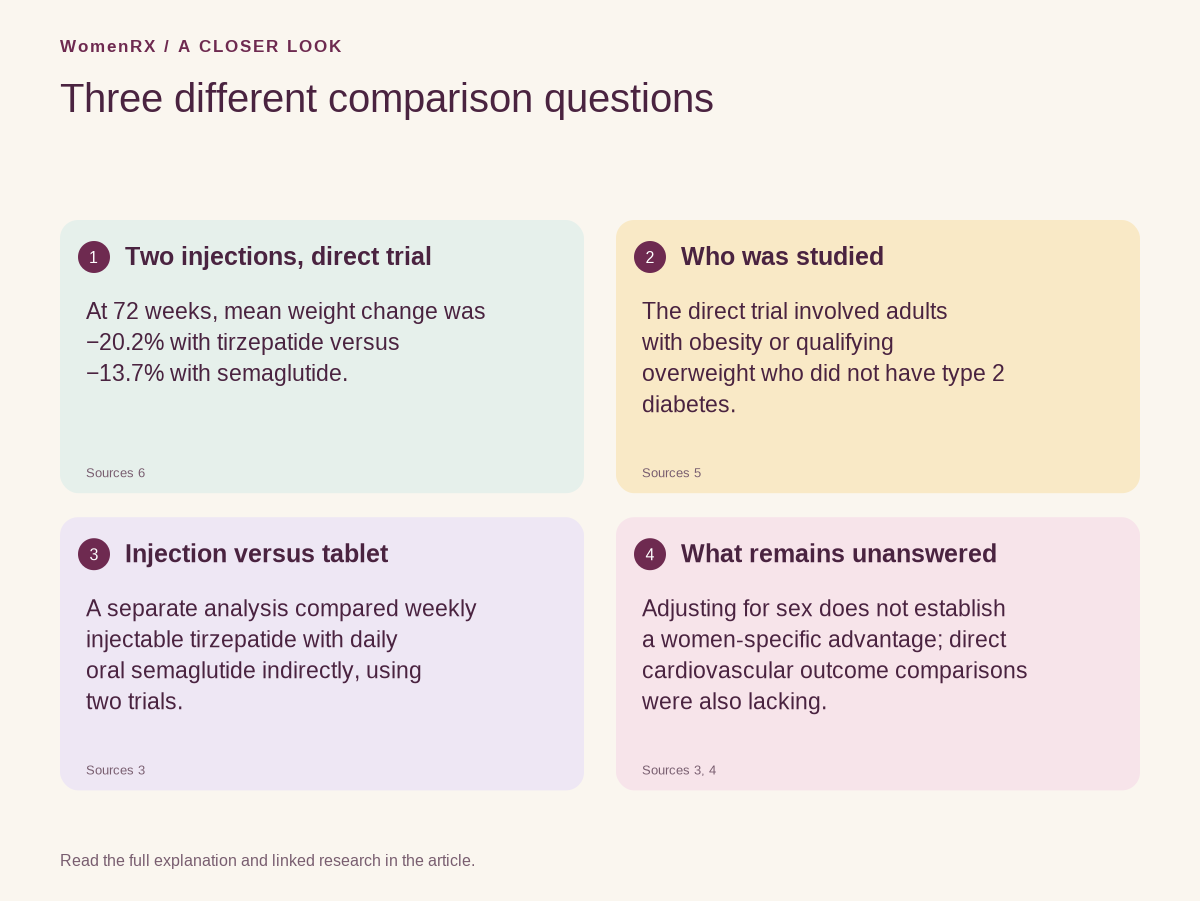
Two injections, direct trial: At 72 weeks, mean weight change was −20.2% with tirzepatide versus −13.7% with semaglutide.6
Who was studied: The direct trial involved adults with obesity or qualifying overweight who did not have type 2 diabetes.5
Injection versus tablet: A separate analysis compared weekly injectable tirzepatide with daily oral semaglutide indirectly, using two trials.3
What remains unanswered: Adjusting for sex does not establish a women-specific advantage; direct cardiovascular outcome comparisons were also lacking.34
Read the figure as text
A result is most useful when you know which treatments were compared and how.- Two injections, direct trial: At 72 weeks, mean weight change was −20.2% with tirzepatide versus −13.7% with semaglutide.6
- Who was studied: The direct trial involved adults with obesity or qualifying overweight who did not have type 2 diabetes.5
- Injection versus tablet: A separate analysis compared weekly injectable tirzepatide with daily oral semaglutide indirectly, using two trials.3
- What remains unanswered: Adjusting for sex does not establish a women-specific advantage; direct cardiovascular outcome comparisons were also lacking.34
Sources you can check
- WEGOVY (SEMAGLUTIDE) INJECTION, SOLUTION WEGOVY (SEMAGLUTIDE) TABLET [NOVO NORDISK PHARMACEUTICAL INDUSTRIES, LP] | US prescribing information and patient instructionsAccessed 2026-09-25Return to first citation
- ZEPBOUND (TIRZEPATIDE) INJECTION, SOLUTION ZEPBOUND (TIRZEPATIDE) INJECTION, SOLUTION ZEPBOUND KWIKPEN (TIRZEPATIDE) INJECTION, SOLUTION [ELI LILLY AND COMPANY] | US prescribing information and patient instructionsAccessed 2026-09-25Return to first citation
- Indirect Comparative Efficacy and Safety of Tirzepatide Versus Oral Semaglutide for the Treatment of Overweight and Obesity.Ciudin A, Johansson E, Zimner-Rapuch S, Dimitriadis GK, Hempfling M, Clark LJ, Fan L, Sapin H. · Diabetes, obesity & metabolism · 2026Return to first citation
- Tirzepatide vs. semaglutide for obesity, glycemic control, and cardiovascular outcomes: a narrative review of clinical trials.Harbi MH, Ashour AM, Alorfi NM, Aldurdunji MM, Wali SM, Alzahrani YA. · Frontiers in medicine · 2026Return to first citation
- Cost-effectiveness of tirzepatide versus semaglutide for patients with obesity or overweight in the US: evidence from the SURMOUNT-5 head-to-head phase-3 trial.Johansson E, Wilding JPH, Upadhyay N, van Hest N, Kirk M, Spaepen E, Zimner-Rapuch S, Annemans L, Bays H. · Journal of medical economics · 2026Return to first citation
- Comparative Efficacy and Safety of Tirzepatide Versus Semaglutide for Obesity: A Systematic Review.Mohamed Abdalla SA, Gharbawi L, Elshaikh N, Elfaki Omer EO, Osman AFM, Hassan Ali AS, Yousif Mohamed TM, Alhajri AHM. · Cureus · 2026Return to first citation