Cash or Insurance for a GLP-1: Compare the Full-Year Cost
The cheaper first fill may not be the cheaper year, especially when a deductible or introductory price changes.
Neither cash nor insurance is automatically cheaper for a GLP-1 prescribed for weight management. Compare quotes for the same medication and form, then add what you’d pay for each expected fill across your plan year. An insured price can change after you meet a deductible; a cash offer can change after its introductory fills. Some self-pay purchases won’t count toward your insurance deductible or out-of-pocket limit.856
Start with the price you’d actually pay
A cash price is a price for a particular product under particular terms. An insured price is your share of a covered claim under your particular plan. They aren’t interchangeable numbers, and neither tells you the full-year cost on its own. High costs and insurance barriers can interrupt obesity treatment, which makes an affordable first fill less useful if later fills are out of reach.4
First, name the exact medication, form and pharmacy you’re comparing. For example, a Wegovy injection offer isn’t a quote for Wegovy tablets, and a Zepbound vial offer isn’t a quote for a pen.57 Ask the pharmacy or plan for your expected cost for that prescription, not just whether “GLP-1s” are covered. Wegovy contains semaglutide; Zepbound contains tirzepatide.12
Why the insured price may move during the year
A deductible is an amount you may pay for covered care or prescriptions before your plan begins paying its share. After that, your cost may be a copay or coinsurance. Your plan’s out-of-pocket maximum limits what you pay for covered services during the coverage year; it isn’t a promise that every purchase at a pharmacy will count toward it. These amounts can make an early fill cost more than a later one, and costs may rise again when a new coverage year begins.8
Before treating a quoted copay as your year-round price, confirm that the plan covers your specific prescription for your reason for taking it. Ask whether approval is required, how long any approval lasts, whether there are refill or pharmacy restrictions, and what you would pay before and after meeting the applicable deductible. Coverage and cost barriers are real for obesity medicines, but a general account of those barriers cannot tell you what your own plan will pay.34
If you’re already comparing health plans, include each plan’s premiums in the broader annual comparison: premiums are what you pay to keep coverage, separate from what you pay when you get care.8 If you’ll keep the same plan whether you pay cash or use insurance, don’t add the same premium to one column but not the other.
Why the cash price may move, too
Manufacturer offers show why one advertised fill price shouldn’t be multiplied across a year. In an offer observed September 25, 2026, eligible new patients could pay $199 per box for their first two qualifying 28-day Wegovy injection fills; the listed standard price for several injection strengths was $349 per box. Eligibility, deadlines and prices can change. Wegovy tablets had separate prices, so those figures aren’t substitutes for an injection quote.56
Zepbound’s observed self-pay terms also varied by strength and refill timing: the listed starting price for four 2.5 mg vials was $299 per 28-day supply, while certain higher-strength savings depended on refilling within 45 days. Supplies such as needles and syringes were an additional consideration for those vials. Those terms illustrate what to check, not what your next fill will cost.7
One particularly consequential difference: Wegovy purchases through the cited self-pay offer operate outside insurance and cannot be submitted for reimbursement or counted toward a deductible or out-of-pocket limit.6 If a cash option costs less today, ask whether giving up that deductible progress changes the comparison later in the year. Check the terms of any other cash program separately rather than assuming they work the same way.
Fill in a comparison for your own plan year
Use the same expected prescription and fill dates in both columns. Enter actual quotes where you have them; leave an uncertain amount blank rather than substituting an advertised starting price.
| Fill in | Paying cash | Using insurance |
|---|---|---|
| Exact product, form and pharmacy | ______ | ______ |
| First fill and later-fill price | __ / ____ | __ / ____ |
| What changes the price? | Offer eligibility, strength, refill timing: ______ | Deductible, copay or coinsurance: ______ |
| Fills you expect before and after a price change | __ / ____ | __ / ____ |
| Other costs tied to this route | Supplies, visits or program fees: ______ | Covered visits or other charges: ______ |
| Total you’d pay through the end of your plan year | ______ | ______ |
| First fill after the plan-year reset | Recheck offer price: ______ | Recheck deductible and coverage: ______ |
For each column, add the prices for the fills you expect at the price that applies to each fill, plus any costs that differ between the two routes. Don’t assume 12 fills if the quoted supply is 28 days, or assume an introductory offer continues. Then look at the first fill after your plan-year reset separately; it can be a different budget problem from the current year’s total.568
Here’s a hypothetical three-fill comparison, not an insured-price quote. Suppose you’re eligible for the observed Wegovy injection self-pay offer, your first two qualifying 28-day fills occur by its stated December 31, 2026, deadline, and the third costs the listed $349 standard price. Cash would be $199 + $199 + $349 = $747. Now suppose your plan covers the same prescription, you’ve already met the applicable deductible, and your copay is an assumed $100 for each of those same three fills. Insurance would be $100 × 3 = $300, or $447 less in this illustration. The $100 copay is made up for the arithmetic; it isn’t a typical price or a quote from an insurer. Neither total includes costs outside those three fills. To compare a full year, replace every assumption with your own quotes, verify current offer terms, and add the remaining fills, including any that follow a deductible reset or offer change.568
Finally, test how sturdy the lower total is. If insurance approval ends, the plan changes, or you have a treatment interruption, ask what must happen before the next covered fill. If a pregnancy-related pause or another interruption is possible, check how restarting would affect approval or offer eligibility and what you would pay for the next fill.
Where each price can change
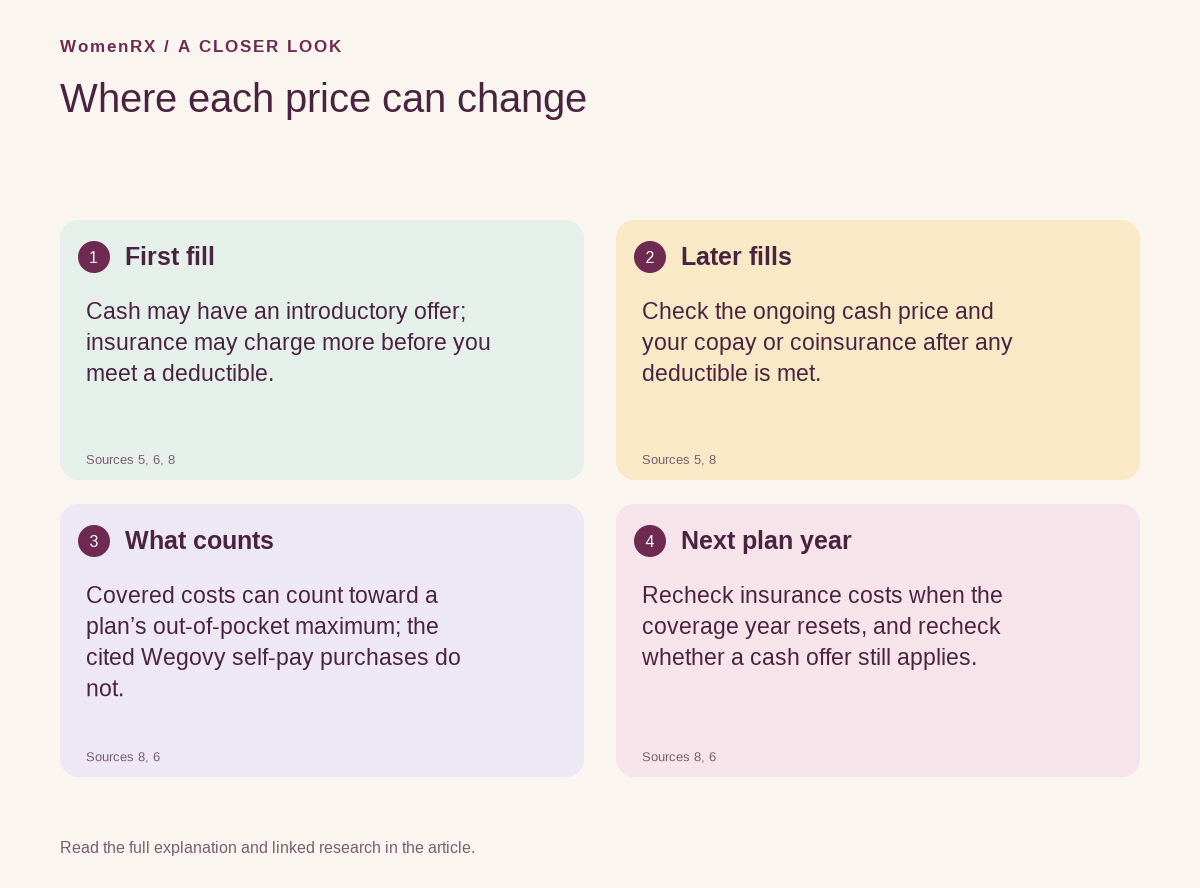
First fill: Cash may have an introductory offer; insurance may charge more before you meet a deductible.568
Later fills: Check the ongoing cash price and your copay or coinsurance after any deductible is met.58
What counts: Covered costs can count toward a plan’s out-of-pocket maximum; the cited Wegovy self-pay purchases do not.86
Next plan year: Recheck insurance costs when the coverage year resets, and recheck whether a cash offer still applies.86
Read the figure as text
Use these differences to check a quote before adding up expected fills.- First fill: Cash may have an introductory offer; insurance may charge more before you meet a deductible.568
- Later fills: Check the ongoing cash price and your copay or coinsurance after any deductible is met.58
- What counts: Covered costs can count toward a plan’s out-of-pocket maximum; the cited Wegovy self-pay purchases do not.86
- Next plan year: Recheck insurance costs when the coverage year resets, and recheck whether a cash offer still applies.86
More questions, answered
Should I compare a cash quote with my insurance copay?
Yes, but ask whether the quoted copay applies before you meet your deductible and whether the prescription is covered for your indication. If the price changes during the year, compare the expected series of fills rather than one cash price against one copay.8
Will a lower cash price help me reach my insurance out-of-pocket maximum?
Not necessarily. The out-of-pocket maximum applies to covered services under your plan. Wegovy purchases through the cited self-pay offer specifically cannot be counted toward a deductible or out-of-pocket limit; check the terms of any other offer rather than assuming the same rule applies.86
Sources you can check
- WEGOVY (SEMAGLUTIDE) INJECTION, SOLUTION WEGOVY (SEMAGLUTIDE) TABLET [NOVO NORDISK PHARMACEUTICAL INDUSTRIES, LP] | US prescribing information and patient instructionsAccessed 2026-09-25Return to first citation
- ZEPBOUND (TIRZEPATIDE) INJECTION, SOLUTION ZEPBOUND (TIRZEPATIDE) INJECTION, SOLUTION ZEPBOUND KWIKPEN (TIRZEPATIDE) INJECTION, SOLUTION [ELI LILLY AND COMPANY] | US prescribing information and patient instructionsAccessed 2026-09-25Return to first citation
- Estimating the lives that could be saved by expanded access to weight-loss drugs.Pandey A, Ye Y, Wells CR, Singer BH, Galvani AP. · Proceedings of the National Academy of Sciences of the United States of America · 2024Return to first citation
- Real-World Evidence for Existing Anti-Obesity Therapies-The Realities of Treatment Adherence, Tolerability, Access and Patient Satisfaction.Kassem S. · Diabetes, obesity & metabolism · 2026Return to first citation
- NovoCare: Wegovy semaglutide self-pay pricesAccessed 2026-09-25Return to first citation
- NovoCare: Wegovy self-pay offer quantities and eligibilityAccessed 2026-09-25Return to first citation
- LillyDirect: Zepbound self-pay product pricesAccessed 2026-09-25Return to first citation
- Your total costs for health care: Premium, deductible, and out-of-pocket costs | HealthCare.govAccessed 2026-09-25Return to first citation