GLP-1 Medicines and Sleep Apnea: What Changes, What Doesn’t
Weight-loss medicines may improve obstructive sleep apnea, but feeling better or losing weight doesn’t show that nighttime breathing pauses have resolved.
If you have obstructive sleep apnea (OSA) and obesity, a weight-loss medicine may be one part of your care. Trials summarized in a 2026 guideline found improvements in sleep-apnea measures with tirzepatide and liraglutide, alongside weight loss. The evidence isn’t the same for every medicine, and improvement isn’t a reason to stop prescribed apnea treatment without reassessing your breathing during sleep. 2
Why weight loss and apnea treatment do different jobs
Obstructive sleep apnea happens when the airway becomes blocked or collapses during sleep, repeatedly interrupting breathing. A breathing device such as CPAP treats those nighttime events while it’s used. Weight management addresses a factor that can make OSA worse, but it doesn’t tell you whether airway obstruction has gone away. Sleep-study results, along with your symptoms and treatment history, are used to assess OSA. 12
That distinction matters if you’re considering a medicine for weight loss. You can pursue weight management alongside treatment for the breathing problem you have now. A 2026 clinical guideline on obesity and OSA recommends continued follow-up even when symptoms improve or the need for positive airway pressure may change. 2
What the medicine studies actually show
For tirzepatide, the guideline describes a randomized trial in adults with obesity and moderate-to-severe OSA found improvements in both body weight and the apnea-hypopnea index, or AHI, a count of breathing events during sleep. The guideline also reports that a trial of liraglutide found improvements in weight and AHI. These are findings in the studied populations, not a promise that either medicine will resolve your OSA. 2
Semaglutide is a different evidence question. The guideline notes that it had not been directly studied for OSA in the research it reviewed. Weight loss with semaglutide may give reason to investigate an OSA benefit, but results from tirzepatide or liraglutide trials shouldn’t simply be assigned to it. 2
There’s another distinction behind all three names: an improvement in AHI during weight loss doesn’t, by itself, establish that a medicine acts directly on the sleeping airway apart from its effects on weight. For your decision, the practical question is whether a medicine fits your weight-management goals and how your existing OSA care will be followed as your weight or symptoms change. 2
If CPAP is hard to use, bring that into the conversation
A medicine isn’t a workaround for nights when apnea treatment isn’t being used. If CPAP has been prescribed but you regularly take it off or skip it, say so when discussing weight-loss treatment. That gives your sleep-care team a clearer picture of what treatment you’re actually receiving now. Other OSA approaches can include mouthpieces, lifestyle changes and surgery, depending on the person; a change in weight doesn’t automatically settle which approach you need. 12
For example, if you’ve lost weight and no longer wake with a headache, that’s welcome news. It still isn’t a measurement of breathing pauses during sleep. Ask whether your change in weight or symptoms calls for reassessment and whether a sleep study would help decide if your current treatment should change. Keep using prescribed treatment unless you and your treating clinician have made a new plan. 12
What women may notice before OSA is recognized
OSA isn’t always experienced as the familiar picture of loud snoring and obvious daytime sleepiness. A review of OSA in women describes presentations that can include fatigue, insomnia symptoms, morning headaches or mood symptoms, which may contribute to missed diagnoses. In a multicenter study of people diagnosed with OSA in Italy, women reported more fatigue and several other symptoms or coexisting conditions than men, despite having milder OSA on average. Those patterns are reasons to take your symptoms seriously, not a symptom checklist that can diagnose apnea or predict your response to a medicine. 34
If you’re seeking help for persistent fatigue or broken sleep, mention any known OSA diagnosis, prior sleep-study results and whether your prescribed treatment is working for you. If you haven’t been evaluated, don’t rule out OSA simply because you don’t fit a stereotypical description. A sleep evaluation, rather than symptoms alone, establishes what’s happening with your breathing at night. 13
Before adding a weight-loss medicine, three questions can connect the two parts of your care: How severe was my OSA on my sleep study? Is my current treatment being used and working as intended? If my weight or symptoms change, what would prompt a repeat assessment? They help distinguish a possible improvement from evidence that it’s time to change apnea treatment. 12
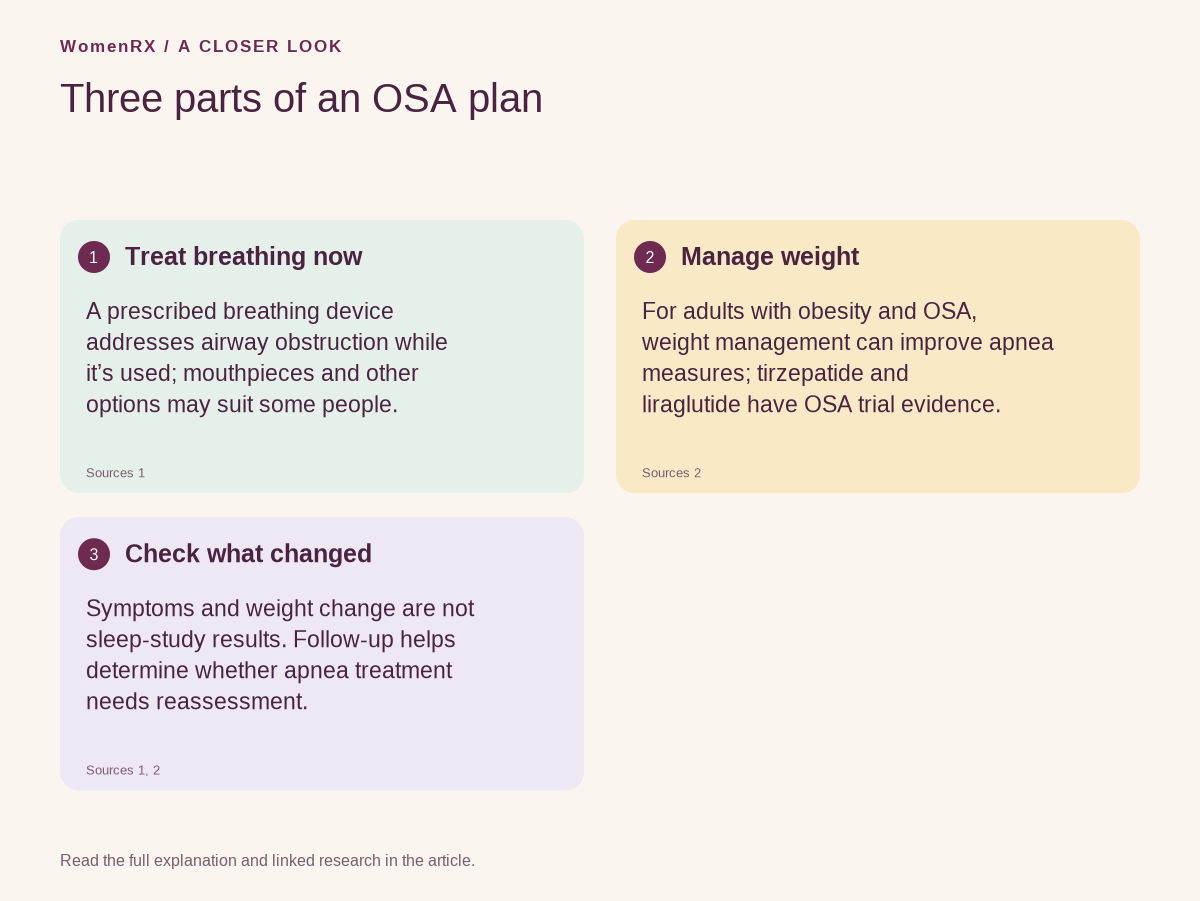
Three parts of an OSA plan
Treat breathing now: A prescribed breathing device addresses airway obstruction while it’s used; mouthpieces and other options may suit some people.1
Manage weight: For adults with obesity and OSA, weight management can improve apnea measures; tirzepatide and liraglutide have OSA trial evidence.2
Check what changed: Symptoms and weight change are not sleep-study results. Follow-up helps determine whether apnea treatment needs reassessment.12
Read the figure as text
Each part answers a different question, so improvement in one doesn’t automatically replace the others.- Treat breathing now: A prescribed breathing device addresses airway obstruction while it’s used; mouthpieces and other options may suit some people.1
- Manage weight: For adults with obesity and OSA, weight management can improve apnea measures; tirzepatide and liraglutide have OSA trial evidence.2
- Check what changed: Symptoms and weight change are not sleep-study results. Follow-up helps determine whether apnea treatment needs reassessment.12
Sources you can check
- Sleep Apnea | MedlinePlusAccessed 2026-09-25Return to first citation
- Guideline for the Management of Obesity in Adult Patients With Obstructive Sleep Apnea.Park SK, Kang YJ, Lee SH, Park CS, Hong SJ, Choi JH, Cho JH. · Clinical and experimental otorhinolaryngology · 2026Return to first citation
- Evaluation of Obstructive Sleep Apnea in Female Patients in Primary Care: Time for Improvement?Bouloukaki I, Tsiligianni I, Schiza S. · Medical principles and practice : international journal of the Kuwait University, Health Science Centre · 2021Return to first citation
- Excessive daytime sleepiness and sex-related differences in the clinical presentation of obstructive sleep apnea in Italian patients.Insalaco G, Braghiroli A, Buzzi F, Cappellano S, Castelli A, Castelnuovo A, Fanfulla F, Ferini Strambi L, Lo Bue A, Marelli S, Pizza F, Placidi F, Plazzi G, Pronzato C, Romigi A, S... · Sleep medicine · 2025Return to first citation