PCOS and Sleep Apnea: When to Get Checked
Snoring alone doesn’t diagnose sleep apnea, but gasping, witnessed breathing pauses, or ongoing daytime sleepiness are good reasons to ask about an assessment.
If you have PCOS and often feel sleepy during the day, wake unrefreshed, or someone notices pauses in your breathing followed by snorting or gasping, ask a healthcare provider whether sleep apnea should be assessed. Snoring can be a clue, but it isn’t a diagnosis. Assessment typically starts with your symptoms and an exam; a sleep study is used to diagnose sleep apnea. 1 2
Which sleep signs deserve attention?
Snoring is common, and many people who snore don’t have obstructive sleep apnea (OSA). The concern rises when snoring comes with other signs: someone sees your breathing stop and start, you wake up gasping or choking, you often feel unrefreshed, or you’re unusually sleepy during the day. Those symptoms are reasons to discuss an assessment, not proof that you have OSA. 1 2 3
OSA happens when the airway becomes blocked or collapses during sleep, interrupting breathing. Those interruptions can disturb sleep and leave you drowsy the next day. Snoring happens when tissues in the upper airway vibrate as air moves through; it can occur without apnea. 1 2
Daytime sleepiness is worth mentioning even if nobody has heard you snore. If you’re struggling to stay alert while driving, take that seriously: sleep apnea can increase the risk of car crashes and other accidents. 1
What PCOS changes, and what it doesn’t
Research finds OSA more often in groups of people with PCOS than in groups without PCOS. A 2025 meta-analysis combined eight cross-sectional studies and found higher OSA prevalence in the PCOS groups. Its results also suggested higher risk among adults and people with overweight or obesity than among adolescent and normal-weight subgroups. These group findings can’t tell you whether you personally have OSA, and the studies varied. They don’t mean PCOS itself proves the cause of your symptoms. 4
Body size can be one risk factor, but it isn’t a yes-or-no test: people of different body sizes can snore, and a person’s symptoms still matter. Don’t dismiss repeated gasping, observed breathing pauses, or persistent sleepiness because your weight seems “normal.” 2 3 4
The available PCOS findings compare adolescents with adults, but don’t establish how OSA assessment should differ across menstrual, perimenopausal, or postmenopausal stages. Menopause-specific conclusions can’t be drawn from those comparisons. 4
What an assessment may involve
Expect the conversation to start with what happens during the night and how you feel during the day. A clinician may ask about snoring, gasping, whether anyone has observed breathing pauses, and whether you feel tired despite spending time asleep. A partner or other person who has heard your breathing can offer useful observations. 2 3
An exam may include looking inside your mouth and nose for features that could contribute to snoring. A sleep study is used along with your medical and family history and physical exam to diagnose sleep apnea. Snoring or a symptom checklist alone isn’t the diagnosis. 1 3
If you’re unsure what to bring, jot down a few real examples: how often you wake gasping, what someone else has noticed, whether you feel sleepy during the day, and whether you feel rested on waking. If someone shares your bedroom, ask what they’ve observed, if you’re comfortable doing so. These details help make the appointment conversation concrete. 2 3
You can ask: “Do these symptoms warrant a sleep study?” and “What would the next step be if the assessment suggests sleep apnea?” The aim is to distinguish ordinary snoring from disrupted breathing that needs further evaluation, rather than trying to diagnose yourself from PCOS or one symptom.
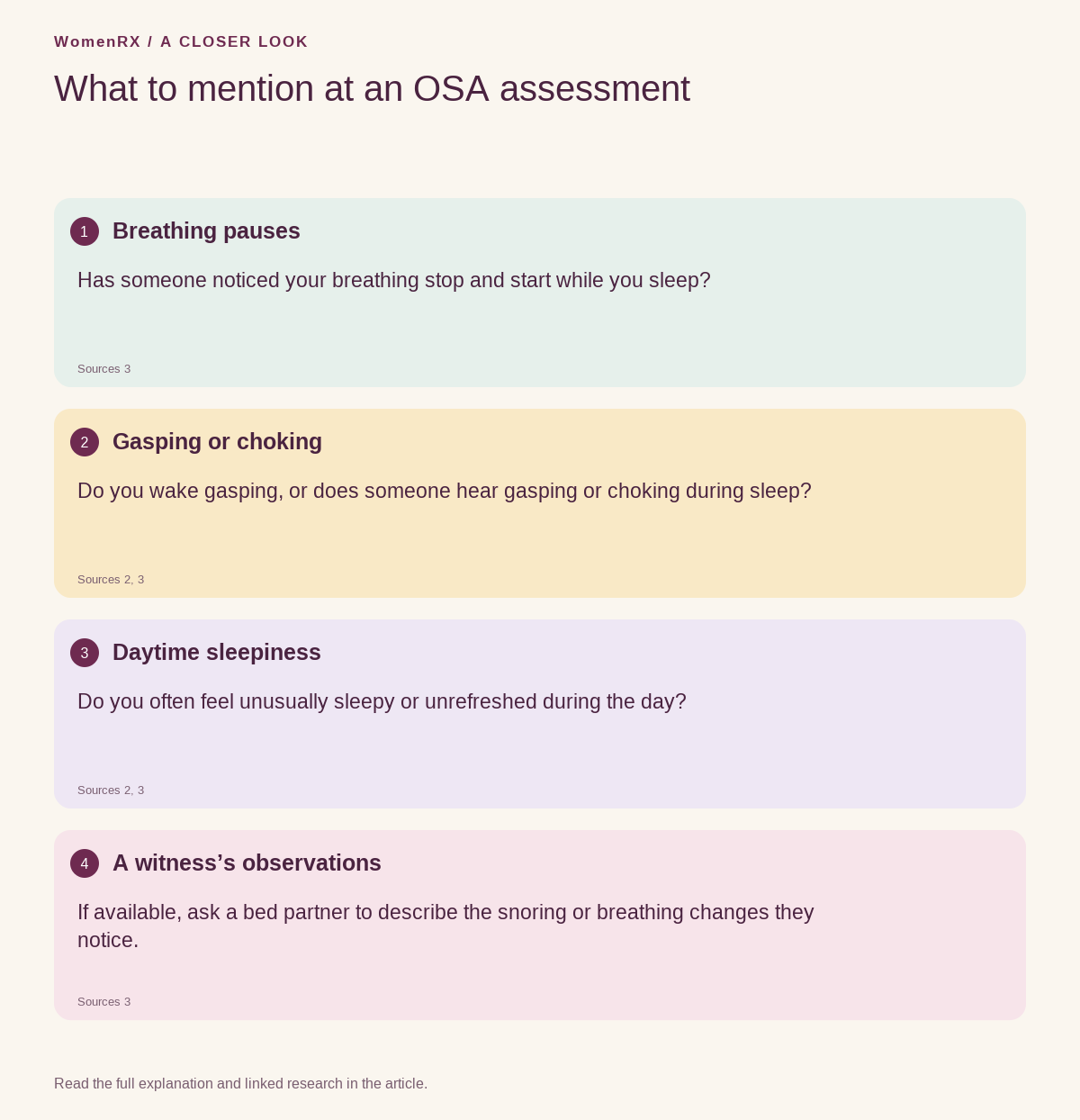
What to mention at an OSA assessment
Breathing pauses: Has someone noticed your breathing stop and start while you sleep?3
Gasping or choking: Do you wake gasping, or does someone hear gasping or choking during sleep?23
Daytime sleepiness: Do you often feel unusually sleepy or unrefreshed during the day?23
A witness’s observations: If available, ask a bed partner to describe the snoring or breathing changes they notice.3
Read the figure as text
Use these prompts to describe what you or someone else has noticed. They organize symptoms; they do not diagnose sleep apnea.- Breathing pauses: Has someone noticed your breathing stop and start while you sleep?3
- Gasping or choking: Do you wake gasping, or does someone hear gasping or choking during sleep?23
- Daytime sleepiness: Do you often feel unusually sleepy or unrefreshed during the day?23
- A witness’s observations: If available, ask a bed partner to describe the snoring or breathing changes they notice.3
More questions, answered
Does snoring mean I have sleep apnea?
No. Snoring can happen without sleep apnea. Repeated gasping, observed breathing pauses, waking unrefreshed, or frequent daytime sleepiness make it more useful to ask about an assessment. 1 2
Can I rule out sleep apnea if I’m not overweight?
No. Overweight is one risk factor for sleep apnea, but it doesn’t determine who has it. 1 Symptoms such as witnessed breathing pauses, gasping, or ongoing daytime sleepiness still deserve attention. 1 2
Sources you can check
- Sleep Apnea | MedlinePlusAccessed 2026-09-25Return to first citation
- Snoring | MedlinePlusAccessed 2026-09-25Return to first citation
- Snoring - NHSAccessed 2026-09-25Return to first citation
- Obstructive sleep apnea syndrome in polycystic ovary syndrome: a systematic review and meta-analysis.Abdul Jafar NK, Al Balushi A, Subramanian A, Lee SI, Bennett CJ, Moran LJ, Mousa A, Tay CT, Teede HJ, Mansfield DR. · Frontiers in endocrinology · 2025Return to first citation