Do You Need a Calcium Supplement, or Can Food Cover Your Needs?
Add up your usual food sources first; a supplement is a way to fill a gap, not something every woman automatically needs.
Start by comparing your usual food-and-drink intake with the calcium amount recommended for your age, then count calcium from supplements and calcium-containing antacids too. Dairy, fortified drinks, some tofu, fish with edible bones, and certain greens can all contribute. If your intake seems low or a health condition could affect absorption or calcium needs, get individualized advice before choosing a pill. 12
Start with your usual intake, not the supplement aisle
Calcium needs vary by age, and being a woman does not automatically mean you need a calcium pill. For most adults through age 50, including pregnant and breastfeeding adults, the recommended intake is 1,000 mg a day. For women ages 51 to 70 and older than 70, it is 1,200 mg a day. For pregnant or breastfeeding teens ages 14 to 18, it is 1,300 mg. These targets are for total daily calcium from food and supplements combined. 1
The recommended dietary allowance (RDA) is a planning target for healthy people, not a test of whether you have a deficiency. Check what you typically eat over several days rather than judging your intake from one unusually high- or low-calcium day.
A quick food tally
Check serving sizes and calcium amounts on the foods you actually eat. As examples, one cup of milk has about 299 mg, an 8-ounce serving of plain low-fat yogurt about 415 mg, and one cup of fortified soy milk about 299 mg. Together, those example servings add up to about 1,013 mg. Your products may differ, so use their labels when available. 1
Other options include calcium-fortified juice, tofu made with calcium sulfate, canned sardines or salmon with bones, and greens such as kale or bok choy. Fortified products vary, and not every tofu or plant drink contains much calcium, so check the label. Spinach contains calcium, but the body absorbs less of it than calcium from milk; a varied diet can include different sources without requiring you to calculate absorption from every meal. 12
Count calcium in a multivitamin, a calcium supplement, and calcium-containing antacids as well as food. That gives you a more useful picture than looking at the calcium pill alone. 1
Read the calcium line on the label
On a supplement, look for the amount of calcium in the Supplement Facts panel. That figure is the elemental calcium your body can use; you do not need to calculate it from the weight of calcium carbonate or calcium citrate. The percent Daily Value (%DV) uses 1,300 mg as its reference, which is not the same as every adult woman’s age-specific RDA. 1
Calcium carbonate and calcium citrate are common forms. Carbonate is absorbed best with food and may be less well absorbed when stomach acid is low. Citrate is less dependent on stomach acid and can be taken with or without food. Calcium absorption from supplements is highest when a dose is 500 mg or less at one time. If the amount you are considering is larger, ask a pharmacist or clinician how to handle it rather than assuming one large dose is equivalent. 12
Some people get gas, bloating, or constipation from calcium supplements; carbonate may cause more of these effects than citrate, particularly in older adults. If you notice symptoms, discuss the product and amount with a pharmacist or clinician. 12
When a pill may deserve a closer look
If your usual diet falls short of your age-based target, a supplement may be one way to make up the difference. First check whether a realistic food change, such as choosing a fortified drink or including another calcium-rich food, could help. People who avoid dairy can still use fortified foods, calcium-set tofu, fish with bones, and certain vegetables, though a supplement may be needed if those options do not cover their intake. 12
Life stage provides context, not an automatic prescription. Pregnancy does not raise the RDA above the age-based target for adults 19 to 50, and the target is also 1,000 mg for adults who are breastfeeding. After menopause, the RDA for women over 50 is higher, at 1,200 mg, and menopause is associated with changes in calcium absorption and bone loss. Those facts can make an intake check especially useful, but they do not show that every pregnant or postmenopausal woman needs a pill. 1
Ask for individualized guidance if you have been told you have a problem affecting calcium absorption or calcium levels, have low stomach acid, or are managing a condition or treatment that may change your needs. Vitamin D status also matters: low vitamin D can reduce calcium absorption. A pill choice should take those circumstances and your total intake into account. 1
A four-step decision check
- Estimate your usual food intake. Use serving sizes and product labels, and include fortified foods.
- Add other sources. Count calcium in supplements, multivitamins, and calcium antacids.
- Compare with your age-based target. Use the RDA as a daily planning guide, not as a diagnosis.
- Get specific advice when the situation is more complex. Mention your estimated intake, supplement label, and any absorption, calcium-level, or bone-health concern.
That small check can prevent both guesswork and taking more calcium than your food pattern calls for.
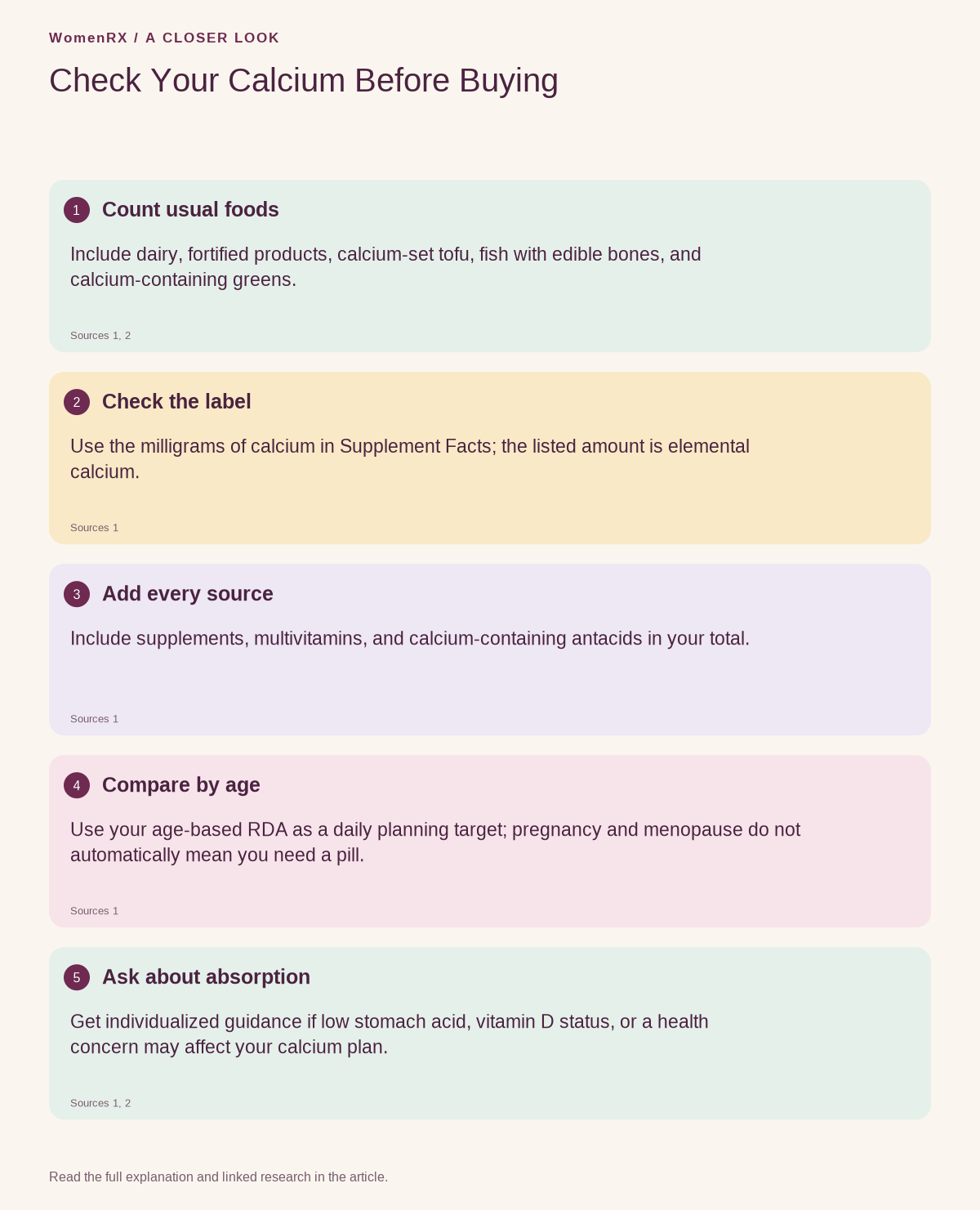
Check Your Calcium Before Buying
Count usual foods: Include dairy, fortified products, calcium-set tofu, fish with edible bones, and calcium-containing greens.12
Check the label: Use the milligrams of calcium in Supplement Facts; the listed amount is elemental calcium.1
Add every source: Include supplements, multivitamins, and calcium-containing antacids in your total.1
Compare by age: Use your age-based RDA as a daily planning target; pregnancy and menopause do not automatically mean you need a pill.1
Ask about absorption: Get individualized guidance if low stomach acid, vitamin D status, or a health concern may affect your calcium plan.12
Read the figure as text
A practical sequence for estimating total intake and deciding whether a supplement question needs individualized advice.- Count usual foods: Include dairy, fortified products, calcium-set tofu, fish with edible bones, and calcium-containing greens.12
- Check the label: Use the milligrams of calcium in Supplement Facts; the listed amount is elemental calcium.1
- Add every source: Include supplements, multivitamins, and calcium-containing antacids in your total.1
- Compare by age: Use your age-based RDA as a daily planning target; pregnancy and menopause do not automatically mean you need a pill.1
- Ask about absorption: Get individualized guidance if low stomach acid, vitamin D status, or a health concern may affect your calcium plan.12
More questions, answered
Is the % Daily Value on a calcium label my personal target?
Not exactly. Calcium’s label Daily Value is 1,300 mg, while the RDA for adult women varies by age. Use the amount of calcium listed in milligrams and compare it with your age-based target. 1
Do fortified plant drinks and tofu always provide calcium?
No. Some plant drinks and tofu are fortified or made with calcium salts, but products differ. Check the nutrition label and, for tofu, the product details. 12
Sources you can check
- Calcium - Health Professional Fact SheetAccessed 2026-09-25Return to first citation
- Calcium | MedlinePlusAccessed 2026-09-25Return to first citation