What We Know About Staying on Zepbound
Weight-management studies support continuing tirzepatide for some adults, but several years of trial data can’t establish lifetime safety.
Zepbound can be used for long-term weight management, and trials have followed some people taking tirzepatide for nearly three and a half years. In a study of adults with obesity and prediabetes, weight loss persisted during 176 weeks of treatment and no new safety signals were identified. That’s reassuring, not a guarantee of lifetime safety. Whether to continue depends on the benefit you’re getting, side effects, other health conditions, and pregnancy plans. 13
What “long term” means in the studies
Zepbound is tirzepatide prescribed for weight reduction and long-term maintenance. Continuing treatment isn’t automatically the right choice for everyone, but neither is there a trial-based rule that everyone should stop after reaching a particular weight. The useful question is whether its ongoing benefits outweigh its burdens and risks for you. The prescribing information says treatment response and tolerability should guide maintenance treatment. 1
The length of follow-up matters. In two placebo-controlled Zepbound weight-reduction trials, 2,519 adults with obesity or overweight received the medicine for up to 72 weeks, followed by four weeks off treatment. Another weight-management trial included 335 people treated for up to 88 weeks. Those figures describe how long participants could be treated, not a promise that every participant took it for the full period. 1
A longer report from the SURMOUNT-1 randomized trial followed a more specific group: participants who had both obesity and prediabetes. They received tirzepatide or placebo for 176 weeks, then had a 17-week period off treatment. At week 176, average weight change was −12.3%, −18.7%, and −19.7% across the three tirzepatide groups, compared with −1.3% with placebo. The researchers reported no new safety signals over the three years of treatment. That finding applies to this trial population; it doesn’t establish safety for every person or for lifelong use. 3
What might make continuing worthwhile?
If tirzepatide is helping you maintain a meaningful change in weight and you’re tolerating it, continuing may preserve a benefit that matters to you. In a review of randomized weight-management trials in adults without diabetes, continued tirzepatide treatment was associated with weight-loss maintenance, while stopping treatment in a randomized-withdrawal study was followed by weight gain. That doesn’t predict exactly what will happen to your weight if you stop. It does mean that stopping is a change in the treatment plan, not simply the end of an initial course. 2
Consider the whole picture rather than a target number alone. For example, a woman who is maintaining weight loss but struggling with frequent vomiting faces a different tradeoff from someone who feels well on treatment. If Zepbound hasn’t provided enough benefit, or side effects are making everyday life harder, those are reasons to reassess rather than assume continuation is required. 1
Side effects still matter after the first months
Digestive symptoms are the most common difficulty. Across the two pooled placebo-controlled Zepbound weight-reduction trials, gastrointestinal adverse reactions occurred in 56% of participants in each Zepbound dose group, versus 30% of those receiving placebo. Most nausea, vomiting, and diarrhea occurred while doses were being increased and decreased over time. Some people stopped treatment because of gastrointestinal effects. In the three dose groups, 1.9% to 4.3% stopped for that reason, compared with 0.5% on placebo. 1
A symptom becoming less common over time doesn’t mean it should be ignored if it’s happening to you. Repeated vomiting or diarrhea can lead to dehydration; Zepbound’s prescribing information calls for kidney-function monitoring when adverse effects could cause substantial fluid loss. Gallbladder disease has also been reported in weight-reduction trials. Persistent or severe abdominal pain, sometimes reaching the back and with or without vomiting, needs prompt medical assessment because it can be a sign of pancreatitis. 1
There are other reasons to review your own health history before deciding to stay on treatment. Zepbound shouldn’t be used by someone with a personal or family history of medullary thyroid cancer or with multiple endocrine neoplasia syndrome type 2. The thyroid-tumor warning comes from rat studies; whether tirzepatide causes these tumors in humans is unknown. If you also take insulin or an insulin-releasing diabetes medicine, your risk of low blood sugar needs particular attention. 1
Pregnancy plans can change the decision
If pregnancy is possible, contraception is part of the long-term conversation. Zepbound slows stomach emptying and may make oral hormonal contraceptives less effective, particularly when treatment starts or a dose increases. The US prescribing information advises using a non-oral contraceptive method or adding a barrier method for four weeks after starting and four weeks after each dose increase. Non-oral hormonal contraceptives are not expected to be affected in the same way. 1
Weight loss isn’t recommended during pregnancy, and the prescribing information says to discontinue Zepbound when a pregnancy is recognized. Human pregnancy data are insufficient to assess drug-related risks, so if you’re planning a pregnancy, raise that before deciding on a long-term treatment plan rather than waiting until you’re pregnant. 1
Breastfeeding is a separate decision. In a small, single-dose study, tirzepatide was undetectable or present at low levels in breast milk. That study doesn’t tell us its effects on a breastfed baby, milk production, or continued use while nursing. Your need for treatment and the benefits of breastfeeding both belong in that discussion. 1
A practical way to reassess
Ask what continuing is doing for you now: Is the weight change holding? Are side effects manageable? Has anything changed, such as pregnancy plans, a new diabetes medicine, or persistent digestive symptoms? These questions connect the evidence to your circumstances. The trials offer meaningful reassurance over their observed periods, especially for people with obesity and prediabetes followed for 176 weeks. They can’t settle the decision once and for all, so it makes sense to revisit the balance as your health and priorities change. 13
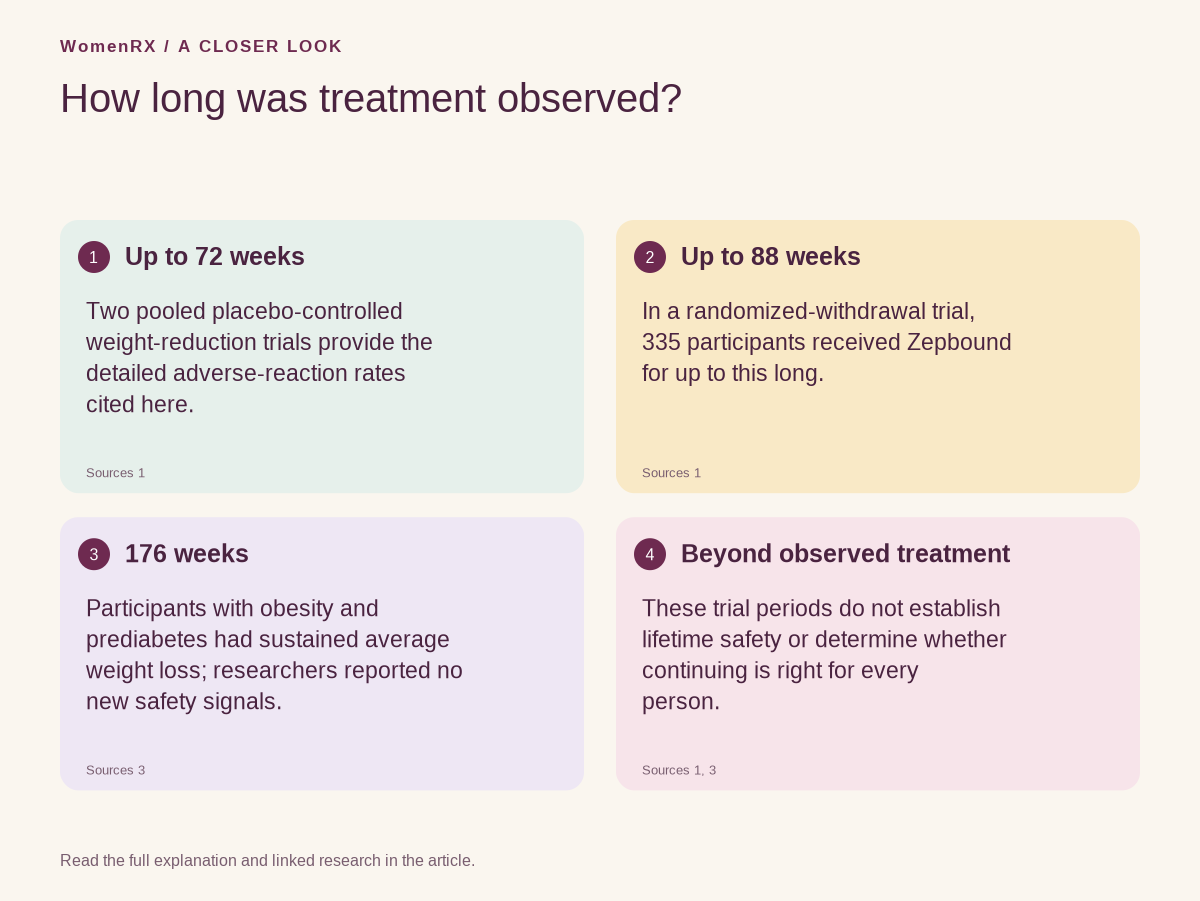
How long was treatment observed?
Up to 72 weeks: Two pooled placebo-controlled weight-reduction trials provide the detailed adverse-reaction rates cited here.1
Up to 88 weeks: In a randomized-withdrawal trial, 335 participants received Zepbound for up to this long.1
176 weeks: Participants with obesity and prediabetes had sustained average weight loss; researchers reported no new safety signals.3
Beyond observed treatment: These trial periods do not establish lifetime safety or determine whether continuing is right for every person.13
Read the figure as text
Different Zepbound weight-management findings answer different parts of the long-term question.- Up to 72 weeks: Two pooled placebo-controlled weight-reduction trials provide the detailed adverse-reaction rates cited here.1
- Up to 88 weeks: In a randomized-withdrawal trial, 335 participants received Zepbound for up to this long.1
- 176 weeks: Participants with obesity and prediabetes had sustained average weight loss; researchers reported no new safety signals.3
- Beyond observed treatment: These trial periods do not establish lifetime safety or determine whether continuing is right for every person.13
More questions, answered
Does the three-year trial prove Zepbound is safe indefinitely?
No. The 176-week treatment results came from participants with both obesity and prediabetes. Researchers reported no new safety signals during that period, but the trial cannot establish lifetime safety or predict every uncommon problem that might emerge with wider, longer use. 3
Are hair changes reported more often in women?
Yes. In two pooled Zepbound weight-reduction trials, hair loss was reported by 7.1% of female participants taking Zepbound and 1.3% taking placebo; the corresponding figures for male participants were 0.5% and 0%. The prescribing information says hair-loss reports among Zepbound users were associated with weight reduction. 1
Sources you can check
- ZEPBOUND (TIRZEPATIDE) INJECTION, SOLUTION ZEPBOUND (TIRZEPATIDE) INJECTION, SOLUTION ZEPBOUND KWIKPEN (TIRZEPATIDE) INJECTION, SOLUTION [ELI LILLY AND COMPANY] | US prescribing information and patient instructionsAccessed 2026-09-25Return to first citation
- Tirzepatide and Cardiometabolic Effects in Obese Non-diabetic Adults: A Systematic Review, Meta-Analysis, and Narrative Synthesis of Cardiovascular Outcomes.Chaparala P, Aravind Rongali D, Khot M, Rangachari B, Ahmed KU, Suri S, Greeshma M, Shafiq MM. · Cureus · 2026Return to first citation
- Tirzepatide for Obesity Treatment and Diabetes Prevention.Jastreboff AM, le Roux CW, Stefanski A, Aronne LJ, Halpern B, Wharton S, Wilding JPH, Perreault L, Zhang S, Battula R, Bunck MC, Ahmad NN, Jouravskaya I, SURMOUNT-1 Investigators. · The New England journal of medicine · 2025Return to first citation