Choosing Cardio After 50: Find Your Best Fit
The best cardio is one that fits your body, routine, and starting point, not a single activity that works for every woman.
Walking, indoor cycling, swimming, and dance can all be cardio options, but the available findings don’t establish one as best for women over 50. Choose by what you can access and enjoy, and by what feels workable for your body. Build activity gradually; research in older adults and older women shows that aerobic fitness can improve, though results vary by program and participant. 1 2 3
Start with the kind of fit you need
Cardio is activity that raises your breathing and heart rate. Walking, running, and swimming are examples; an indoor stationary bike and workout videos can make it easier to exercise at home. Regular practice helps your body adapt, and MedlinePlus recommends building activity gradually rather than pushing too hard all at once. 1
That gives you a practical starting point: pick an activity you can realistically repeat, then adjust it to your comfort, access, and current ability. “Over 50” covers a wide range of fitness levels and health circumstances, so age alone can’t tell you which activity will suit you.
Compare options by practical fit
This comparison is about what each activity asks of you, not a research-based ranking of joint impact or fitness gains. The progression ideas are examples of how to build gradually, not targets you have to meet. 1
| Activity | Movement and physical fit | Access and skill | A way to build gradually |
|---|---|---|---|
| Walking | You’re on your feet and can choose a route that feels manageable. If walking itself is uncomfortable, a different movement may be easier to repeat. | It can work outdoors or in an indoor public space, but weather and a comfortable place to walk matter. 1 | For example, begin with a walk that feels manageable and add time gradually. 1 |
| Stationary cycling | You pedal while seated rather than taking steps. That may make it worth trying if time on your feet is the obstacle; check whether the seat and pedaling motion feel comfortable for you. | You need access to a bike at home or a fitness center and enough familiarity to use it comfortably. 1 | For example, build up the time you spend pedaling before changing how hard it feels. 1 |
| Swimming | You move through water rather than along a walking route. Whether that feels better for your body is personal, not something these studies compare. | You need a pool you can get to and the ability to swim comfortably. Swimming is an aerobic activity. 1 | For example, start with an amount of swimming you can manage and increase it gradually. 1 |
| Simplified dance | The routine tested in one small study used pelvic tilts, rotations, and breathing. That describes this particular routine, not every dance class or its joint demands. 3 | Following a few basic movements may appeal more than learning complex choreography; a class or workout video needs to fit your access and preferences. 1 3 | For example, get comfortable with the basic movements before extending the time you dance. 1 3 |
Use the movement column to narrow your choices, then check the practical barrier. A pool may sound appealing but be too far away; a stationary bike may be convenient but uncomfortable to sit on. Neither observation means you’ve chosen cardio “wrong.” The findings don’t establish which of these activities places the least load on a particular joint or produces the largest fitness gain for women over 50.
What research in older women can tell you
A small dance pilot provides one direct example: among 26 obese older women, the dance group improved its measured aerobic fitness over 12 weeks compared with its own baseline; the control group had no significant change. Because the sample was small and limited to obese older women, the finding shouldn’t be treated as proof that dance is best for all women over 50. 3
Other research tested a combination of activities rather than comparing cardio options. In a study of non-physically active older women with metabolic syndrome, a 16-week program combined walking or running with resistance training. Cardiorespiratory fitness increased, while several metabolic syndrome measures, including body composition, did not change. That distinction matters: an improvement in fitness doesn’t guarantee weight loss or changes in every health measure. 4
A separate one-year trial in older adults, with a mean age of 69 and 77% women, found that the aerobic-training group increased cardiorespiratory fitness compared with a stretching group. It supports the possibility of improving fitness in an older, mostly female group, but it doesn’t identify which activity is best or report a menopause-specific effect. 2
Make the choice adjustable
If one option isn’t accessible or doesn’t feel workable, try another rather than treating that as a failure. For example, if weather keeps interrupting walks, an indoor option removes that particular barrier. If staying on your feet is the problem, you could see whether seated cycling feels more workable. Those are ways to test practical fit, not evidence that one activity works better for everyone. 1
Start at a level that fits your current capacity and build gradually. If a health condition or physical limitation affects what feels suitable, MedlinePlus notes that a health provider can help match the type or amount of activity to your fitness and health. 1 A routine can also include strength, balance, or flexibility work; cardio trains a different part of fitness, and many people benefit from combining activity types. 1
What “after 50” does and doesn’t mean
Some studies include older women, but that isn’t the same as showing an effect specific to menopause. The available findings don’t report whether participants were perimenopausal or postmenopausal, or compare results by menopausal status. So use these findings as evidence that some older women can improve aerobic fitness, not as proof that menopause determines which cardio activity you should choose.
The useful decision is personal and practical: select an activity you can access, tolerate, and return to, then progress gradually. You don’t need to find a perfect activity before you begin.
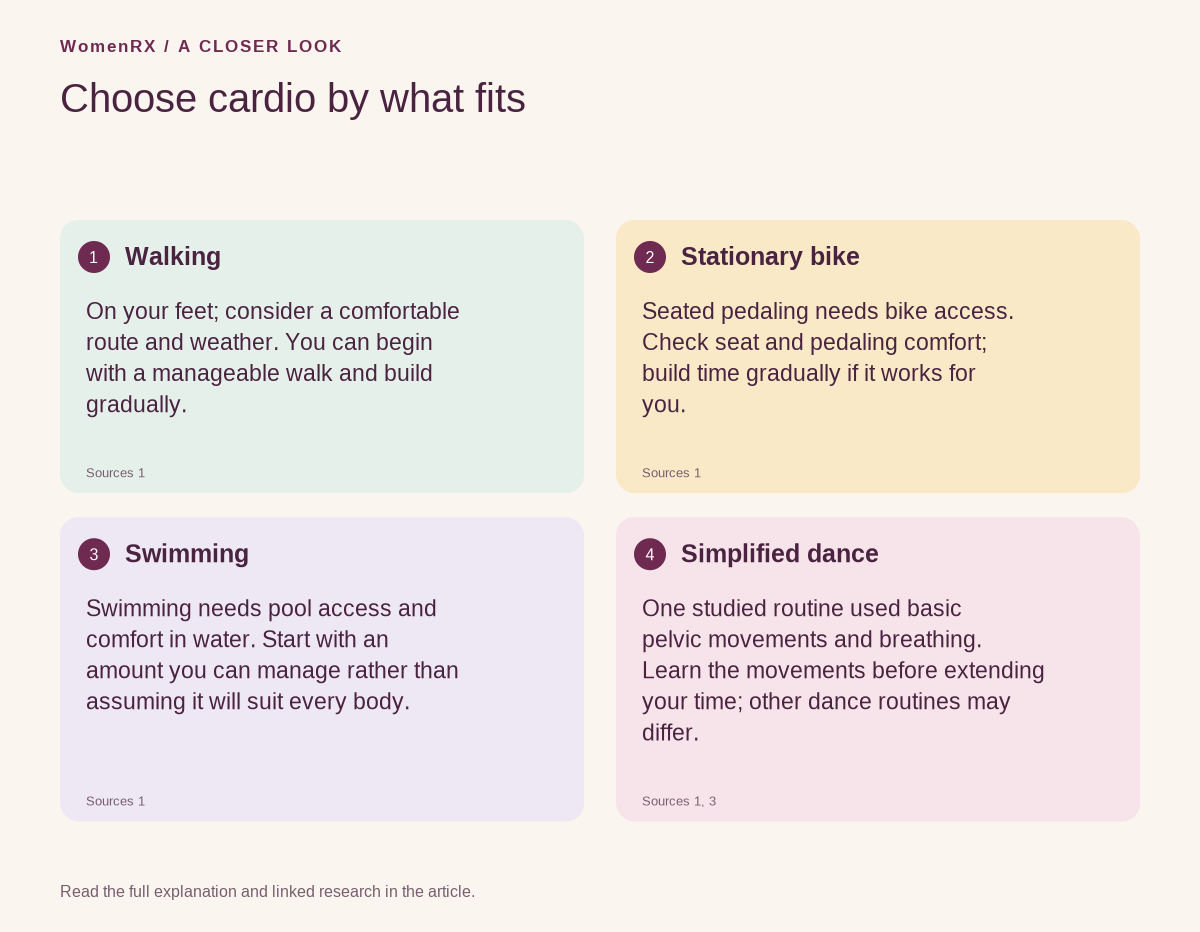
Choose cardio by what fits
Walking: On your feet; consider a comfortable route and weather. You can begin with a manageable walk and build gradually.1
Stationary bike: Seated pedaling needs bike access. Check seat and pedaling comfort; build time gradually if it works for you.1
Swimming: Swimming needs pool access and comfort in water. Start with an amount you can manage rather than assuming it will suit every body.1
Simplified dance: One studied routine used basic pelvic movements and breathing. Learn the movements before extending your time; other dance routines may differ.13
Read the figure as text
Compare the movement, access, and first adjustment each option asks of you. These are practical distinctions, not scores for joint impact or fitness gains.- Walking: On your feet; consider a comfortable route and weather. You can begin with a manageable walk and build gradually.1
- Stationary bike: Seated pedaling needs bike access. Check seat and pedaling comfort; build time gradually if it works for you.1
- Swimming: Swimming needs pool access and comfort in water. Start with an amount you can manage rather than assuming it will suit every body.1
- Simplified dance: One studied routine used basic pelvic movements and breathing. Learn the movements before extending your time; other dance routines may differ.13
More questions, answered
Does menopause change which cardio activity is best?
These studies don’t compare cardio choices by menopausal status. They support possible fitness improvement in older women and older adults, but they don’t show that menopause makes one activity best. 2 3 4
Does improving cardio fitness mean I’ll lose weight?
Not necessarily. In a 16-week combined exercise study of older women with metabolic syndrome, cardiorespiratory fitness improved, but body mass, BMI, body fat, and waist circumference did not change. 4
Sources you can check
- Exercise and Physical Fitness: MedlinePlusAccessed 2026-09-25Return to first citation
- Effects of aerobic exercise and cardiorespiratory fitness on white matter free water fraction in older adults: a 1-year randomized controlled trial.Tarumi T, Won J, Tomoto T, Scheel N, Zhu DC, Ashley J, Rodrigue KM, Kennedy KM, Park DC, Zhang R. · GeroScience · 2026Return to first citation
- Pilot testing of a simplified dance intervention for cardiorespiratory fitness and blood lipids in obese older women.Wang Y, Liu L, Chen Q, Chen Y, Lam WK. · Geriatric nursing (New York, N.Y.) · 2023Return to first citation
- Metabolomic Response throughout 16 Weeks of Combined Aerobic and Resistance Exercise Training in Older Women with Metabolic Syndrome.Sardeli AV, Castro A, Gadelha VB, Santos WMD, Lord JM, Cavaglieri CR, Chacon-Mikahil MPT. · Metabolites · 2022Return to first citation