Why UTIs Keep Coming Back, and What May Help
Repeated urinary symptoms deserve a closer look: confirming bacterial infections can point you toward prevention that fits your pattern and health.
A commonly used definition of recurrent UTI is two infections in six months or three in a year, but the count alone doesn’t explain why they’re happening. Reviewing urine results and the timing of episodes can help distinguish repeated bacterial infections from other causes of urinary symptoms. Prevention may include options such as vaginal estrogen after menopause, methenamine, or selected antibiotic prevention, depending on your situation. 1 3
Start by checking what is recurring
A commonly used threshold for recurrent UTI is two infections within six months or three within 12 months. That’s a useful signal to review the pattern, not an explanation of its cause. 1 3
Burning, urgency, or discomfort that returns doesn’t always mean another bacterial infection. Recurrent symptoms with repeatedly negative cultures can have a different explanation, and some urinary conditions can resemble infection. Before settling on a prevention plan, bring together the details of your episodes: when symptoms began, what urine testing showed, which treatments you took, and whether symptoms improved or returned. 3
That record can help answer two different questions: “How often does this happen?” and “What might be driving it?” For example, episodes that tend to follow sex may prompt a different discussion than repeated infections after menopause, a pattern of low fluid intake, or trouble emptying the bladder. These are examples of possible patterns, not a way to diagnose the cause on your own. 3
Match the prevention discussion to your pattern
After menopause: ask whether vaginal estrogen is relevant. A review describes topical estrogen as an option that addresses changes associated with lower estrogen after menopause. 4 A randomized trial in 114 postmenopausal people with laboratory-proven recurrent UTI compared two ways of applying estrogen cream, not estrogen with a placebo or no treatment. At six months, 50.9% in one group and 52.6% in the other were UTI-free. Those results help compare application methods, but they don’t show how much estrogen itself reduces risk compared with no estrogen. 6
If infections are linked to sex: discuss targeted prevention. A clinical editorial describes post-coital antibiotic prevention as an option for selected people with frequent, burdensome, confirmed infections. Whether that pattern fits you, and whether this approach makes sense, depends on your infection history and other health factors. 3
If you usually drink little: ask whether increasing fluids is worth trying. Increased fluid intake is discussed as a possible targeted approach for selected patients, not a universal fix. 3
If you want to avoid daily antibiotics: ask about methenamine. A clinical editorial summarizes the ALTAR randomized non-inferiority trial, in which methenamine hippurate showed preventive efficacy comparable to daily low-dose antibiotic prevention in women with recurrent UTI. This makes it an option to discuss, not a guarantee that it will suit your circumstances. 3
If episodes remain frequent: weigh antibiotic prevention carefully. For selected patients with confirmed, frequent infections, an antibiotic taken continuously or after a trigger may reduce recurrences. The tradeoff is exposure to antibiotics and the possibility that resistant bacteria complicate future treatment. A UK primary-care audit found resistant urine isolates among adults receiving preventive antibiotics, but that audit describes one setting and does not predict your individual risk. 3 5
Cranberry products may help prevent UTIs for some people, but there is no evidence they treat an infection that has already started. 1 D-mannose is not a proven default: a clinical editorial notes negative trial evidence, so it’s reasonable to ask about the evidence before spending money on it. 3
Situations that change the conversation
Pregnancy changes which prevention choices are appropriate. Don’t assume that options discussed for nonpregnant adults apply in pregnancy; make the plan specific to pregnancy. A clinical editorial notes that specialist input may be needed for methenamine in pregnancy, as well as for recurrent upper UTIs or complicated lower UTIs. 3
Other health factors can also matter. Diabetes, use of a bladder catheter, and spinal cord injury are among factors associated with higher UTI risk. Mention them, along with any difficulty emptying your bladder, when reviewing repeated infections. 2 3
Make the visit about a decision, not just a count
Useful questions include: “Were my episodes supported by urine test results?” “Could something other than infection explain symptoms between episodes?” “Does my timing suggest a particular trigger?” and “What are the likely benefits and tradeoffs of prevention options for my health history?” If you discuss long-term antibiotic prevention, ask how your response and urine results will be reviewed over time. Regular review and attention to resistant results are identified as opportunities to improve preventive prescribing. 5
The goal isn’t to choose the strongest prevention option by default. It’s to confirm what’s recurring, identify a plausible pattern, and compare approaches that fit your circumstances.
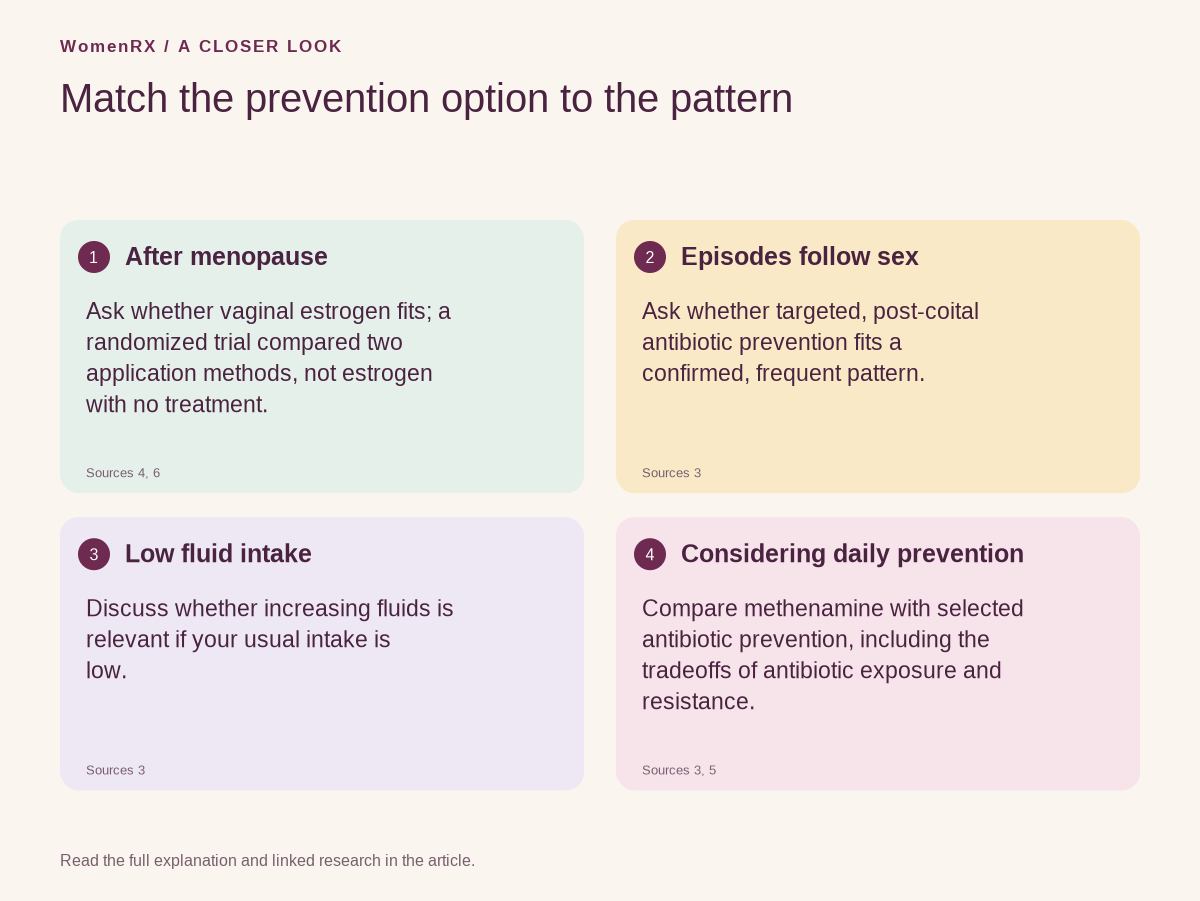
Match the prevention option to the pattern
After menopause: Ask whether vaginal estrogen fits; a randomized trial compared two application methods, not estrogen with no treatment.46
Episodes follow sex: Ask whether targeted, post-coital antibiotic prevention fits a confirmed, frequent pattern.3
Low fluid intake: Discuss whether increasing fluids is relevant if your usual intake is low.3
Considering daily prevention: Compare methenamine with selected antibiotic prevention, including the tradeoffs of antibiotic exposure and resistance.35
Read the figure as text
These options are discussion points, not one-size-fits-all recommendations. The episode pattern and health context help determine what is relevant.- After menopause: Ask whether vaginal estrogen fits; a randomized trial compared two application methods, not estrogen with no treatment.46
- Episodes follow sex: Ask whether targeted, post-coital antibiotic prevention fits a confirmed, frequent pattern.3
- Low fluid intake: Discuss whether increasing fluids is relevant if your usual intake is low.3
- Considering daily prevention: Compare methenamine with selected antibiotic prevention, including the tradeoffs of antibiotic exposure and resistance.35
More questions, answered
Does every episode need a urine test?
Testing decisions depend on the situation, but reviewing urine results across episodes can help establish whether repeated symptoms are bacterial infections. Recurrent urinary symptoms can also have noninfectious explanations, especially when cultures are repeatedly negative. 1 3
Is cranberry a treatment for an active UTI?
There is no evidence that cranberry products treat an infection that has already started. They may help prevent UTIs for some people. 1
Sources you can check
- Urinary tract infections (UTIs) - NHSAccessed 2026-09-25Return to first citation
- Urinary Tract Infections | UTI | UTI Symptoms | MedlinePlusAccessed 2026-09-25Return to first citation
- Recurrent urinary tract infection is not one disease: moving from antibiotic suppression to phenotype-guided prevention.Ahmad B, Khan K. · Annals of medicine and surgery (2012) · 2026Return to first citation
- The role of estrogen in prevention of recurrent urinary tract infections in postmenopausal women.Wiese E, Amjad A, Bartoli G, Beyzarov M, Gigliotti S, Hanna C, Myers O, Galarza C, Adler J. · JAAPA : official journal of the American Academy of Physician Assistants · 2026Return to first citation
- A retrospective evaluation of antibiotic prescribing for recurrent urinary tract infection prophylaxis in adults in general practice.Hamilton RA, Mahomed Z, Bharkhada A, Tucker A, Choudhary A, Ravindra P, Rai J, Veater J. · Family practice · 2026Return to first citation
- Vaginal Estrogen Application Techniques for Prevention of Urinary Tract Infection: A Randomized Trial.Zuo SW, Mowers EE, Hem S, Bradley M, Zyczynski HM, Hillier SL, Ackenbom MF. · Obstetrics and gynecology · 2026Return to first citation