When Vaginal Yeast Symptoms Keep Coming Back
Recurring itching or discharge is a reason to check the cause, not just repeat the last treatment.
If vaginal itching or discharge keeps returning, an exam and testing while you have symptoms can help distinguish yeast from other infections or vulvar skin conditions. A Candida culture can identify the species, but a positive result alone doesn’t prove yeast is causing your symptoms. Treatment depends on that whole picture, including whether you’re pregnant and how you responded before. 14
The first question is whether this episode is yeast
Yeast can cause itching, soreness and thick white discharge. But discharge can also change with the menstrual cycle or pregnancy, and other infections can cause symptoms that feel similar. A fishy smell points more toward bacterial vaginosis; green, yellow or frothy discharge can occur with trichomoniasis. These are clues, not a way to diagnose yourself. 1
Recurring discomfort may not be an infection at all. Vulvar eczema or dermatitis, other skin conditions and persistent vulvar pain can overlap with suspected yeast symptoms. More than one cause can be present at the same time. That’s why an examination of the vulva matters when symptoms keep returning, especially if treatment helped only partly or not at all. 4
For example, if an over-the-counter antifungal eases discharge but the skin still burns, another cause of irritation may also need attention. Repeating the antifungal would not answer that question. 4
What testing can, and cannot, tell you
Testing is most useful during a symptomatic episode, when a clinician can consider the symptoms, examine the area and collect a vaginal sample for microscopy or culture. A clinical guideline defines recurrent vulvovaginal candidiasis as four or more episodes in a year. 2 To establish that diagnosis, at least two episodes should be confirmed by microscopy or culture while symptoms are present, including at least one by culture. If symptoms respond poorly to treatment, identifying the Candida species and checking antifungal susceptibility can help guide the next choice. 4
A culture result still needs context. Candida can be present without causing the current discomfort, so a positive culture isn’t the whole diagnosis. Conversely, if treatment clears Candida but the burning or itching continues, it’s worth looking for another or an additional cause rather than assuming the yeast treatment needs repeating. Vaginal pH can sometimes help distinguish a yeast episode from bacterial vaginosis, but a normal pH does not rule out a vulvar skin condition. 4
Tell the clinician if the discharge has changed in smell or color, or if you have pelvic pain, bleeding between periods or after sex, pain when you pee, or sores. Those details may shift which causes and tests need attention. 1
Why the Candida species changes the treatment discussion
Candida albicans causes most typical vaginal yeast infections and is generally susceptible to standard antifungal treatments. Some other species are less responsive: many C. glabrata isolates have reduced susceptibility to fluconazole, while C. krusei is often inherently not susceptible to it. Species identification becomes particularly useful when symptoms persist after treatment. 45
For confirmed recurrent vulvovaginal candidiasis, the discussion may move beyond treating each episode separately. A clinical guideline reports that, following initial therapy, weekly maintenance oral fluconazole for up to six months can improve treatment success in recurrent vulvovaginal candidiasis. 2
Treating a symptomatic episode is a separate question: a longer course of topical azole treatment may be needed to resolve it. That does not make a longer topical course an alternative maintenance plan. Neither approach is a reason to start repeated treatment without confirming what is happening. 24
If testing finds a non-albicans species or poor response raises concern about resistance, the useful next question is whether the species and susceptibility results call for a different antifungal approach. This evidence supports making that distinction, but not picking one replacement medicine that works for every non-albicans infection. 45
Pregnancy, diabetes and the plan that fits you
Pregnancy and diabetes can affect how recurrent yeast symptoms are assessed. In a review of genital candidiasis, pregnancy and diabetes are among the contexts considered more complicated than an occasional, uncomplicated episode; poorly controlled diabetes is also described as a risk factor for recurrence. Neither means that every new itch is yeast. 34
If you’re pregnant, say so before discussing medication. Clotrimazole is a topical antifungal that can usually be used during pregnancy, with a pharmacist or clinician checking that it suits your situation. That does not establish that any particular course is right for recurrent symptoms. 6
The practical goal is a plan with a way to reassess it: confirm whether Candida is causing symptoms, identify the species when recurrence or poor response makes that useful, and revisit the diagnosis if symptoms continue despite treatment. That gives you a better next move than buying the same product each time itching returns. 4
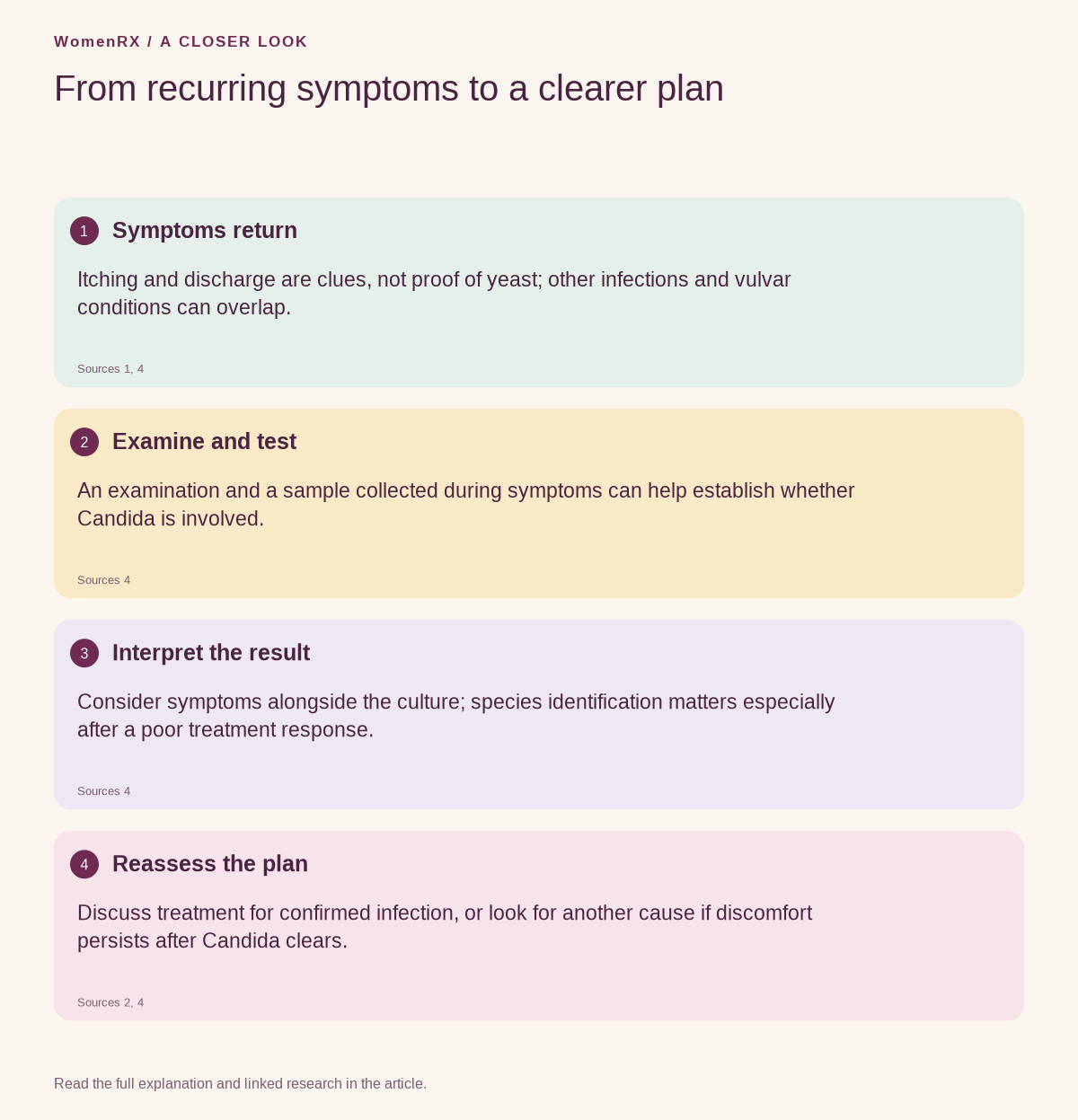
From recurring symptoms to a clearer plan
Symptoms return: Itching and discharge are clues, not proof of yeast; other infections and vulvar conditions can overlap.14
Examine and test: An examination and a sample collected during symptoms can help establish whether Candida is involved.4
Interpret the result: Consider symptoms alongside the culture; species identification matters especially after a poor treatment response.4
Reassess the plan: Discuss treatment for confirmed infection, or look for another cause if discomfort persists after Candida clears.24
Read the figure as text
The useful next step changes as the cause becomes clearer.- Symptoms return: Itching and discharge are clues, not proof of yeast; other infections and vulvar conditions can overlap.14
- Examine and test: An examination and a sample collected during symptoms can help establish whether Candida is involved.4
- Interpret the result: Consider symptoms alongside the culture; species identification matters especially after a poor treatment response.4
- Reassess the plan: Discuss treatment for confirmed infection, or look for another cause if discomfort persists after Candida clears.24
More questions, answered
Does a positive Candida culture mean yeast is causing my symptoms?
Not necessarily. Candida may be present without being the cause of discomfort. The result needs to be interpreted alongside your symptoms and examination findings, especially if symptoms continue after the yeast has cleared. 4
Sources you can check
- Vaginal discharge - NHSAccessed 2026-09-25Return to first citation
- Vulvovaginitis: screening for and management of trichomoniasis, vulvovaginal candidiasis, and bacterial vaginosis.van Schalkwyk J, Yudin MH, INFECTIOUS DISEASE COMMITTEE. · Journal of obstetrics and gynaecology Canada : JOGC = Journal d'obstetrique et gynecologie du Canada : JOGC · 2015Return to first citation
- Genital cutaneous candidiasis versus chronic recurrent vulvovaginal candidiasis: distinct diseases, different populations.Day T, Sobel JD. · Clinical microbiology reviews · 2025Return to first citation
- Compliance with the Updated BASHH Recurrent Vulvovaginal Candidiasis Guidelines Improves Patient Outcomes.Brown L, Chamula M, Weinberg S, Jbueen F, Rautemaa-Richardson R. · Journal of fungi (Basel, Switzerland) · 2022Return to first citation
- FLUCONAZOLE TABLET [REMEDYREPACK INC.] | US prescribing information and patient instructionsAccessed 2026-09-25Return to first citation
- Clotrimazole: antifungal for fungal infections - NHSAccessed 2026-09-25Return to first citation