BV or Yeast Infection? What Symptoms Can Tell You
A fishy smell or thick white discharge can offer a clue, but neither can confirm what’s causing your symptoms.
BV often causes thin, grayish-white discharge with a fishy smell, especially after sex. A yeast infection may cause thick, white discharge, while itching and irritation can occur with either condition. These patterns are clues, not a diagnosis. If you’re unsure what’s changed, an exam and vaginal testing can help identify the cause and the right treatment. 134
Start with what’s different for you
Vaginal discharge isn’t automatically a sign of infection. Clear or white discharge can be thick and sticky or slippery and wet; it may become more noticeable around ovulation or during pregnancy. What deserves attention is a change from your usual smell, color or texture, particularly if you also feel itchy or sore. 3
BV and vaginal yeast infections can both change how your vagina feels or how your discharge looks. Other conditions can cause similar symptoms, too. Use the pattern to describe what’s happening, not to decide on treatment before you know the cause. 34
Which clues point toward BV or yeast?
A fishy smell with thin discharge points more toward BV. BV happens when the balance of bacteria in the vagina changes. Its typical discharge is thin or watery and may look grayish-white; the smell can be especially noticeable after sex. BV isn’t classified as a sexually transmitted infection (STI), though sexual activity can be associated with it. 1
Thick, white discharge points more toward yeast. It’s sometimes described as looking like cottage cheese. Candida, the fungus that causes a vaginal yeast infection, can multiply when conditions change, including after antibiotic use. Itching or irritation may accompany yeast infection, but those sensations aren’t exclusive to it. 234
The overlap matters. For example, itching plus a change in discharge doesn’t tell you whether you need an antifungal medicine for yeast, an antibiotic for BV, or assessment for something else. Green, yellow or frothy discharge can suggest trichomoniasis; discharge with pelvic pain or bleeding can raise concern for other infections. Those are reasons to get checked rather than choose a treatment from the appearance of discharge alone. 123
What testing adds that symptoms can’t
A clinician may ask about the change, examine the area and take a vaginal sample. Depending on what’s being checked, diagnostic methods for BV include clinical criteria or examination of a sample under a microscope; yeast can be investigated by looking for fungal forms, by culture or with a molecular test. The point isn’t that everyone needs every test. It’s that a sample can provide information a symptom description can’t. 45
If an STI is also a possibility, say so when you seek care. Testing for BV or yeast doesn’t necessarily answer that separate question. A study of women with symptomatic vaginitis evaluated combined testing for vaginal infections and STIs, underscoring why the conditions may need to be considered together rather than treated as mutually exclusive. 5
The treatment categories differ: BV may need an antibiotic, while antifungal medicines treat most yeast infections. Getting the cause right matters more than matching a single symptom to a product. Avoid douching or using perfumed vaginal washes to try to fix a new smell or irritation; these products can add irritation rather than clarify what’s going on. 126
When pregnancy or menopause changes the picture
During pregnancy, more discharge can be normal, but a new change in its smell, color or texture still deserves a conversation with your pregnancy care team. Pregnancy is a reason for tailored assessment, not a reason to assume that every change is an infection or to guess whether it’s BV or yeast. 13
After menopause, soreness, itching or discomfort may reflect vaginal dryness related to hormonal changes, not necessarily an infection. Dryness can also be associated with unusual discharge. If symptoms are new, persistent or affecting daily life, an assessment can help sort out what’s happening. Bleeding after menopause should be checked rather than attributed to BV, yeast or dryness. There are several possible causes of that bleeding. 67
If your symptoms don’t fit the familiar BV-or-yeast descriptions, that isn’t a failure to recognize your own body. It’s a useful sign that the comparison has reached its limit. A clear account of what changed, including smell, discharge, soreness and any bleeding or pelvic pain, helps direct the next assessment. 34
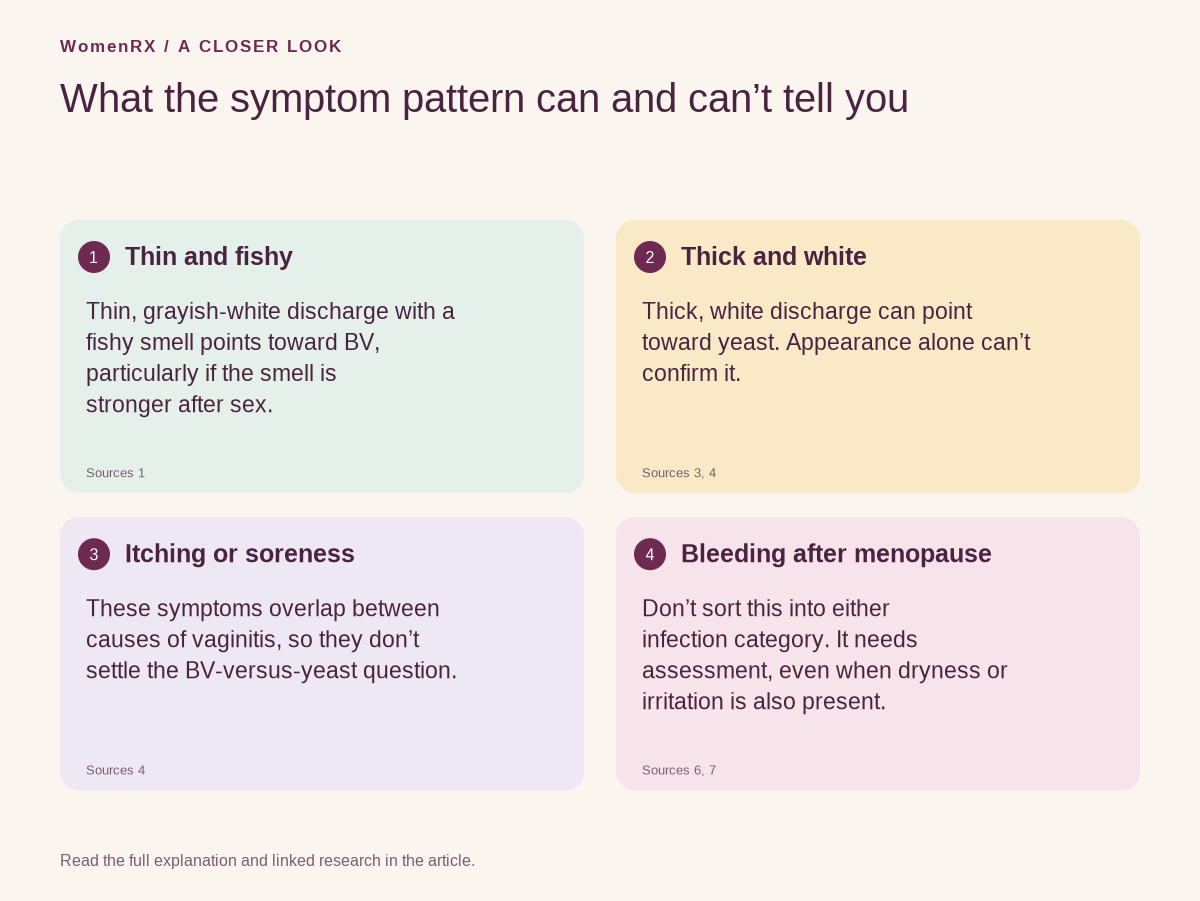
What the symptom pattern can and can’t tell you
Thin and fishy: Thin, grayish-white discharge with a fishy smell points toward BV, particularly if the smell is stronger after sex.1
Thick and white: Thick, white discharge can point toward yeast. Appearance alone can’t confirm it.34
Itching or soreness: These symptoms overlap between causes of vaginitis, so they don’t settle the BV-versus-yeast question.4
Bleeding after menopause: Don’t sort this into either infection category. It needs assessment, even when dryness or irritation is also present.67
Read the figure as text
These clues can help you describe a change, but an exam or test may be needed to identify its cause.- Thin and fishy: Thin, grayish-white discharge with a fishy smell points toward BV, particularly if the smell is stronger after sex.1
- Thick and white: Thick, white discharge can point toward yeast. Appearance alone can’t confirm it.34
- Itching or soreness: These symptoms overlap between causes of vaginitis, so they don’t settle the BV-versus-yeast question.4
- Bleeding after menopause: Don’t sort this into either infection category. It needs assessment, even when dryness or irritation is also present.67
More questions, answered
Is BV an STI?
BV isn’t classified as an STI. Sexual activity can be associated with it, though, and having BV doesn’t rule out an STI that may need its own test. 15
Sources you can check
- Bacterial vaginosis - NHSAccessed 2026-09-25Return to first citation
- Yeast Infections: MedlinePlusAccessed 2026-09-25Return to first citation
- Vaginal discharge - NHSAccessed 2026-09-25Return to first citation
- Diagnostic performance of deep learning-based vaginal microecological morphology assessment for bacterial vaginosis and vulvovaginal candidiasis.Zhang P, Li HM, Gao HH, Yan L. · Frontiers in microbiology · 2026Return to first citation
- Clinical utility of nucleic acid amplification testing for detection of sexually transmitted infections in women with symptomatic bacterial vaginosis and vulvovaginal candidiasis identified by conventional versus molecular diagnoses.Getman D, Seña AC, Nenninger A, Schwebke JR. · Journal of clinical microbiology · 2026Return to first citation
- Vaginal dryness - NHSAccessed 2026-09-25Return to first citation
- Symptoms of vaginal cancer - NHSAccessed 2026-09-25Return to first citation