New Symptoms After HRT: Yeast Infection or Menopause?
Genital itching or burning after starting hormone therapy can have more than one cause, and timing alone can’t tell you which one it is.
New genital symptoms after starting HRT could be a yeast infection, but they could also reflect menopause-related tissue changes or another vulvar condition. One estradiol-and-progestin patch label lists vaginal yeast infection as a reported adverse reaction; that doesn’t prove the patch caused your symptoms. Dryness and pain with sex can point toward menopause-related changes, but symptoms alone may not settle the diagnosis. 1 4 6
The timing is a clue, not a diagnosis
If symptoms began soon after you started hormone therapy, it’s reasonable to wonder whether the two are connected. A US prescribing label for one specific systemic patch containing estradiol and levonorgestrel, used after menopause, lists vaginal yeast infection among reported adverse reactions. That’s a reason to mention the timing to your prescriber, but it doesn’t show that the patch caused your symptoms, how often this happens, or whether the finding applies to other systemic HRT or vaginal hormone treatments. 1
There’s another complication: vaginal and vulvar symptoms can also arise from menopause-related tissue changes. So even when symptoms start after HRT, the timing alone can’t separate a yeast infection from another cause.
Why menopause can feel like an infection
Genitourinary syndrome of menopause, or GSM, is related to lower estrogen after menopause. It can involve the vulva, vagina, and urinary tract. Dryness and pain with sex are common; itching, urinary urgency, and discomfort when urinating can occur too. Those sensations may be mistaken for infection, and they can coexist with another condition. 4 5 6
Yeast is a genuine possibility, but it isn’t the only one. A 2025 review describes one form of genital candidiasis as estrogen-dependent, while noting that most uncomplicated or acute vaginal yeast infections occur in premenopausal women. That finding doesn’t establish that starting menopausal HRT causes candidiasis. It does show why estrogen and yeast can be relevant to the discussion without making symptoms a reliable way to identify the cause. 3
Other vulvar conditions can overlap with GSM and infection symptoms. A recent clinical review emphasizes that careful evaluation, including the appearance and distribution of skin changes, can help distinguish among them. 4
What the symptom pattern can tell you
Dryness, especially alongside pain with sex or urinary symptoms, makes GSM worth considering. It doesn’t rule out yeast or another condition. The distinction between vaginal yeast infection and yeast affecting the outer genital skin also matters: a clinical review describes these as different conditions with different findings and approaches to investigation. In other words, where you feel the problem and what the skin looks like may change what needs checking. 3 4 6
If this is an unfamiliar episode, you can’t tell what’s causing it, or symptoms keep coming back, an exam is more useful than repeatedly assuming yeast. A clinician can consider your history and examine the area, then decide whether testing is needed. Visible skin changes, symptoms that don’t improve, or scarring deserve particular attention; a vulvar specialist may be helpful when the diagnosis remains uncertain or scarring affects function. Treatments aimed at yeast won’t address menopause-related tissue changes or a different vulvar condition. 4
When you reach out, mention when symptoms began, when you started HRT, and whether your treatment is a patch or a vaginal product. That information gives the clinician a clearer picture, but it can’t establish the cause by itself. Discuss the symptoms and your treatment with the person who prescribed it.
If you use the estrogen-only Climara patch, its patient instructions say to report unusual vaginal bleeding, including bleeding after menopause, so its cause can be checked. Don’t treat bleeding as a yeast symptom. 2
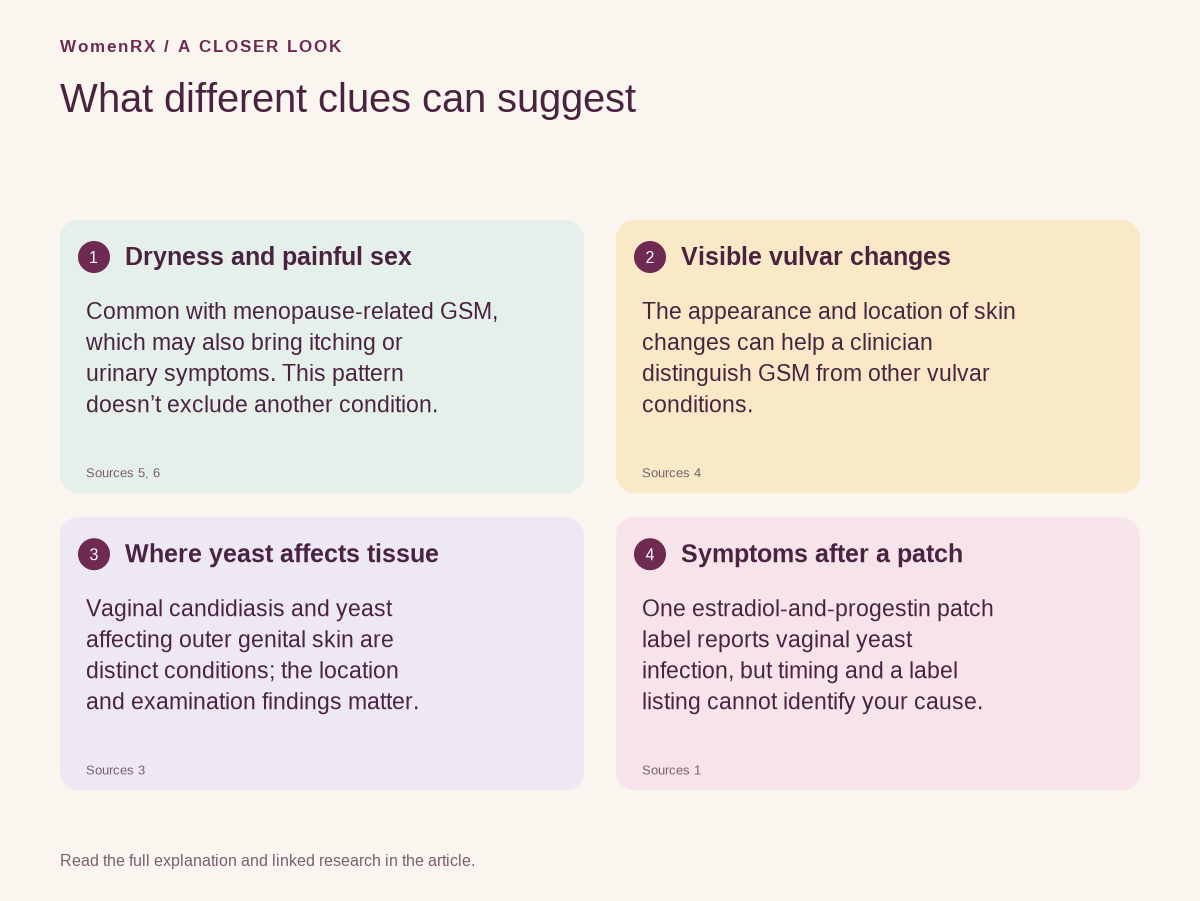
What different clues can suggest
Dryness and painful sex: Common with menopause-related GSM, which may also bring itching or urinary symptoms. This pattern doesn’t exclude another condition.56
Visible vulvar changes: The appearance and location of skin changes can help a clinician distinguish GSM from other vulvar conditions.4
Where yeast affects tissue: Vaginal candidiasis and yeast affecting outer genital skin are distinct conditions; the location and examination findings matter.3
Symptoms after a patch: One estradiol-and-progestin patch label reports vaginal yeast infection, but timing and a label listing cannot identify your cause.1
Read the figure as text
These distinctions can guide what to describe during an assessment. None confirms yeast or rules it out.- Dryness and painful sex: Common with menopause-related GSM, which may also bring itching or urinary symptoms. This pattern doesn’t exclude another condition.56
- Visible vulvar changes: The appearance and location of skin changes can help a clinician distinguish GSM from other vulvar conditions.4
- Where yeast affects tissue: Vaginal candidiasis and yeast affecting outer genital skin are distinct conditions; the location and examination findings matter.3
- Symptoms after a patch: One estradiol-and-progestin patch label reports vaginal yeast infection, but timing and a label listing cannot identify your cause.1
More questions, answered
Does a yeast infection listed on an HRT label prove the medicine caused it?
No. The label for one estradiol-and-levonorgestrel patch lists vaginal yeast infection among reported adverse reactions, but that listing alone doesn’t establish that the patch caused an individual case or that the same finding applies to other hormone therapies. 1
Can menopause-related symptoms include itching or urinary discomfort?
Yes. GSM can include vulvovaginal dryness and itching, pain with sex, and urinary symptoms such as urgency or discomfort when urinating. These symptoms can overlap with other conditions, so they don’t identify the cause on their own. 4 5 6
Sources you can check
- CLIMARA PRO (ESTRADIOL AND LEVONORGESTREL) PATCH [BAYER HEALTHCARE PHARMACEUTICALS INC.] | US prescribing information and patient instructionsAccessed 2026-09-25Return to first citation
- CLIMARA (ESTRADIOL) PATCH [BAYER HEALTHCARE PHARMACEUTICALS INC.] | US prescribing information and patient instructionsAccessed 2026-09-25Return to first citation
- Genital cutaneous candidiasis versus chronic recurrent vulvovaginal candidiasis: distinct diseases, different populations.Day T, Sobel JD. · Clinical microbiology reviews · 2025Return to first citation
- A Practical Management Approach to Vulvar Dermatoses and Genitourinary Syndrome of Menopause.Negris O, Ghafari-Saravi A, Mauskar MM. · Obstetrics and gynecology · 2026Return to first citation
- Genitourinary syndrome of menopause (GSM): recommendations from the Fifth International Consultation on Sexual Medicine (ICSM 2024).Simon JA, Nappi RE, Chedraui P, Clark AL, Gompel A, Nasreen SZA, Palacios S, Wolfman W. · Sexual medicine reviews · 2026Return to first citation
- Case-Based Perspectives on the Management of Genitourinary Syndrome of Menopause.Cyriac J, Sood R. · Clinics and practice · 2026Return to first citation