Vaginal Symptoms After Menopause: Yeast or Another Cause?
Itching and soreness can come from yeast, menopause-related dryness and irritation, or another cause, so symptoms alone can’t settle the question.
After menopause, lower estrogen can contribute to vaginal dryness and irritation, while yeast can cause itching, burning, and soreness. Those symptoms overlap, so itching alone doesn’t confirm an infection. An examination and, when appropriate, a vaginal swab or other testing can help identify the cause. If symptoms keep returning or antifungal treatment hasn’t helped, get the diagnosis checked rather than repeating treatment by guesswork. 3 6 7
Why the symptoms can look alike
Yeast infection, also called vulvovaginal candidiasis, can cause vulvar itching, burning, soreness, redness, and sometimes a change in discharge. Menopause-related changes can also cause vaginal dryness and irritation as estrogen levels fall. Because discomfort can overlap, a symptom such as itching doesn’t tell you which cause is responsible. 3 7
A thick, white discharge can occur with yeast, but discharge appearance is only a clue, not a diagnosis. Other vaginal conditions can change discharge too, and some people with Candida detected on testing have no symptoms. That means a test result needs to be interpreted alongside what you’re experiencing and what an examination shows. 2 7
| What you notice | What it may suggest | Why it isn’t conclusive |
|---|---|---|
| Dryness or irritation after menopause | A menopause-related vaginal change is possible. | Yeast and other causes can also irritate the area. 3 7 |
| Itching, burning, or soreness | Yeast is one possibility. | These symptoms overlap with other vaginal problems. 7 |
| Thick, white discharge | Yeast is one possible cause. | Discharge patterns are clues, not a reliable diagnosis by themselves. 2 |
| Symptoms that persist or return | The cause may need reassessment. | Repeated symptoms do not, on their own, confirm recurrent yeast. 6 7 |
What an assessment can clarify
A clinician can consider the timing and pattern of symptoms, examine the area, and decide whether testing is useful. Vaginal swab testing may include laboratory methods such as microscopy or culture; molecular tests are also used in some evaluations of symptomatic vaginitis. The best approach depends on the situation. Research comparing diagnostic approaches in women with symptomatic vaginitis found that molecular testing could identify causes differently from clinical assessment alone, but that study was not focused specifically on postmenopausal women. 6 8
Testing also has limits: finding Candida does not always prove it is causing symptoms, because Candida may be present in people without symptoms. A result makes most sense when it fits the symptoms and examination. If symptoms are repeated or don’t improve with initial treatment, reassessing the diagnosis matters; another course of antifungal treatment may not address a non-yeast cause. 6 7
Treatment depends on the cause
If yeast is the cause, antifungal medicines treat yeast infections in most people. If dryness or irritation is related to menopause, antifungal medicine won’t address that underlying problem. Vaginal estrogen is one treatment used for menopause-related vaginal dryness and irritation; menopause guidance also supports discussing low-dose vaginal estrogen or other therapies when bothersome symptoms aren’t relieved with over-the-counter options. Vaginal moisturizers and lubricants may also help some people with vaginal symptoms. 1 3 4 5
More than one factor may need consideration, so don’t assume that being postmenopausal rules out yeast, or that a positive yeast test automatically explains every symptom. If treatment hasn’t helped, tell the clinician what you’ve tried and whether the symptoms improved, stayed the same, or returned. That information can help guide whether examination or further testing is needed.
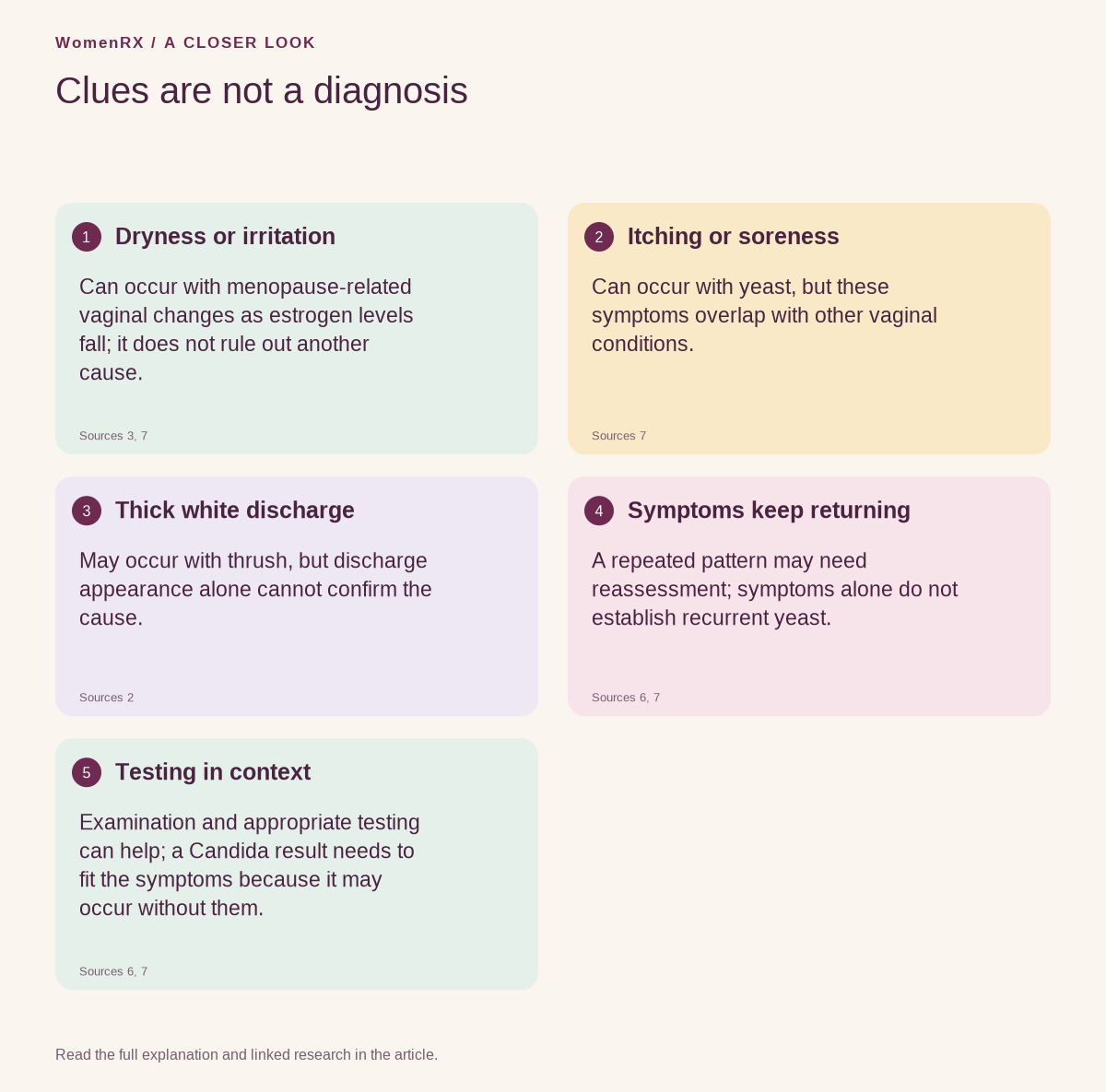
Clues are not a diagnosis
Dryness or irritation: Can occur with menopause-related vaginal changes as estrogen levels fall; it does not rule out another cause.37
Itching or soreness: Can occur with yeast, but these symptoms overlap with other vaginal conditions.7
Thick white discharge: May occur with thrush, but discharge appearance alone cannot confirm the cause.2
Symptoms keep returning: A repeated pattern may need reassessment; symptoms alone do not establish recurrent yeast.67
Testing in context: Examination and appropriate testing can help; a Candida result needs to fit the symptoms because it may occur without them.67
Read the figure as text
Yeast and menopause-related vaginal symptoms can overlap. This comparison shows what symptom patterns may suggest and why examination or testing can help.- Dryness or irritation: Can occur with menopause-related vaginal changes as estrogen levels fall; it does not rule out another cause.37
- Itching or soreness: Can occur with yeast, but these symptoms overlap with other vaginal conditions.7
- Thick white discharge: May occur with thrush, but discharge appearance alone cannot confirm the cause.2
- Symptoms keep returning: A repeated pattern may need reassessment; symptoms alone do not establish recurrent yeast.67
- Testing in context: Examination and appropriate testing can help; a Candida result needs to fit the symptoms because it may occur without them.67
More questions, answered
Does itching after menopause mean I have a yeast infection?
No. Itching can occur with yeast, but menopause-related dryness and irritation can also cause discomfort. Symptoms overlap, so itching alone can’t identify the cause. 3 7
Can a positive yeast test explain symptoms by itself?
Not always. Candida can be detected in people without symptoms, so a result needs to be considered alongside your symptoms and examination. 7
What if antifungal treatment hasn’t helped?
Have the cause reassessed instead of assuming the symptoms are still yeast. Persistent or returning symptoms may call for examination or testing to clarify what’s going on. 6 7
Sources you can check
- Yeast Infections: MedlinePlusAccessed 2026-09-25Return to first citation
- Vaginal discharge - NHSAccessed 2026-09-25Return to first citation
- About vaginal oestrogen - NHSAccessed 2026-09-25Return to first citation
- Common questions about vaginal oestrogen - NHSAccessed 2026-09-25Return to first citation
- The 2022 hormone therapy position statement of The North American Menopause Society.“The 2022 Hormone Therapy Position Statement of The North American Menopause Society” Advisory Panel. · Menopause (New York, N.Y.) · 2022Return to first citation
- 'It's not just thrush, it's recurrent thrush': a qualitative study of patient and clinician perspectives on diagnosing recurrent vulvovaginal candidiasis.Ford T, Ziebland S, Tonkin-Crine S, Hayward G, McNiven A. · The British journal of general practice : the journal of the Royal College of General Practitioners · 2026Return to first citation
- State-of-the-Art Review: Managing Vulvovaginal Candidiasis.Rautemaa-Richardson R, Sobel JD, Stone N, De Seta F, Cassone A, Vieira-Baptista P, Comar M, Warris A, Roselletti E. · Clinical infectious diseases : an official publication of the Infectious Diseases Society of America · 2026Return to first citation
- Clinical utility of nucleic acid amplification testing for detection of sexually transmitted infections in women with symptomatic bacterial vaginosis and vulvovaginal candidiasis identified by conventional versus molecular diagnoses.Getman D, Seña AC, Nenninger A, Schwebke JR. · Journal of clinical microbiology · 2026Return to first citation