Probiotics for Vaginal Health: What the Evidence Shows
A probiotic’s results depend on the strain, route, condition, and outcome studied, so a “vaginal health” label alone can’t tell you whether it may help.
There isn’t one probiotic proven to prevent or treat every vaginal concern. In studies of bacterial vaginosis (BV), some probiotic approaches have shown promise, while others haven’t improved outcomes. The findings apply to particular products and groups of women, not to all supplements. If you’re considering one for symptoms or recurring BV, ask what exact product and outcome have been studied, and whether it’s meant to complement established treatment.
The useful question isn’t “Which probiotic is best?”
It’s “Has this exact probiotic been studied for the problem I’m trying to address?” Probiotics are identified by genus, species, and strain, and effects can differ from one strain to another. A product with more strains or a higher number of live organisms isn’t automatically more effective. Labels also don’t show that a product has been proven for a particular vaginal condition. 2
That distinction matters because “vaginal health” can mean very different things: treating diagnosed bacterial vaginosis (BV), preventing BV from returning, easing symptoms, or changing a microbiome test result. Improvement in a lab measure doesn’t necessarily show that a person’s symptoms or recurrence risk improved.
For BV, some pooled results look promising, but products vary
A 2022 meta-analysis of randomized trials in adult women found a higher BV cure rate when probiotics were used alongside antibiotics than with antibiotics alone or with placebo alongside antibiotics: the pooled relative risk was 1.23 (95% confidence interval 1.05-1.43). But the probiotic interventions differed across trials. The review did not establish one standard product that works for everyone. In the smaller set of trials comparing probiotics alone with antibiotics, the pooled result did not show a clear difference. 3
Individual trials show why that matters. In one randomized study of 126 Chinese women with BV, adding oral Lacticaseibacillus rhamnosus GR-1 and Limosilactobacillus reuteri RC-14 to vaginal metronidazole did not improve cure rates over metronidazole alone at 30 or 90 days. The specific oral strains were rarely found in vaginal samples after use. This trial doesn’t settle the question for other products or routes, but it does show why a result for one probiotic shouldn’t be applied to another. 7
So, if a product says “contains Lactobacillus,” that alone is not enough to connect it to a BV study. Look for the exact strain or strains, whether it was taken orally or used vaginally, whether it was tested with or instead of antibiotics, and what the trial measured. 23
Route and outcome can change the story
Taking a probiotic by mouth doesn’t guarantee that its organisms will establish themselves in the vagina. In a small randomized pregnancy trial, a specific oral blend was taken after vaginal infections had been treated and cleared. The study found no reduction in recurrent vulvovaginal infections compared with placebo, and none of the capsule’s strains were detected as vaginal colonizers. 5
A different study asked a different question: whether a five-strain oral formula could affect a vaginal test measure in reproductive-aged women with intermediate Nugent scores. Among the 76 participants who completed the 12-week trial, the study reported a greater reduction in Nugent score with the formula than with placebo. That finding is about a measured score in that study group; it doesn’t establish that the product treats symptoms, prevents recurrent BV, or works in other populations. 6
For one more distinct population, a 2025 randomized trial compared a 10-day vaginal probiotic capsule with oral metronidazole in Chinese women with asymptomatic BV. Cure rates were not significantly different at the measured follow-ups. Among women who were cured, the probiotic group had fewer recurrences over later follow-up. That result is worth further study, but it applies to this trial’s product, route, comparison, and asymptomatic participants. It isn’t a reason to substitute an unverified supplement for care. 4
Pregnancy is a separate evidence question
The pregnancy trial above was small: 47 women were analyzed, and the oral probiotic did not prevent recurrent vulvovaginal infections after treatment. It included BV and yeast infections, so it wasn’t a trial of recurrent BV alone. Its findings can’t establish whether other probiotics, routes, or pregnancy populations would have different results. 5
If you’re pregnant and have new vaginal symptoms, focus first on finding out what’s causing them rather than assuming a probiotic is the answer. BV and yeast infections are different conditions, and symptoms alone don’t establish which one you have. 15
The studies here mainly involve adult women of reproductive age. They don’t establish which probiotics work for perimenopause or after menopause, or whether benefits differ across those life stages.
A practical way to assess a product claim
Before choosing a probiotic for vaginal symptoms or recurrent BV, use these questions to separate research from marketing:
- What exact condition was studied? BV, yeast infection, general vaginal well-being, and an altered lab score are not interchangeable outcomes.
- What exact strain or strains were tested? A product should identify the organisms specifically enough to compare with the study. 2
- What was the route and treatment plan? Oral and vaginal products aren’t interchangeable, and a probiotic tested alongside antibiotics hasn’t been shown to replace them. 37
- What improved, and when? Ask whether the trial measured symptoms, a confirmed BV cure, recurrence, or only a microbiome or Nugent-score change.
- Who was studied? A result in reproductive-aged, nonpregnant women may not answer the question for someone who is pregnant or postmenopausal.
If you have a fishy odor or unusual discharge, those can occur with BV, but other causes of vaginal changes exist. It’s reasonable to get the cause checked, especially if symptoms return. BV is commonly treated with antibiotics; probiotics shouldn’t delay evaluation or be assumed to replace treatment. 1
judge the evidence by the match between the product, route, condition, and outcome, not by a general promise to support vaginal balance.
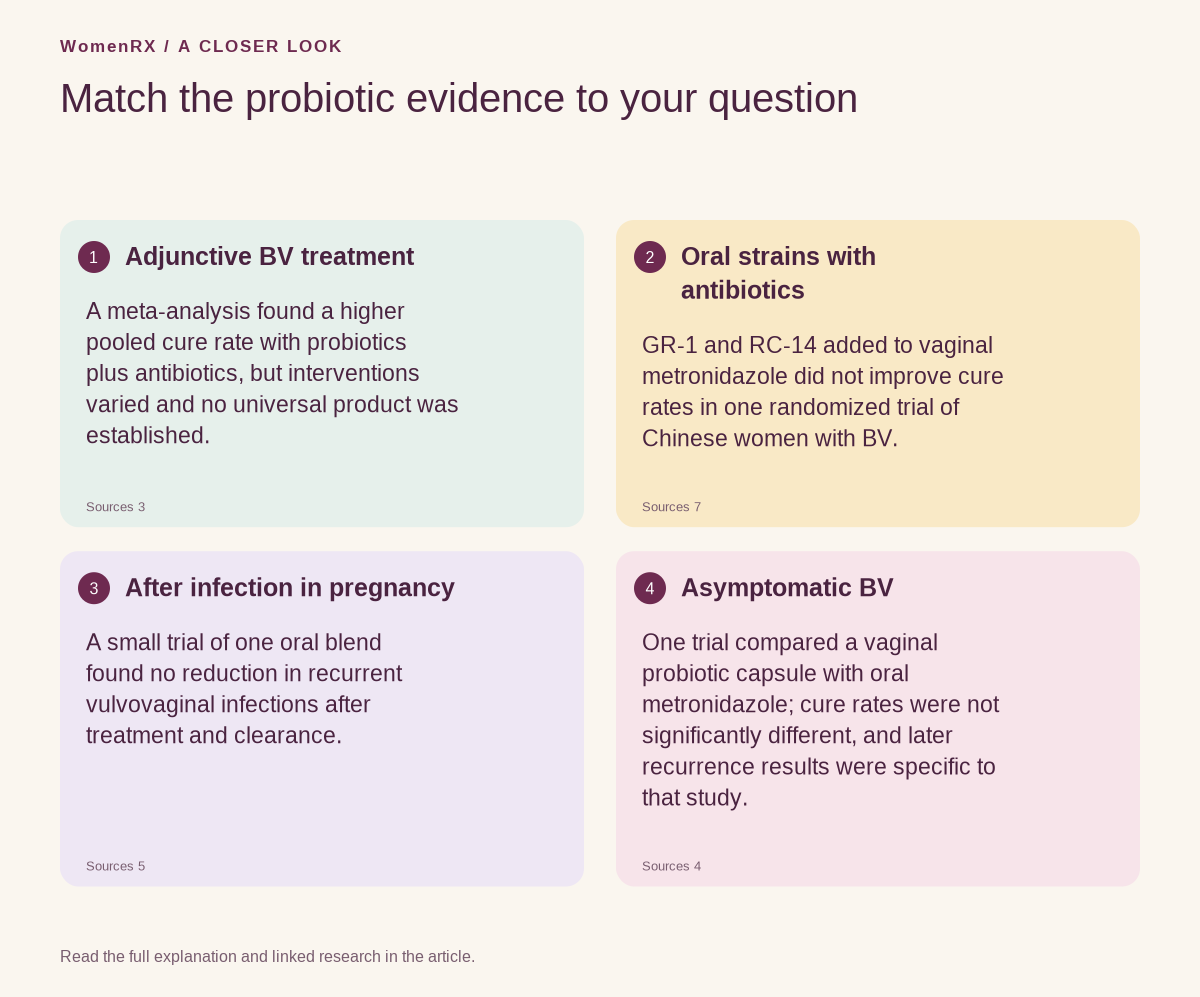
Match the probiotic evidence to your question
Adjunctive BV treatment: A meta-analysis found a higher pooled cure rate with probiotics plus antibiotics, but interventions varied and no universal product was established.3
Oral strains with antibiotics: GR-1 and RC-14 added to vaginal metronidazole did not improve cure rates in one randomized trial of Chinese women with BV.7
After infection in pregnancy: A small trial of one oral blend found no reduction in recurrent vulvovaginal infections after treatment and clearance.5
Asymptomatic BV: One trial compared a vaginal probiotic capsule with oral metronidazole; cure rates were not significantly different, and later recurrence results were specific to that study.4
Read the figure as text
These examples show why strain, route, condition, and measured outcome matter more than a broad promise of vaginal support.- Adjunctive BV treatment: A meta-analysis found a higher pooled cure rate with probiotics plus antibiotics, but interventions varied and no universal product was established.3
- Oral strains with antibiotics: GR-1 and RC-14 added to vaginal metronidazole did not improve cure rates in one randomized trial of Chinese women with BV.7
- After infection in pregnancy: A small trial of one oral blend found no reduction in recurrent vulvovaginal infections after treatment and clearance.5
- Asymptomatic BV: One trial compared a vaginal probiotic capsule with oral metronidazole; cure rates were not significantly different, and later recurrence results were specific to that study.4
More questions, answered
Does a higher CFU count mean a probiotic will work better?
No. A higher count isn’t proof of greater benefit. The NIH Office of Dietary Supplements notes that effects can be strain-specific and that many commercial probiotic products haven’t been studied. If comparing a product with a trial, check the strain and formulation, not just the CFU number. 2
Can I use a probiotic instead of BV treatment?
Current studies don’t establish probiotics as a general replacement for established BV treatment. Some trials studied probiotics alongside antibiotics, and an individual trial of an oral strain combination added to vaginal metronidazole did not improve cure rates. Ask about the specific product and evidence rather than treating probiotics as a substitute. 37
Sources you can check
- Bacterial vaginosis - NHSAccessed 2026-09-25Return to first citation
- Probiotics - Health Professional Fact SheetAccessed 2026-09-25Return to first citation
- Probiotics are a good choice for the treatment of bacterial vaginosis: a meta-analysis of randomized controlled trial.Chen R, Li R, Qing W, Zhang Y, Zhou Z, Hou Y, Shi Y, Zhou H, Chen M. · Reproductive health · 2022Return to first citation
- Probiotics reduce the recurrence of asymptomatic bacterial vaginosis in Chinese women.Zhang R, Liu Z, Zhang Y, Mi L, Zhang D, Li Y, Liao Q. · Scientific reports · 2025Return to first citation
- Oral Probiotics to Prevent Recurrent Vulvovaginal Infections During Pregnancy-Multicenter Double-Blind, Randomized, Placebo-Controlled Trial.Nachum Z, Suleiman A, Colodner R, Battino S, Wattad M, Kuzmin O, Yefet E. · Nutrients · 2025Return to first citation
- Efficacy and Safety of MED-01 Probiotics on Vaginal Health: A 12-Week, Multicenter, Randomized, Double-Blind, Placebo-Controlled Clinical Trial.Park SH, Lee ES, Park ST, Jeong SY, Yun Y, Kim Y, Jeong Y, Kang CH, Choi HJ. · Nutrients · 2023Return to first citation
- Probiotic Lacticaseibacillus rhamnosus GR-1 and Limosilactobacillus reuteri RC-14 as an Adjunctive Treatment for Bacterial Vaginosis Do Not Increase the Cure Rate in a Chinese Cohort: A Prospective, Parallel-Group, Randomized, Controlled Study.Zhang Y, Lyu J, Ge L, Huang L, Peng Z, Liang Y, Zhang X, Fan S. · Frontiers in cellular and infection microbiology · 2021Return to first citation