Menopause Symptom Check: What Your Answers Can Tell You
A symptom check can help you choose a next step, but menstrual history and your health context matter more than a quiz result.
A quiz can help you notice patterns, but it can’t diagnose menopause. For many people over 45, menopause is identified clinically after 12 months without a period. If you have vaginal bleeding after menopause, promptly request an evaluation rather than just tracking it. If periods are hard to interpret because of contraception or hysterectomy, or your ovaries have been affected by treatment or surgery, ask for an individualized assessment. 1 3 6
Start with the pattern, not a score
A useful symptom check doesn’t add up points or declare that you’re in menopause. It helps you notice what has changed, when it happens, and whether your menstrual history makes the pattern easier or harder to interpret.
For example, you might jot down when hot flashes or night sweats occur, whether sleep or mood changes alongside them, and how your periods have changed. That’s an organizing tool, not a validated diagnostic test. Menopause symptoms can overlap with depression and other midlife stressors, so a familiar symptom by itself may not explain the whole picture. 5
A brief check to choose your next step
Start with the first question. These answers don’t produce a score, and one answer doesn’t rule out another concern.
- Have you had vaginal bleeding after menopause, even spotting once? Promptly request a clinical evaluation rather than tracking it. If you’ve gone 12 consecutive months without a period after age 45, bleeding after that point needs checking. 1 3
- Have your periods stopped or become irregular before age 40? Arrange an assessment rather than assuming it’s menopause. Primary ovarian insufficiency is one possible explanation, but a symptom check can’t identify the cause. 6
- Are periods an unreliable clue because of hormonal contraception or hysterectomy, or have you had cancer treatment or surgery affecting the ovaries? Arrange an individualized assessment if you’re trying to understand your menopausal status; don’t use a missed-period answer as your result. Hysterectomy removes periods as a marker, while treatment or surgery affecting the ovaries raises a different question about ovarian function. 3 6
- Have hot flashes or night sweats changed, returned long after menopause, or come with other symptoms? Arrange an assessment. If changes are familiar and manageable, with none of the situations above, you can track their timing and impact to see whether the pattern changes. That record is an organizing aid, not a diagnosis. 4
Choose a next step
Track a familiar pattern
If your changes are manageable and you don’t have a warning sign such as bleeding after menopause, keeping a simple record can help you see whether symptoms are changing. Note timing, menstrual changes, and how much symptoms affect daily life. Tracking doesn’t confirm menopause; it gives you a clearer description if you decide to discuss the pattern.
Arrange a routine assessment
Consider a routine appointment if symptoms are changing, troubling you, affecting sleep or daily life, or don’t fit your usual pattern. A guideline on vasomotor symptoms recommends further assessment when symptoms change, return long after menopause, come with other symptoms, or persist despite treatment. The assessment starts with a history and clinical examination; what happens next depends on what that shows. 4
A visit is also a sensible next step if your periods have stopped or become irregular before age 40. Symptoms alone can’t establish the cause. Primary ovarian insufficiency is one possible explanation for ovarian function changes before 40, but a symptom quiz cannot diagnose it. 6
Promptly request evaluation for bleeding after menopause
If you have any vaginal bleeding after menopause, contact a clinician to request an evaluation rather than waiting to see what a quiz or symptom tracker shows. Even one episode of spotting or a small amount of blood needs to be checked. 1
Why your menstrual history matters
For someone over 45 with a typical pattern, menopause is generally a clinical diagnosis made retrospectively after 12 consecutive months without a period. In that usual situation, a hormone test or imaging isn’t needed just to make the diagnosis. 3
That rule is harder to apply when bleeding patterns aren’t a reliable guide. Hormonal contraception can change or stop bleeding, and hysterectomy removes periods as a marker. After cancer treatment that can affect ovarian function, the usual 12-month rule may not establish menopause with certainty. Surgery affecting the ovaries is another reason to discuss ovarian function specifically; it isn’t the same issue as losing the period marker after a hysterectomy. These situations call for an assessment that takes your specific history into account, not a quiz answer or a single symptom. 3 6
A hormone result doesn’t automatically solve the puzzle. Anti-Müllerian hormone (AMH) can offer information about ovarian reserve, but its reliability for diagnosing menopause is inconsistent, especially for predicting the exact timing in younger people. A result shouldn’t be treated as a stand-alone menopause verdict. 2
What a check can, and can’t, tell you
A symptom check can make changes easier to describe and help you decide whether to track them or seek an assessment. It cannot confirm menopause, rule out another cause, or determine what an unusual symptom means. Mood changes deserve particular care in interpretation: depression and menopause symptoms can occur together and overlap, and evaluation may need to consider mood symptoms, menopause stage, and other factors. 5
The practical takeaway is simple: use the check to identify the next conversation, not to label yourself. If your periods are a useful marker, include their timing. If they aren’t, say why, such as contraception or hysterectomy. Also mention cancer treatment or surgery affecting the ovaries, because that history changes what needs to be assessed. 3 6
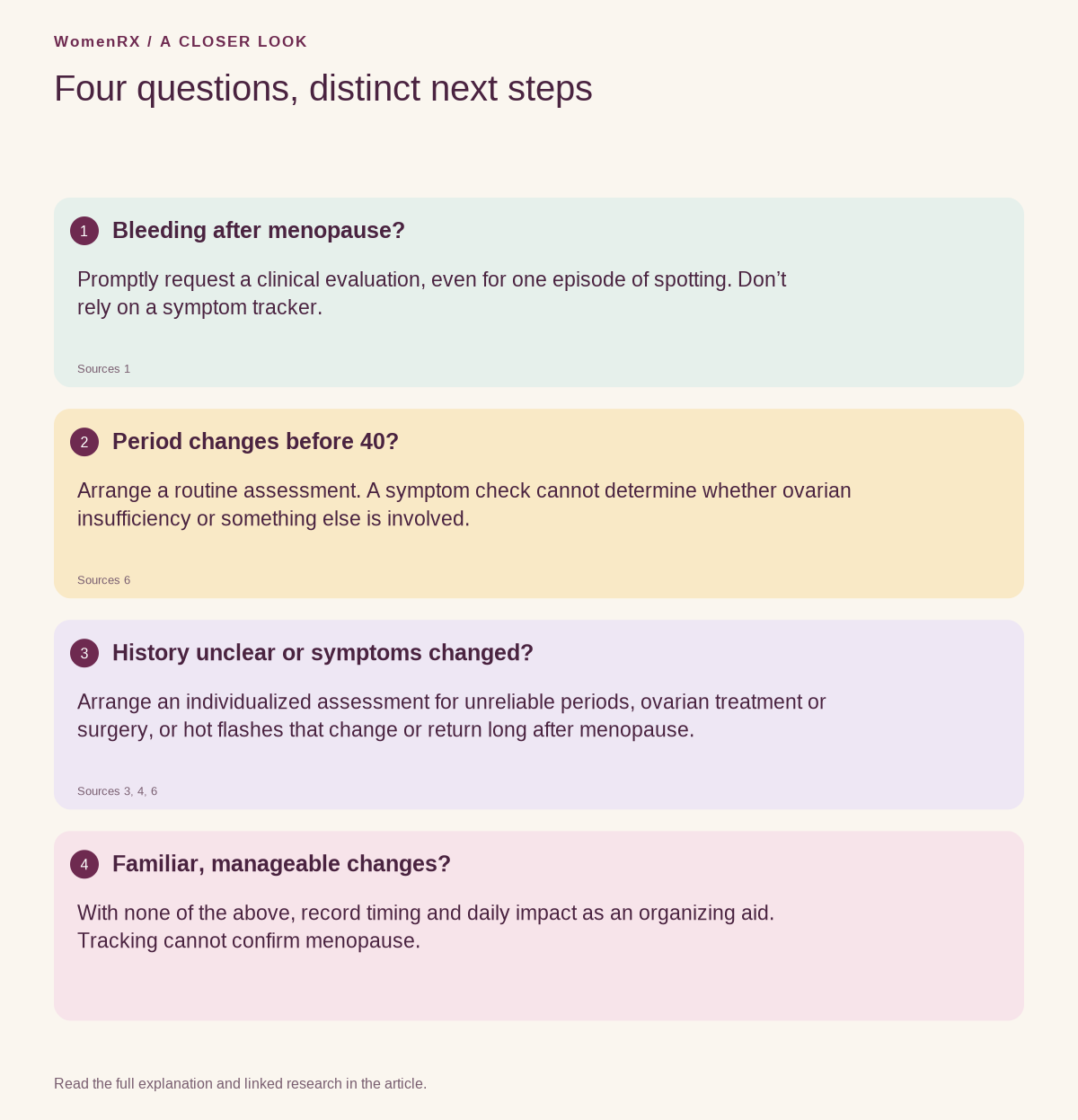
Four questions, distinct next steps
Bleeding after menopause?: Promptly request a clinical evaluation, even for one episode of spotting. Don’t rely on a symptom tracker.1
Period changes before 40?: Arrange a routine assessment. A symptom check cannot determine whether ovarian insufficiency or something else is involved.6
History unclear or symptoms changed?: Arrange an individualized assessment for unreliable periods, ovarian treatment or surgery, or hot flashes that change or return long after menopause.346
Familiar, manageable changes?: With none of the above, record timing and daily impact as an organizing aid. Tracking cannot confirm menopause.
Read the figure as text
Start with bleeding, then consider age, whether periods are a reliable clue, and whether symptoms have changed. This flow chooses a next step, not a diagnosis.- Bleeding after menopause?: Promptly request a clinical evaluation, even for one episode of spotting. Don’t rely on a symptom tracker.1
- Period changes before 40?: Arrange a routine assessment. A symptom check cannot determine whether ovarian insufficiency or something else is involved.6
- History unclear or symptoms changed?: Arrange an individualized assessment for unreliable periods, ovarian treatment or surgery, or hot flashes that change or return long after menopause.346
- Familiar, manageable changes?: With none of the above, record timing and daily impact as an organizing aid. Tracking cannot confirm menopause.
More questions, answered
Do I need a hormone test to confirm menopause?
In a typical situation after age 45, menopause is usually diagnosed clinically after 12 consecutive months without a period, without hormone testing or imaging just to make the diagnosis. Other circumstances, including hormonal contraception or cancer treatment, can make assessment less straightforward. 3
Can an AMH test tell me when menopause will happen?
AMH can reflect ovarian reserve and may help predict menopause timing in some settings, but its accuracy is inconsistent for diagnosing menopause or pinpointing when it will occur. It isn’t a stand-alone answer to a symptom check. 2
Sources you can check
- Postmenopausal bleeding - NHSAccessed 2026-09-25Return to first citation
- The role of anti-Müllerian hormone: insights into ovarian reserve, primary ovarian insufficiency, and menopause prediction.Karaviti E, Karaviti D, Kani ER, Chatziandreou E, Paschou SA, Psaltopoulou T, Kalantaridou S, Lambrinoudaki I. · Endocrine · 2025Return to first citation
- [How to diagnose menopause? Postmenopausal women management: CNGOF and GEMVi clinical practice guidelines].Rousset-Jablonski C. · Gynecologie, obstetrique, fertilite & senologie · 2021Return to first citation
- [Differential diagnosis of vasomotor symptoms. Postmenopausal women management: CNGOF and GEMVi clinical practice guidelines].Maitrot-Mantelet L, Perol S, Plu-Bureau G. · Gynecologie, obstetrique, fertilite & senologie · 2021Return to first citation
- Guidelines for the evaluation and treatment of perimenopausal depression: summary and recommendations.Maki PM, Kornstein SG, Joffe H, Bromberger JT, Freeman EW, Athappilly G, Bobo WV, Rubin LH, Koleva HK, Cohen LS, Soares CN, Board of Trustees for The North American Menopause Socie... · Menopause (New York, N.Y.) · 2018Return to first citation
- Genes involved in the pathogenesis of premature ovarian insufficiency.Orlandini C, Regini C, Vellucci FL, Petraglia F, Luisi S. · Minerva ginecologica · 2015Return to first citation