Dizziness Around Your Cycle or Menopause: What It May Mean
Hormone shifts may influence dizziness for some people, but a pattern around your period or menopause doesn’t prove hormones are the cause.
Dizziness that repeatedly appears around your period or during perimenopause could be related to hormonal changes, but research hasn’t established a clear cause-and-effect link. Menopause-specific clinical studies are scarce, and proposed links are not proof that hormones explain an individual episode. Pay attention to what “dizzy” feels like, when it happens, what brings it on, and any other symptoms; dizziness can also have inner-ear, blood-pressure, or medication-related causes. 2 3 1
A timing pattern is a clue, not a diagnosis
“Dizzy” can mean spinning, feeling faint or lightheaded, or feeling unsteady. Those sensations can point toward different causes, so it helps to describe what you actually feel rather than treating dizziness as one symptom. 1
Some people notice dizziness or balance symptoms around menstruation or during a reproductive transition. Reviews describe possible effects of sex hormones on vestibular function, the system involved in balance. But the mechanisms are still proposals, and evidence directly connecting hormone changes with symptoms is limited. A 2026 review of menopause transition research found that clinical studies are scarce, even though the topic has a plausible biological basis. 2 3
That means a recurring pattern is worth noticing, but it doesn’t confirm that estradiol or another hormone is the cause. It also doesn’t establish that hormone therapy would treat the dizziness. A hormone-related explanation is one possibility to consider alongside other causes.
Look at the sensation, trigger, and timing
A few details can help distinguish patterns. For example, note whether the room seems to spin, you feel close to fainting, or you feel unsteady. Record when it starts in relation to your cycle or menopause symptoms, whether it follows standing up, and whether you recently started a prescription medicine. This is a way to describe the pattern, not a diagnostic test.
Dizziness that comes on when you stand or sit up suddenly can be associated with a drop in blood pressure. Feeling off-balance, sometimes with hearing changes or ringing in the ears, can point toward an inner-ear problem. Labyrinthitis, for example, can cause spinning or imbalance with nausea, sometimes after a cold or flu. A new prescription medicine can also be a cause. 1
If episodes line up with your cycle, mention that pattern, but also mention these other details. If the timing is inconsistent, that doesn’t rule out a hormone contribution; it simply makes timing less useful as an explanation on its own. Research on vestibular symptoms and hormonal transitions remains limited, and reported patterns aren’t consistent enough to settle the cause. 2 3
When to get a broader medical check
Arrange an evaluation if dizziness keeps returning, doesn’t go away, or is worrying you. Also bring it up if you have ringing or other sounds in your ears, vision changes, numbness or weakness, changes in your pulse, fainting, headaches, or nausea or vomiting. These accompanying symptoms can matter as much as whether dizziness coincides with a cycle or menopause change. 1
Seek prompt medical assessment for new weakness or numbness, changes in vision, fainting, or other concerning symptoms rather than assuming they’re hormonal. 1
The useful question isn’t only “Could this be hormones?” It’s also “What does the sensation feel like, what sets it off, and what else happens with it?” That fuller picture makes it easier to consider hormone timing without overlooking another explanation.
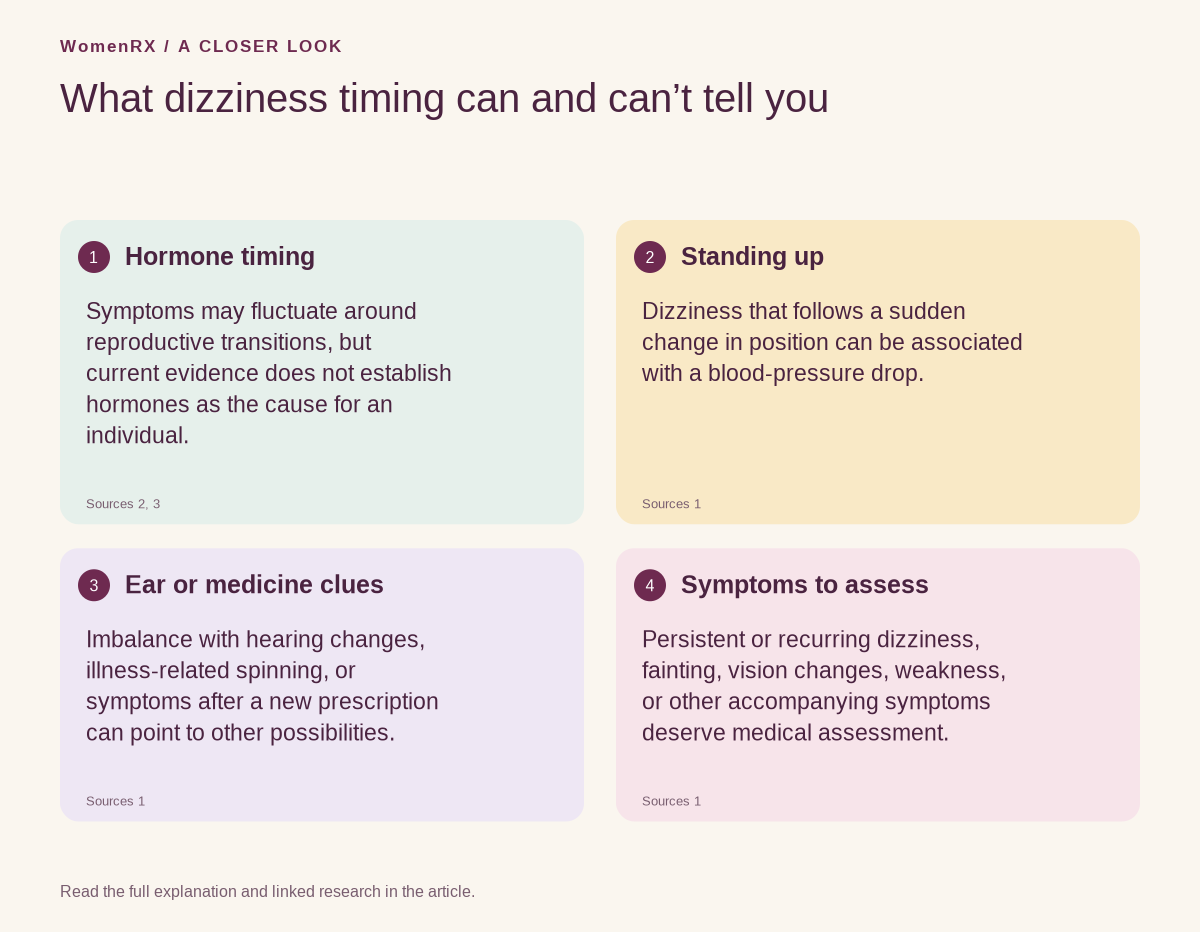
What dizziness timing can and can’t tell you
Hormone timing: Symptoms may fluctuate around reproductive transitions, but current evidence does not establish hormones as the cause for an individual.23
Standing up: Dizziness that follows a sudden change in position can be associated with a blood-pressure drop.1
Ear or medicine clues: Imbalance with hearing changes, illness-related spinning, or symptoms after a new prescription can point to other possibilities.1
Symptoms to assess: Persistent or recurring dizziness, fainting, vision changes, weakness, or other accompanying symptoms deserve medical assessment.1
Read the figure as text
A cycle or menopause pattern may be relevant, but the sensation, triggers, and accompanying symptoms help keep other explanations in view.- Hormone timing: Symptoms may fluctuate around reproductive transitions, but current evidence does not establish hormones as the cause for an individual.23
- Standing up: Dizziness that follows a sudden change in position can be associated with a blood-pressure drop.1
- Ear or medicine clues: Imbalance with hearing changes, illness-related spinning, or symptoms after a new prescription can point to other possibilities.1
- Symptoms to assess: Persistent or recurring dizziness, fainting, vision changes, weakness, or other accompanying symptoms deserve medical assessment.1
More questions, answered
Should I track dizziness alongside my cycle?
If you notice a pattern, jot down when it happens, what the dizziness feels like, what you were doing just before it began, and any accompanying symptoms. A record can help describe the pattern, but it can’t by itself identify the cause.
Can dizziness after starting a new medicine be related?
Yes. A side effect of a new prescription medicine is one possible cause of dizziness. Include when you started it and when symptoms began when you describe the pattern. 1
Sources you can check
- Dizziness - NHSAccessed 2026-09-25Return to first citation
- Hormonal Contraception and Vestibular Disorders: A Narrative Review of Clinical Implications, Diagnostic Challenges, and Evidence Gaps.Castillo-Bustamante M, Whelan DM, Martin L. · Cureus · 2026Return to first citation
- Is there any relationship between the menopause transition and dizziness?Mangia LRL, Bittar RSM. · Brazilian journal of otorhinolaryngology · 2026Return to first citation