Dizziness in Perimenopause: Read the Pattern, Not Just the Hormones
Perimenopause may be part of the context, but whether you feel faint, off-balance, or spinning can point toward different next steps.
Dizziness can mean several different things: feeling faint or lightheaded, being unsteady, or feeling that you or the room are spinning. Notice when it happens, what brings it on, and any symptoms in your ears, vision, or elsewhere. Hormonal changes may contribute to vestibular symptoms during the menopause transition, but research is limited, so dizziness shouldn’t automatically be attributed to perimenopause. 1 2
First, name the sensation
“Dizzy” can describe feeling faint, unsteady, or as if you or the room are spinning. These experiences can have different explanations, so the most useful starting point is to describe what you mean as specifically as you can. 1
A few details can make the pattern clearer: Does it start when you stand up, happen with a head movement, or come on without an obvious trigger? Does it last briefly or keep going? Do you also notice nausea, ringing in your ears, changes in hearing or vision, a headache, or weakness? These clues don’t diagnose the cause, but they help distinguish what needs attention.
What the pattern may suggest
A faint or lightheaded feeling after standing can happen with a sudden drop in blood pressure when changing position. If that’s your pattern, note whether it happens after sitting or lying down and whether you feel close to fainting. 1
A spinning sensation, or feeling off-balance with ear symptoms, can point toward an inner-ear problem. Dizziness with nausea after a cold or flu is one pattern associated with labyrinthitis; changes in hearing or ringing in the ears are other details worth mentioning. 1
Dizziness that begins after starting a prescription medicine may be a side effect. Note when you started the medicine and when the dizziness began, and ask the prescriber or pharmacist what to do before changing or stopping it. 1
Repeated episodes without a clear position change deserve attention too, especially if they come with other symptoms. In one cross-sectional study at a specialist clinic, women aged 40 to 65 with recurrent spontaneous vestibular symptoms often reported brief episodes, headaches, and migraine-related symptoms. Because this was a selected clinic group, those findings don’t establish what is causing dizziness for other women. 3
Where perimenopause fits
There is a plausible connection between changing hormone levels and the vestibular system, which helps with balance and spatial orientation. A 2026 review found that hormonal effects are biologically possible, but also concluded that clinical studies are scarce and the details of dizziness during the menopause transition are not well established. Sleep, mood, and cognitive changes may also affect balance or perception, making a direct hormone effect hard to separate. 2
So, a pattern that overlaps with hot flashes or other perimenopause symptoms can be useful context, but it doesn’t prove that hormones are the cause. In a small specialist-clinic study, menopausal symptom scores were associated with dizziness-related handicap, but an association cannot show that one caused the other. 3
Choose a next step based on the pattern
If dizziness is happening now, sit or lie down until it passes, then get up slowly. Move carefully, and don’t drive, climb, or operate machinery while you feel dizzy. 1
If it keeps returning, doesn’t go away, or worries you, arrange medical assessment. Describe the sensation and its timing, and mention any new medicine, ear symptoms, headaches, vision changes, fainting, or changes in your pulse. Dizziness with new weakness or numbness, trouble speaking, double vision, or fainting or collapse needs prompt assessment rather than being assumed to be a menopause symptom. 1
The practical aim isn’t to solve the cause on your own. It’s to give a clear description of what happens, so the next evaluation can focus on the pattern that fits you.
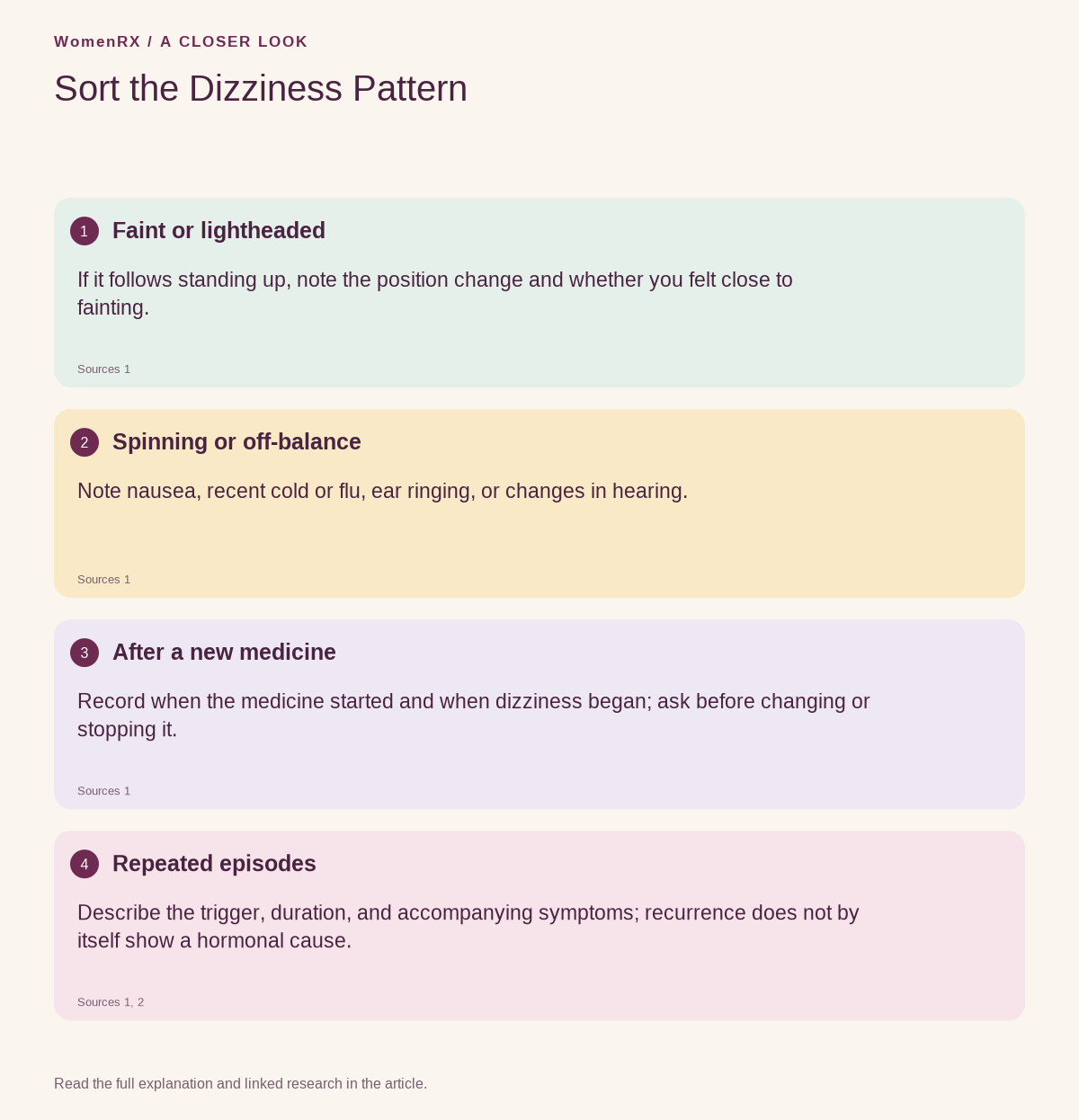
Sort the Dizziness Pattern
Faint or lightheaded: If it follows standing up, note the position change and whether you felt close to fainting.1
Spinning or off-balance: Note nausea, recent cold or flu, ear ringing, or changes in hearing.1
After a new medicine: Record when the medicine started and when dizziness began; ask before changing or stopping it.1
Repeated episodes: Describe the trigger, duration, and accompanying symptoms; recurrence does not by itself show a hormonal cause.12
Read the figure as text
Start with what the sensation feels like, then note its timing and accompanying clues. These patterns can guide a conversation about evaluation but do not diagnose the cause.- Faint or lightheaded: If it follows standing up, note the position change and whether you felt close to fainting.1
- Spinning or off-balance: Note nausea, recent cold or flu, ear ringing, or changes in hearing.1
- After a new medicine: Record when the medicine started and when dizziness began; ask before changing or stopping it.1
- Repeated episodes: Describe the trigger, duration, and accompanying symptoms; recurrence does not by itself show a hormonal cause.12
More questions, answered
Does dizziness mean I’m in perimenopause?
No. Dizziness can occur for many reasons, and current research does not establish it as a reliable sign of perimenopause. Hormonal changes may play a role for some people, but the clinical evidence is limited. 2
What details should I remember about an episode?
Note whether it feels like faintness, imbalance, or spinning; what you were doing when it started; how long it lasted; and any accompanying symptoms such as nausea, ear changes, headache, or vision changes. These details help describe the pattern without trying to diagnose it yourself. 1
Sources you can check
- Dizziness - NHSAccessed 2026-09-25Return to first citation
- Is there any relationship between the menopause transition and dizziness?Mangia LRL, Bittar RSM. · Brazilian journal of otorhinolaryngology · 2026Return to first citation
- Clinical Features of Midlife Women With Isolated Episodic Vestibular Syndrome and Their Relationship With Migraine and Menopause Transition.Mangia LRL, Bittar RSM. · Otology & neurotology : official publication of the American Otological Society, American Neurotology Society [and] European Academy of Otology and Neurotology · 2026Return to first citation