Dizziness in Perimenopause: What the Feeling Can Tell You
Spinning, faintness, and unsteadiness are different sensations, but none can identify the cause by itself.
Dizziness can feel like spinning, like you might faint, or like you’re unsteady. When you notice it, also note what you were doing, how long it lasted, and any other symptoms or recent medication changes. That pattern can help guide an assessment, but the sensation alone can’t confirm a cause or show that hormones are responsible. Sudden or severe dizziness with vision problems, slurred speech, or weakness needs emergency help. 1 3
Start with the sensation, then look at the pattern
People use “dizzy” to describe several feelings. Vertigo is a sensation that you or the room is spinning. Faintness can feel lightheaded or as if you might pass out. Imbalance is feeling unsteady on your feet. Nausea, sweating, trouble walking, or ringing in the ears can happen too. 1
Those descriptions are useful, but they’re not a diagnosis. A recent interdisciplinary guidance paper says the type of dizziness alone doesn’t reliably reveal its cause or tell whether it’s harmless or serious. 3 Other details can help describe an episode, including whether it happens when you stand or move your head, ear symptoms, and medicines you take. 1 2
Perimenopause may be part of the context you notice, especially if an episode seems to coincide with cycle changes or hot flashes. But that timing doesn’t establish that hormones caused the dizziness, and perimenopause doesn’t rule out other explanations.
Notice what happens before and during an episode
A short record can make the pattern clearer. Write down:
- What it feels like: spinning, faintness, or unsteadiness.
- When it starts and stops: whether it’s a brief spell, keeps returning, or stays present.
- What was happening: for example, standing up, moving your head, walking, or being still. Note what seemed to bring it on, and what only made it worse.
- What came with it: such as nausea, ringing in the ears, changes in hearing, vision changes, headache, weakness, or a change in pulse.
- Relevant context: a recent medication start or change, and whether the episode occurred around a cycle change or hot flash.
This is a way to describe what happened, not a test that identifies the cause. Bring it to an assessment: a clinician may ask about your symptoms and medicines. 1 2
Patterns that may help focus an assessment
Feeling faint after standing up suddenly can fit with a drop in blood pressure, while dizziness that begins after starting a prescription medicine may be a side effect. Spinning or imbalance with nausea or ear symptoms may point toward an inner-ear or balance problem. These are examples of patterns to report, not ways to diagnose yourself. 1 2
Repeated spells and dizziness that stays present call for attention to the overall timing and associated symptoms. Some vestibular conditions cause episodic symptoms, while others cause more persistent problems; clinicians may also consider causes outside the balance system. 3
Know when to seek help
Get emergency help for sudden or severe dizziness or vertigo together with vision problems, slurred speech, or weakness. These symptoms can signal a serious problem. 1
Arrange medical assessment if dizziness keeps returning or won’t go away, or if it comes with fainting or collapse, changes in your pulse, hearing or speech problems, ringing in your ears, vision changes, numbness, weakness, headache, or nausea. Those details deserve assessment even when they don’t match the emergency combination above. 2
While you’re dizzy, sit or lie down and move carefully when you get up. Avoid driving or other activities where losing your balance could put you or someone else at risk. 2
Bring your notes and a current medication list to an assessment. The useful question isn’t only “Is this perimenopause?” It’s also “What was the timing, what triggered or worsened it, and what else happened?” That fuller picture can help distinguish possible balance, blood-pressure, medication, and other causes without assuming the answer in advance. 1 3
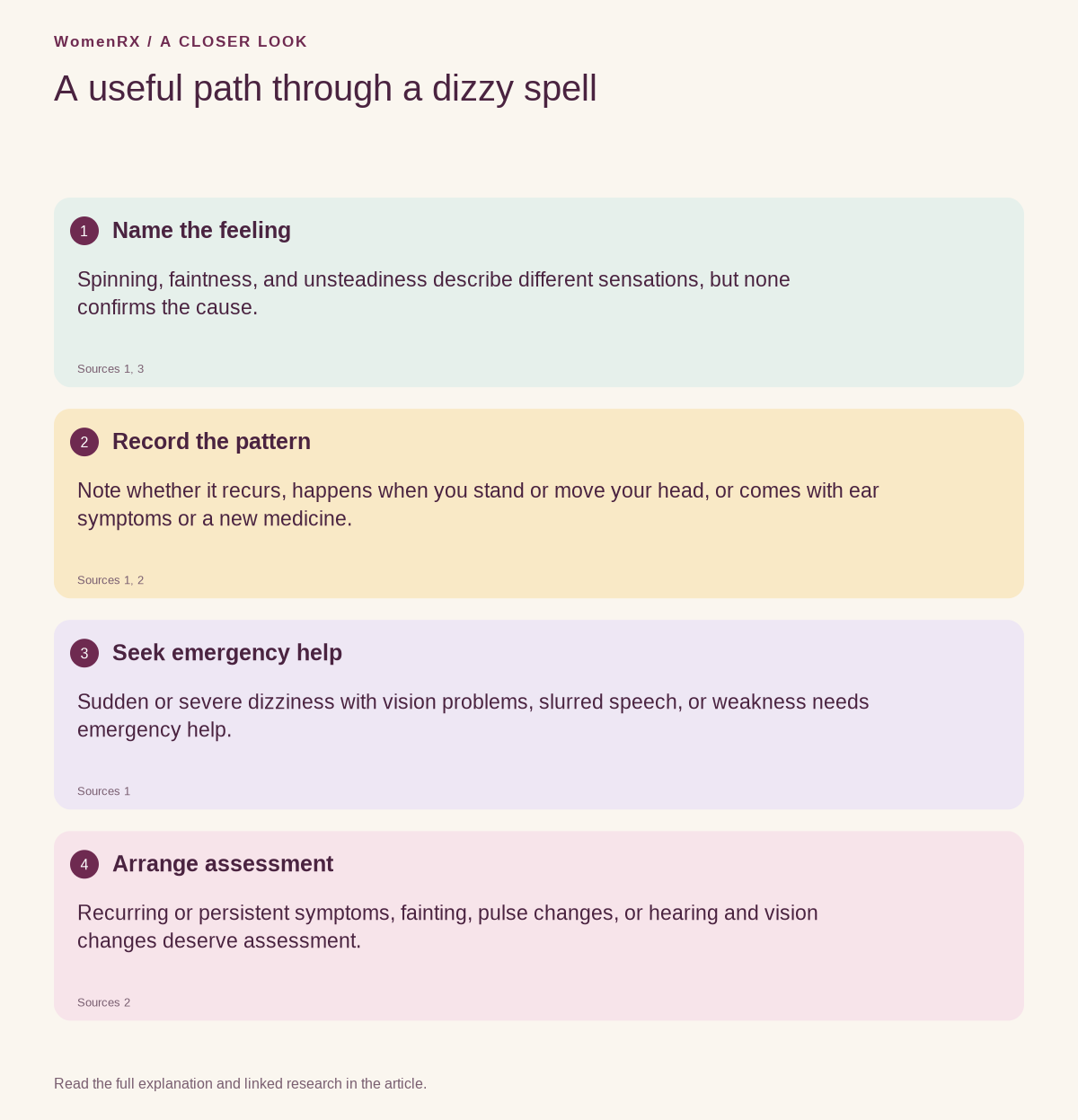
A useful path through a dizzy spell
Name the feeling: Spinning, faintness, and unsteadiness describe different sensations, but none confirms the cause.13
Record the pattern: Note whether it recurs, happens when you stand or move your head, or comes with ear symptoms or a new medicine.12
Seek emergency help: Sudden or severe dizziness with vision problems, slurred speech, or weakness needs emergency help.1
Arrange assessment: Recurring or persistent symptoms, fainting, pulse changes, or hearing and vision changes deserve assessment.2
Read the figure as text
Sort what you felt and what was happening, then use specific warning signs to decide whether to seek emergency help or arrange an assessment.- Name the feeling: Spinning, faintness, and unsteadiness describe different sensations, but none confirms the cause.13
- Record the pattern: Note whether it recurs, happens when you stand or move your head, or comes with ear symptoms or a new medicine.12
- Seek emergency help: Sudden or severe dizziness with vision problems, slurred speech, or weakness needs emergency help.1
- Arrange assessment: Recurring or persistent symptoms, fainting, pulse changes, or hearing and vision changes deserve assessment.2
More questions, answered
Does dizziness by itself mean perimenopause is the cause?
No. A pattern that seems to coincide with cycle changes or hot flashes is worth recording, but timing alone doesn’t establish the cause. Dizziness can have vestibular, blood-pressure, medication-related, and other explanations. 1 2 3
Sources you can check
- Dizziness | Vertigo | MedlinePlusAccessed 2026-09-25Return to first citation
- Dizziness - NHSAccessed 2026-09-25Return to first citation
- Diagnosis and treatment of vertigo and dizziness : Interdisciplinary guidance paper for clinical practice.Tarnutzer AA, Kerkeni H, Diener S, Kalla R, Candreia C, Piantanida R, Maire R, Welge-Lüssen A, Budweg J, Zwergal A, Dlugaiczyk J. · HNO · 2025Return to first citation