Dizzy? Start With What the Feeling Is Like
Spinning, feeling faint, and feeling unsteady point toward different questions, while certain accompanying symptoms call for emergency help.
First, describe the feeling: Is the room spinning, do you feel close to fainting, or are you unsteady on your feet? Notice whether it starts when you stand, move your head, or begin a medicine. Those clues help guide an assessment, but they don’t diagnose the cause. Sudden or severe dizziness with vision problems, slurred speech, or weakness needs emergency help.25
First, name the sensation
“Dizzy” can mean several things. You might feel as if you or the room is spinning, feel lightheaded and close to fainting, or feel off-balance when you walk. The distinction helps you explain what’s happening, but it isn’t a diagnosis on its own.25
Before sorting through possible causes, check for a more urgent combination: Get emergency help for sudden or severe dizziness or vertigo accompanied by vision problems, slurred speech, or weakness. Don’t assume spinning means it’s harmless or that new dizziness is simply hormonal.5
If you’re dizzy right now, lie down until it passes, then get up slowly. Avoid driving, climbing a ladder, or using machinery while you feel unsteady.2
If you feel faint, notice what happens when you stand
Lightheadedness, sometimes with vision changes, can be presyncope: the feeling that you might faint. Fainting itself means briefly losing consciousness. A drop in blood pressure when you stand or sit up suddenly is one possible explanation for posture-related dizziness; dehydration and some medicines are other possibilities. The timing is a clue, not a way to tell which one is responsible.23
For example, “I feel faint just after getting out of bed, and it settles when I lie back down” tells a different story from “the room spins when I turn my head.” If you actually faint, an assessment can help establish what happened. Evaluation of a fainting episode typically includes a history, examination, blood pressure measurements with position changes, and an electrocardiogram.3
If things spin or your balance feels off
A sensation of motion or spinning is called vertigo. Inner-ear problems are among its possible causes. Changes in head position may be worth mentioning; so are nausea, hearing changes, or ringing in an ear. Feeling off-balance with hearing loss or ringing can also point toward an inner-ear problem, but symptoms alone don’t identify which one.25
Migraine, an ear infection, and other conditions can also be associated with dizziness. If it keeps coming back, doesn’t go away, or comes with hearing changes, an assessment can look beyond the word “dizzy” to your hearing, balance, walking, medicines, and other symptoms.25
Bring bleeding and medicines into the picture
If you have heavy periods, mention them when describing lightheadedness, especially if you also feel unusually tired or short of breath. Heavy menstrual bleeding can contribute to anemia, and anemia can cause dizziness. A blood test, rather than the feeling alone, is used to diagnose it.1
The timing of a new medicine matters too. Dizziness can be a medicine side effect. For example, studies of gabapentin used for hot flashes in women reported more dizziness or unsteadiness with gabapentin than with placebo. That doesn’t mean a medicine is the cause of your symptoms, but it makes the start of treatment a useful detail to share.24
Menopause may be part of the context in which dizziness appears, particularly if you’ve started a treatment for hot flashes. It shouldn’t replace a look at the sensation, its timing, bleeding, medicines, and accompanying symptoms.124
Put the clues into one clear description
A useful description joins the feeling to its trigger and what happened next: “I nearly faint when I stand up,” “I feel spinning when I move my head,” or “I’m unsteady and my hearing has changed.” Add when it began, whether it recurs, and whether you fainted. Persistent or recurring dizziness, fainting, hearing or vision changes, or other new symptoms deserve assessment even when the emergency signs above aren’t present.235
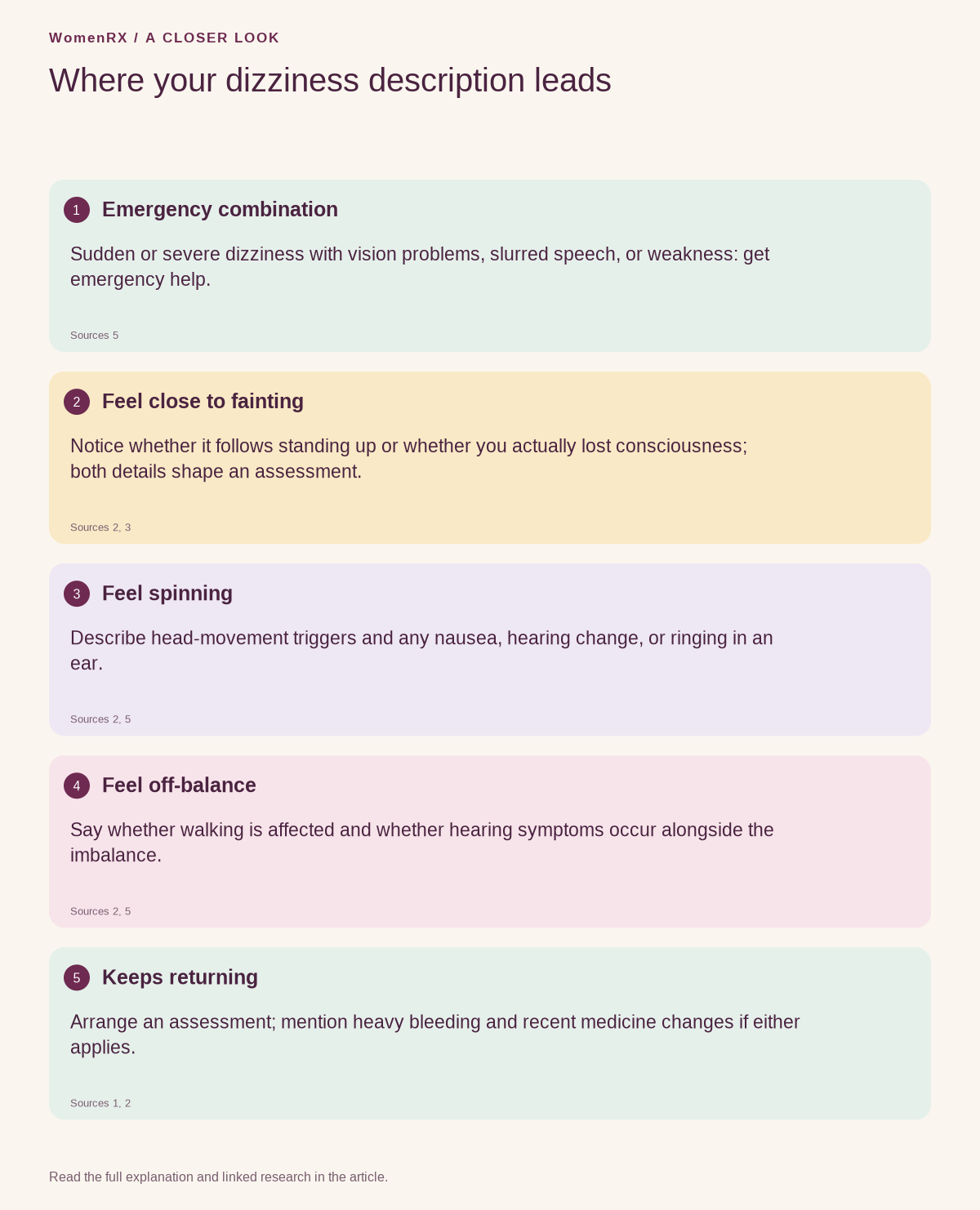
Where your dizziness description leads
Emergency combination: Sudden or severe dizziness with vision problems, slurred speech, or weakness: get emergency help.5
Feel close to fainting: Notice whether it follows standing up or whether you actually lost consciousness; both details shape an assessment.23
Feel spinning: Describe head-movement triggers and any nausea, hearing change, or ringing in an ear.25
Feel off-balance: Say whether walking is affected and whether hearing symptoms occur alongside the imbalance.25
Keeps returning: Arrange an assessment; mention heavy bleeding and recent medicine changes if either applies.12
Read the figure as text
Start with urgent accompanying symptoms, then describe the sensation and its timing. These routes organize a conversation, not a self-diagnosis.- Emergency combination: Sudden or severe dizziness with vision problems, slurred speech, or weakness: get emergency help.5
- Feel close to fainting: Notice whether it follows standing up or whether you actually lost consciousness; both details shape an assessment.23
- Feel spinning: Describe head-movement triggers and any nausea, hearing change, or ringing in an ear.25
- Feel off-balance: Say whether walking is affected and whether hearing symptoms occur alongside the imbalance.25
- Keeps returning: Arrange an assessment; mention heavy bleeding and recent medicine changes if either applies.12
More questions, answered
Can heavy periods make me dizzy?
They can contribute to anemia, which can cause dizziness along with symptoms such as tiredness or shortness of breath. Heavy periods and dizziness don’t prove anemia; blood tests help determine whether it’s present.1
Is spinning the same as feeling faint?
No. Spinning is vertigo, a sensation of motion. Feeling faint is lightheadedness or presyncope and may include vision changes. Tell the person assessing you which feeling fits, even if you’ve experienced both.35
Sources you can check
- Anemia | MedlinePlusAccessed 2026-09-25Return to first citation
- Dizziness - NHSAccessed 2026-09-25Return to first citation
- Cardiovascular Signs and Symptoms: Syncope and Presyncope.Laurie A, Greenberg J, Greenberg J. · FP essentials · 2026Return to first citation
- Gabapentin for the treatment of hot flashes in women with natural or tamoxifen-induced menopause: a systematic review and meta-analysis.Toulis KA, Tzellos T, Kouvelas D, Goulis DG. · Clinical therapeutics · 2009Return to first citation
- Dizziness | Vertigo | MedlinePlusAccessed 2026-09-25Return to first citation