Dizzy on a GLP-1? Start With the Pattern
The timing and accompanying symptoms can help separate a possible blood-pressure change, low intake, low glucose, or a medication side effect.
Dizziness doesn’t automatically mean your blood sugar is low. Notice whether it starts when you stand, during nausea or vomiting, or with symptoms such as shaking, and check glucose if you have diabetes and a meter or monitor. GLP-1 medicines can be associated with dizziness, but low blood sugar is more of a concern when certain other diabetes medicines are also involved. Don’t change your medicines on your own. 1 2 4
Dizziness can mean feeling faint, off-balance, or as if the room is spinning. Those sensations don’t all point to the same cause. A useful first step is to notice what was happening just before it began, rather than assuming the GLP-1 medicine itself caused it. 2
Start with what the dizziness feels like
If you feel lightheaded or close to fainting just after standing, a temporary drop in blood pressure is one possibility. If the main feeling is spinning or being off-balance, that’s a different pattern. Dizziness can also be a medication side effect, so its timing in relation to starting or changing a prescription is useful context, but it doesn’t prove the medicine is the cause. 2
GLP-1 medicines can be associated with dizziness. A review of these medicines lists dizziness among reported adverse effects, and a meta-analysis of randomized trials in women with polycystic ovary syndrome (PCOS) reported more dizziness with GLP-1 treatment than with its comparison groups. That PCOS finding doesn’t tell us how often dizziness occurs for all women using these medicines, or whether women overall have a different risk than men. 3 4
If you feel sick or are eating less
Nausea and vomiting are among the adverse effects reported with GLP-1 medicines. If you’re sick, eating less, or struggling to keep food down, mention that when you report dizziness. Low carbohydrate intake and being sick and unable to eat enough can contribute to low blood glucose in people at risk. 1 5
If you feel dizzy, sit or lie down until it passes, then get up slowly. Avoid driving or doing something hazardous while you’re unsteady. These steps can lower the chance of a fall; they don’t identify the underlying cause. 2
When checking glucose may help
GLP-1 medicines affect blood glucose, but they don’t make every episode of dizziness a low-glucose episode. The overall risk of low blood sugar with GLP-1 medicines is generally low; it can be more relevant when treatment also includes insulin or certain other diabetes medicines that lower glucose. Eating too little carbohydrate, extra physical activity, or being sick and unable to eat can also contribute. 1 4
If you have diabetes and use a glucose meter or continuous glucose monitor, follow your existing plan for checking when you feel symptoms that could be low blood sugar, such as shaking. A reading below 70 mg/dL is a common threshold for many people with diabetes, but your personal threshold may differ. For mild or moderate low blood glucose, carbohydrate can help; follow the plan you’ve agreed on for treating it. 1
Don’t reduce, skip, or otherwise adjust your GLP-1 medicine or another diabetes medicine based on dizziness alone. Repeated low readings or symptoms are a reason to contact your prescriber to review your overall treatment plan. 1
A quick cause-check
- Starts on standing: A blood-pressure drop is one possibility. Move slowly, and tell your clinician if it keeps happening. 2
- Happens during nausea, vomiting, or poor intake: Describe whether you’ve been able to eat and keep food down. Illness and too little carbohydrate can matter for glucose in people at risk. 1 5
- Comes with shaking or a low glucose reading: Follow your diabetes team’s plan for a low, and report repeated episodes. 1
- Keeps returning or doesn’t fit these patterns: Dizziness can have other causes, including medication effects and inner-ear problems. Get medical advice rather than trying to diagnose it from the symptom alone. 2 4
If someone loses consciousness, get emergency help: severe low blood glucose can cause passing out or coma. If dizziness keeps returning or comes with fainting, get medical advice. 1 2
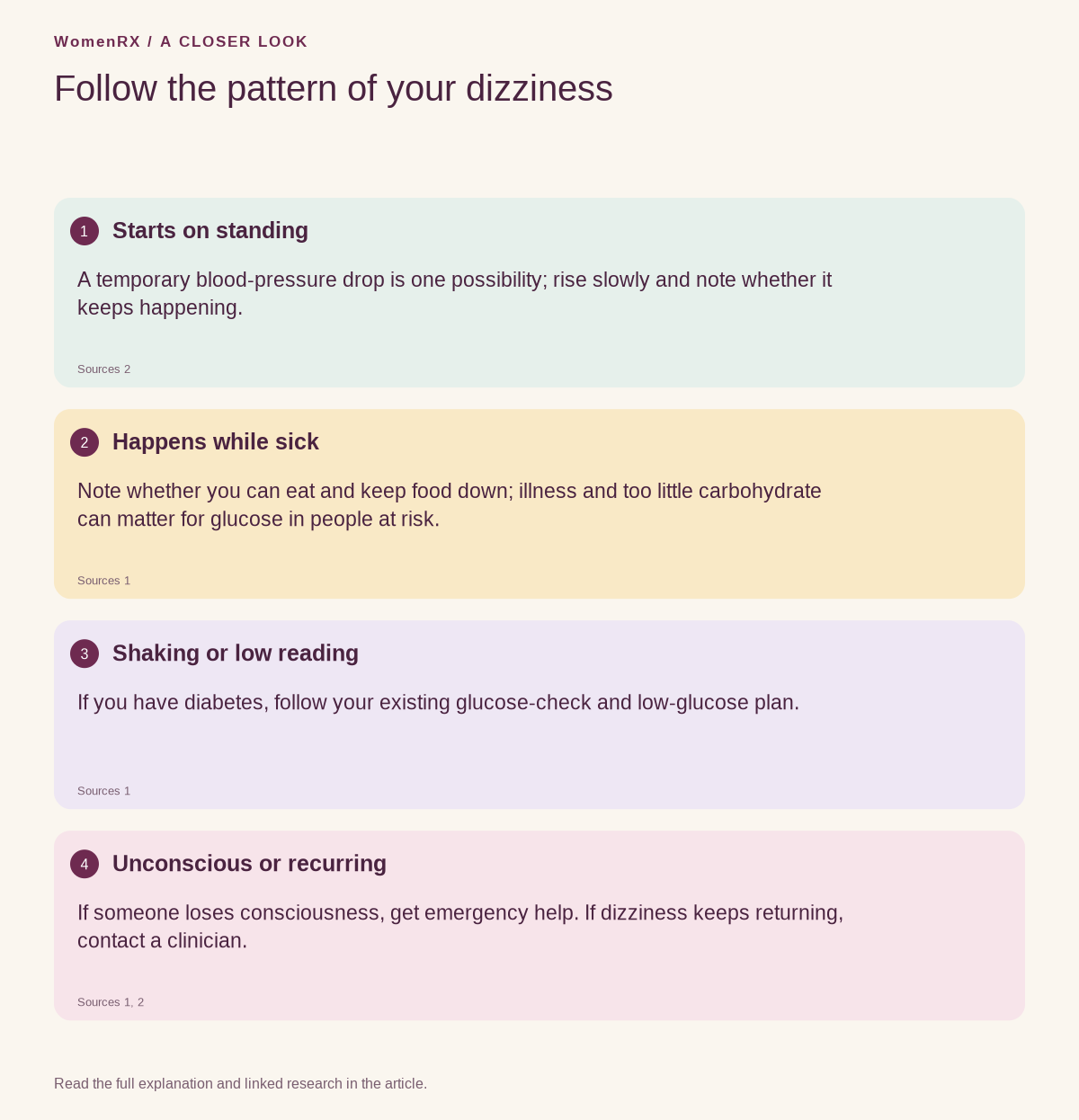
Follow the pattern of your dizziness
Starts on standing: A temporary blood-pressure drop is one possibility; rise slowly and note whether it keeps happening.2
Happens while sick: Note whether you can eat and keep food down; illness and too little carbohydrate can matter for glucose in people at risk.1
Shaking or low reading: If you have diabetes, follow your existing glucose-check and low-glucose plan.1
Unconscious or recurring: If someone loses consciousness, get emergency help. If dizziness keeps returning, contact a clinician.12
Read the figure as text
Use the timing and accompanying symptoms to decide what information may help explain an episode. This flow helps organize observations; it does not diagnose the cause.- Starts on standing: A temporary blood-pressure drop is one possibility; rise slowly and note whether it keeps happening.2
- Happens while sick: Note whether you can eat and keep food down; illness and too little carbohydrate can matter for glucose in people at risk.1
- Shaking or low reading: If you have diabetes, follow your existing glucose-check and low-glucose plan.1
- Unconscious or recurring: If someone loses consciousness, get emergency help. If dizziness keeps returning, contact a clinician.12
More questions, answered
Does dizziness mean my blood sugar is low?
No. Dizziness has several possible causes. A glucose reading, when checking is part of your diabetes plan, can help distinguish a low from other explanations. 1 2
Should I stop my GLP-1 medicine if I feel dizzy?
Dizziness alone doesn’t identify the cause. Don’t change your GLP-1 medicine or other diabetes medicines on your own; contact your prescriber if it keeps happening or you’re having low glucose readings. 1 2
Sources you can check
- Hypoglycemia: MedlinePlusAccessed 2026-09-25Return to first citation
- Dizziness - NHSAccessed 2026-09-25Return to first citation
- Efficacy and safety of GLP-1 receptor agonists on weight management and metabolic parameters in PCOS women: a meta-analysis of randomized controlled trials.Lin S, Deng Y, Huang J, Li M, Sooranna SR, Qin M, Tan B. · Scientific reports · 2025Return to first citation
- The pharmacologic basis for clinical differences among GLP-1 receptor agonists and DPP-4 inhibitors.Morales J. · Postgraduate medicine · 2011Return to first citation
- Changes in Glucagon-Like Peptide-1 Receptor Agonist (GLP-1 RA) Exposures Following Recent Demand for Weight Management: A Retrospective Review of California Poison Control System Data.Ho RY, Regelman H, Ma A, Lee SY, Sandhu S, Shapiro S, Lewis J, Tsutaoka B, Apollonio DE. · The Journal of pharmacy technology : jPT : official publication of the Association of Pharmacy Technicians · 2025Return to first citation