Heartburn on a GLP-1: What to Notice
Heartburn can happen during GLP-1 treatment, and its pattern may help you decide what to try and what to discuss with your prescriber.
If you notice burning while taking a GLP-1 medication, note when you took the medication, when the burning started, and whether meals or lying down make it worse. Timing can describe a pattern, but it can’t prove the medication caused it. Smaller meals may help with ordinary reflux. Contact your prescriber if familiar heartburn keeps returning or worsens. Get emergency help for sudden chest discomfort that doesn’t go away, spreading pain, or chest pain with sweating or shortness of breath.15
First, notice what the burning is like
Heartburn is a burning feeling in the middle of the chest caused by stomach acid coming up toward the throat. A sour taste can come with it. Reflux symptoms are often worse after eating, lying down, or bending over. Those clues are useful, but they don’t prove that every episode of chest discomfort is reflux.15
GLP-1 treatment may be part of the picture. In a large study of adults with type 2 diabetes, reflux and esophagitis diagnoses were more common after people started a GLP-1 medication than after they started a different diabetes medication called an SGLT2 inhibitor. That comparison shows an association, not that the medication caused an individual person’s symptoms.3
The research also depends on how heartburn is measured. An analysis of adverse-event reports from three countries found more reports of reflux with GLP-1 medications than with a comparison class of diabetes drugs. Reporting patterns can flag a concern, but they cannot tell you how likely you are to develop reflux. In a much smaller review of studies involving people with type 2 diabetes fasting during Ramadan, heartburn risks were similar between treatment groups; that finding applies to a specific fasting population.24
Look for a pattern you can use
For a few episodes, jot down what you ate and roughly when, when you took your GLP-1 medication, and when the burning started. Note whether it changed when you lay down or bent over. Include the medication’s name and whether the symptoms began or changed around a treatment change. For example, burning that repeatedly follows dinner and gets worse when you lie down gives you a different starting point for discussion than discomfort with no clear meal pattern.1 The timing you record can help you describe a pattern, but it cannot show that a dose caused the burning.
This record isn’t a test for whether the medication caused heartburn. Reflux can have other contributors, including pregnancy, a hiatal hernia, and medicines such as anti-inflammatory pain relievers. If one of those applies to you, include it when you describe the pattern. Don’t stop a prescribed medicine on your own because you suspect it’s contributing.1
Try a modest change, then reassess
If the symptoms feel like your usual, mild reflux, smaller, more frequent meals are one practical adjustment to try. If lying down brings on the burning, raising the head of the bed may help; piling on extra pillows isn’t the same adjustment and can put more pressure on your belly. These are general reflux measures, not proven ways to prevent GLP-1-related heartburn.1
If heartburn keeps happening, a pharmacist can help you consider whether a reflux remedy is appropriate. Bring your medication list and symptom pattern, rather than assuming you need to add another medicine indefinitely. Recurring or worsening symptoms deserve a discussion with your prescriber, who can consider the symptom alongside your treatment and other possible causes.13
Know when the pattern calls for care
Contact your prescriber if familiar heartburn keeps returning or gets worse, even after practical changes. If chest discomfort is new or unfamiliar, get medical advice rather than treating it as your usual reflux based on a meal pattern. Get emergency help now for sudden chest pain or discomfort that does not go away, pain that spreads to an arm, neck, jaw, stomach, or back, or chest pain with sweating, nausea, lightheadedness, or shortness of breath. A heart problem can feel like burning or indigestion.15
It’s unclear whether reflux risk with GLP-1 treatment differs by sex. One adverse-event study analyzed sex subgroups but did not report those results in its published summary.2
Pregnancy is a separate reason reflux can occur. If you’re pregnant, include that context when you describe your symptoms rather than assuming they’re due to the medication.1
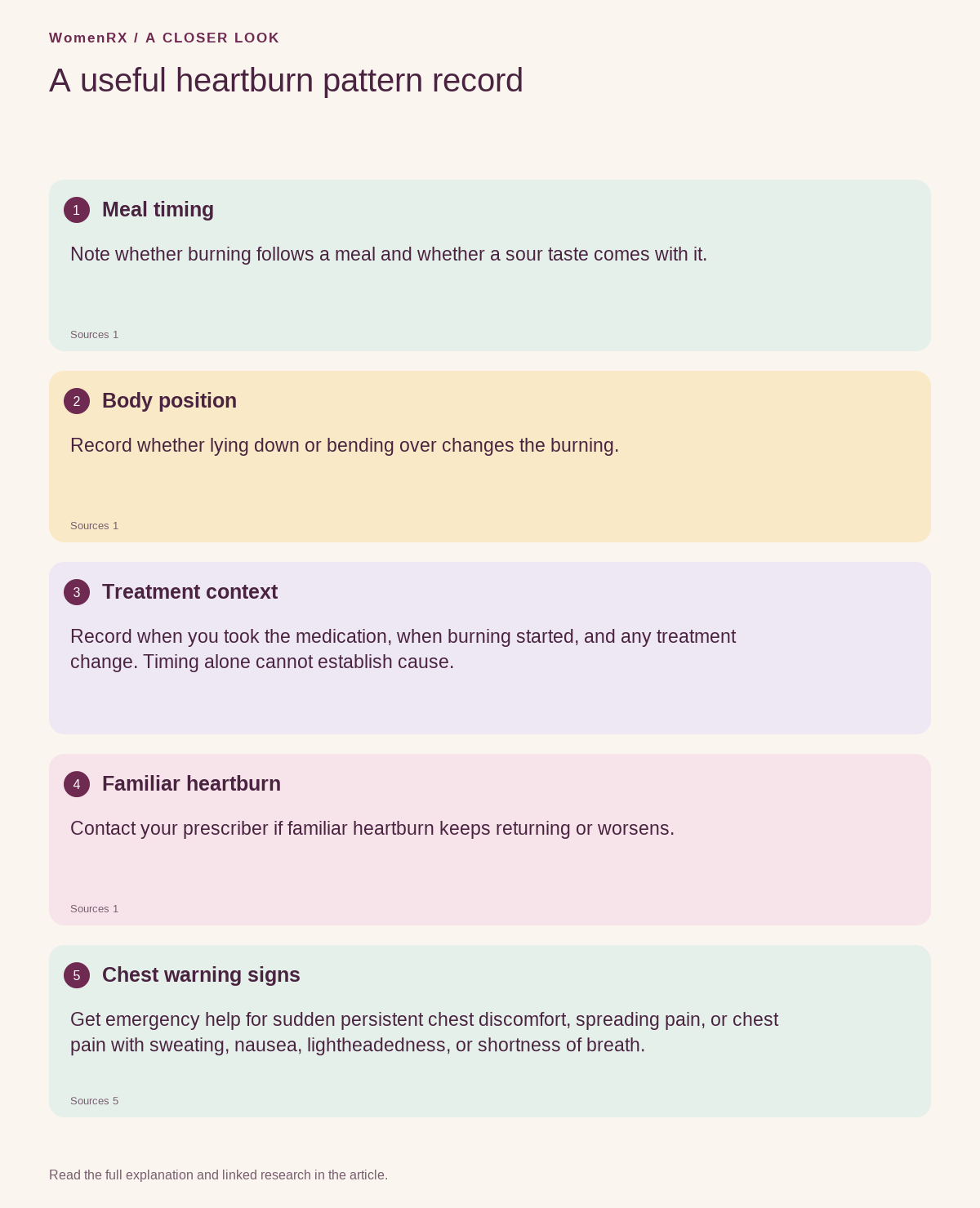
A useful heartburn pattern record
Meal timing: Note whether burning follows a meal and whether a sour taste comes with it.1
Body position: Record whether lying down or bending over changes the burning.1
Treatment context: Record when you took the medication, when burning started, and any treatment change. Timing alone cannot establish cause.
Familiar heartburn: Contact your prescriber if familiar heartburn keeps returning or worsens.1
Chest warning signs: Get emergency help for sudden persistent chest discomfort, spreading pain, or chest pain with sweating, nausea, lightheadedness, or shortness of breath.5
Read the figure as text
These notes can make recurring symptoms easier to describe without treating the record as a diagnosis.- Meal timing: Note whether burning follows a meal and whether a sour taste comes with it.1
- Body position: Record whether lying down or bending over changes the burning.1
- Treatment context: Record when you took the medication, when burning started, and any treatment change. Timing alone cannot establish cause.
- Familiar heartburn: Contact your prescriber if familiar heartburn keeps returning or worsens.1
- Chest warning signs: Get emergency help for sudden persistent chest discomfort, spreading pain, or chest pain with sweating, nausea, lightheadedness, or shortness of breath.5
Sources you can check
- Heartburn and acid reflux - NHSAccessed 2026-09-25Return to first citation
- Multi-Database Pharmacovigilance Analysis of Gastroesophageal Reflux Disease Associated with GLP-1 Receptor Agonists: A Cross-National Signal Validation Study.Choi JG, Gong EJ, Bang CS, Lee JJ. · Gut and liver · 2026Return to first citation
- Downstream Treatment Burden and Health-Care Utilization Following Initiation of GLP-1 Receptor Agonists or SGLT2 Inhibitors in Type 2 Diabetes.Alhamdan Y, Hsu JC, Lu CY. · Diabetes, obesity & metabolism · 2026Return to first citation
- Safety and efficacy of glucagon-like peptide-1 receptor agonists in individuals with type 2 diabetes mellitus fasting during Ramadan: a systematic review and meta-analysis.Kamrul-Hasan ABM, Pappachan JM, Ashraf H, Nagendra L, Dutta D, Kuchay MS, Shaikh S. · World journal of methodology · 2025Return to first citation
- Chest pain - NHSAccessed 2026-09-25Return to first citation