Heartburn on GLP-1 Medicines: What Deserves a Closer Look
An occasional burning sensation can happen for many reasons; how often it returns and what comes with it help determine the next step.
Heartburn is a burning symptom, not by itself a diagnosis of reflux disease. A GERD adverse event was reported more often with liraglutide (Saxenda) than placebo in adult trial data, but a separate review of people with type 2 diabetes fasting during Ramadan reported similar heartburn risks with GLP-1 medicines and comparison treatments. Track when it happens and seek assessment for frequent symptoms, trouble swallowing, repeated vomiting, or unexplained weight loss. 123
A symptom, not a diagnosis
Heartburn is a burning feeling in the chest that can happen when stomach contents move up toward the throat. It may come with a sour taste, and it often feels worse after eating, when lying down, or when bending over. Occasional heartburn doesn’t automatically mean you have gastroesophageal reflux disease (GERD). When reflux keeps happening, it may be diagnosed as GERD. 1
That distinction matters on a GLP-1 medicine. A burning episode is worth noticing, but it doesn’t prove the medicine caused it or that you have a reflux disorder. Other factors may be involved, and the symptom pattern helps make the discussion more useful.
What the medicine evidence can tell you
Heartburn or reflux symptoms are possible during treatment, but the findings don’t show that they happen to everyone taking a GLP-1 medicine. In clinical-trial data for liraglutide (Saxenda), gastroesophageal reflux disease was reported in 4.7% of adults taking the medicine and 1.7% taking placebo. That is a product-specific trial finding, and a reported GERD adverse event is not the same as counting every episode of heartburn. 2
A systematic review and meta-analysis of four studies, including 754 people with type 2 diabetes who fasted during Ramadan, found similar heartburn risk in GLP-1 medicine users and people taking comparison glucose-lowering treatments. That finding comes from a specific population and setting; it doesn’t settle the question for every medicine or person using one for weight management. Taken together, the findings support paying attention to your own symptoms rather than assuming every burning episode is caused by the drug. 3
The GERD percentages in the cited Saxenda adult adverse-event table are not broken down by sex, so that table cannot show whether the reported rates differed by sex. 2
Notice the pattern, not just the burning
For a few episodes, jot down when the burning starts, how long it lasts, what you were doing or eating beforehand, and whether it comes with a sour taste, nausea, or vomiting. Note whether it tends to follow meals, lying down, or bending over, and when it began in relation to starting or changing treatment. These details can help distinguish an occasional, recognizable pattern from symptoms that are becoming frequent or harder to manage. 1
If symptoms keep returning, share the pattern with the clinician who manages your medication. A pharmacist can also advise on options to ease heartburn. 1
When to get checked
Arrange a medical assessment if heartburn happens most days, isn’t improving with steps you’ve already tried, or comes with food feeling stuck in your throat, frequent vomiting, or weight loss you can’t explain. These symptoms deserve a closer look rather than being written off as an expected medication effect. 1
Severe or persistent abdominal pain, especially if it spreads to your back and occurs with or without nausea or vomiting, is different from ordinary heartburn. Liraglutide prescribing information identifies this pattern as a possible sign of acute pancreatitis, which needs prompt medical assessment. 2
You don’t have to decide on your own whether the medicine is responsible. A clear account of how often the burning happens, what seems to bring it on, and what else you’re experiencing gives your care team a better starting point.
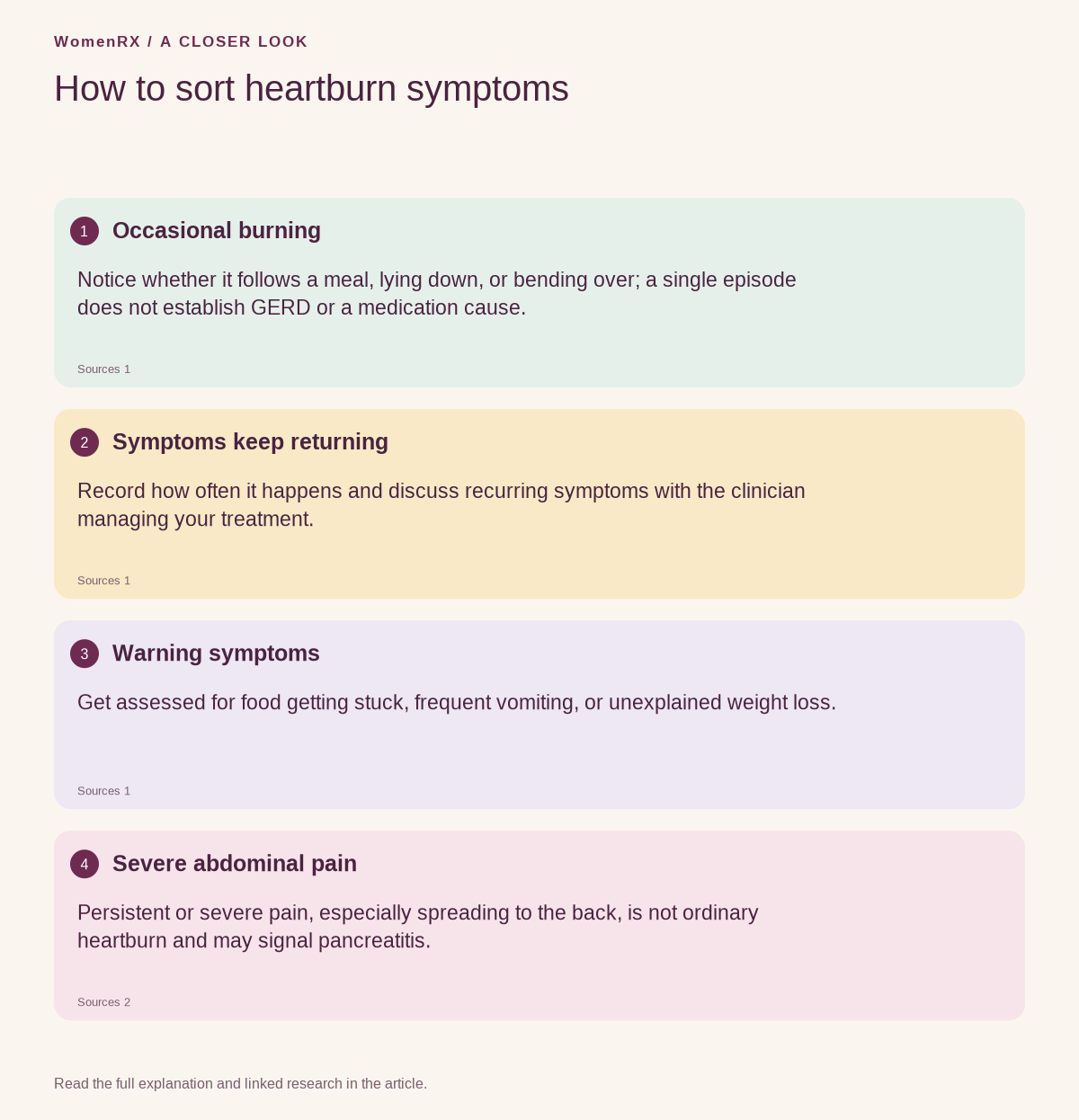
How to sort heartburn symptoms
Occasional burning: Notice whether it follows a meal, lying down, or bending over; a single episode does not establish GERD or a medication cause.1
Symptoms keep returning: Record how often it happens and discuss recurring symptoms with the clinician managing your treatment.1
Warning symptoms: Get assessed for food getting stuck, frequent vomiting, or unexplained weight loss.1
Severe abdominal pain: Persistent or severe pain, especially spreading to the back, is not ordinary heartburn and may signal pancreatitis.2
Read the figure as text
Use the symptom pattern to distinguish occasional burning from symptoms that deserve assessment; this is a practical guide, not a diagnostic tool.- Occasional burning: Notice whether it follows a meal, lying down, or bending over; a single episode does not establish GERD or a medication cause.1
- Symptoms keep returning: Record how often it happens and discuss recurring symptoms with the clinician managing your treatment.1
- Warning symptoms: Get assessed for food getting stuck, frequent vomiting, or unexplained weight loss.1
- Severe abdominal pain: Persistent or severe pain, especially spreading to the back, is not ordinary heartburn and may signal pancreatitis.2
Sources you can check
- Heartburn and acid reflux - NHSAccessed 2026-09-25Return to first citation
- SAXENDA (LIRAGLUTIDE) INJECTION, SOLUTION [NOVO NORDISK PHARMACEUTICAL INDUSTRIES, LP] | US prescribing information and patient instructionsAccessed 2026-09-25Return to first citation
- Safety and efficacy of glucagon-like peptide-1 receptor agonists in individuals with type 2 diabetes mellitus fasting during Ramadan: a systematic review and meta-analysis.Kamrul-Hasan ABM, Pappachan JM, Ashraf H, Nagendra L, Dutta D, Kuchay MS, Shaikh S. · World journal of methodology · 2025Return to first citation