Heartburn on GLP-1 Medicines: Patterns and Chest Pain
A new burning feeling after meals may be reflux; tracking its timing can help, but persistent heartburn and concerning chest pain need different responses.
New heartburn during GLP-1 treatment could be related to your medicine, but the timing alone doesn’t prove it. Notice when the burning happens, what you ate, and whether it began around a medication change. Arrange an assessment if heartburn persists or worsens. Get immediate help for chest pain that doesn’t go away, especially with breathlessness, sweating, or pain spreading to your arm or jaw. 2315
Why the timing can be a clue
Heartburn is a burning feeling in the chest or throat when stomach acid backs up into the esophagus. It may come with a bitter taste or the sense that food or liquid is coming back up. Studies have linked GLP-1 receptor agonists with reflux-related reports and diagnoses. That makes a connection with new reflux symptoms plausible, particularly if the change is noticeable around meals, but it doesn’t establish the cause in any one person. 4523
There’s evidence worth taking seriously, with a limit worth understanding. An analysis of adverse-event reports from the US, Japan, and Canada found that reports of gastroesophageal reflux disease were disproportionately associated with GLP-1 receptor agonists compared with reports involving a different diabetes-drug class. Reporting signals can flag a possible problem; they cannot tell you how often reflux occurs among everyone taking these medicines or prove that a medicine caused a particular episode. A separate study of adults with type 2 diabetes found more reflux diagnoses after people started a GLP-1 medicine than after they started an SGLT2 inhibitor, but that observational comparison cannot settle the cause for an individual. 23
Other explanations can overlap. Pregnancy, certain foods, alcohol, and some other medicines can bring on heartburn. You might also have had occasional reflux before starting treatment. Looking for a pattern is more useful than assuming every burning sensation has one cause. 41
Make the pattern easy to describe
For a few episodes, jot down what actually happened rather than trying to keep a perfect food log. Note when the burning started, whether it followed a meal, what you ate or drank, and whether it happened after lying down or during the night. Record when your GLP-1 treatment started or changed, along with any nausea or vomiting. For example, you may notice burning mainly after one particular dinner, or you may find that it began around a medication change regardless of the meal. These notes are a practical way to describe your symptoms to your prescriber, not a diagnostic test.
If symptoms tend to wake you at night, raising the head of the bed so your chest and head are above your waist may help reduce reflux. If you notice a particular food or drink repeatedly precedes the burning, you can consider whether avoiding that trigger helps. Don’t stop a prescribed medicine on your own to test the theory. 14
Short-term heartburn remedies are another conversation to have with a pharmacist or your care team, especially if you’re pregnant. Antacids and alginates can ease symptoms, but they don’t resolve the underlying problem and aren’t meant to become a long-term substitute for finding out why heartburn keeps happening. 1
When heartburn or chest pain needs care
Arrange a medical assessment if heartburn is happening most days, continues despite changes that usually help, or is getting worse. Tell the clinician prescribing your GLP-1 medicine about the timing and any accompanying nausea or vomiting. Persistent reflux can affect the esophagus, and a medication change should not be the only explanation considered. 143
Chest discomfort isn’t always reflux, even if it feels like burning or indigestion. Get immediate emergency help for sudden chest pain or discomfort that doesn’t go away, especially if it feels like pressure, spreads to an arm, neck, jaw or back, or comes with sweating, lightheadedness or shortness of breath. Don’t wait to see whether a reflux remedy works. 5
The reflux-reporting analysis does not establish whether GLP-1-related reflux is more or less likely in women. If you’re pregnant, pregnancy itself is another possible contributor to heartburn, not evidence that the medicine has a pregnancy-specific reflux effect. 24
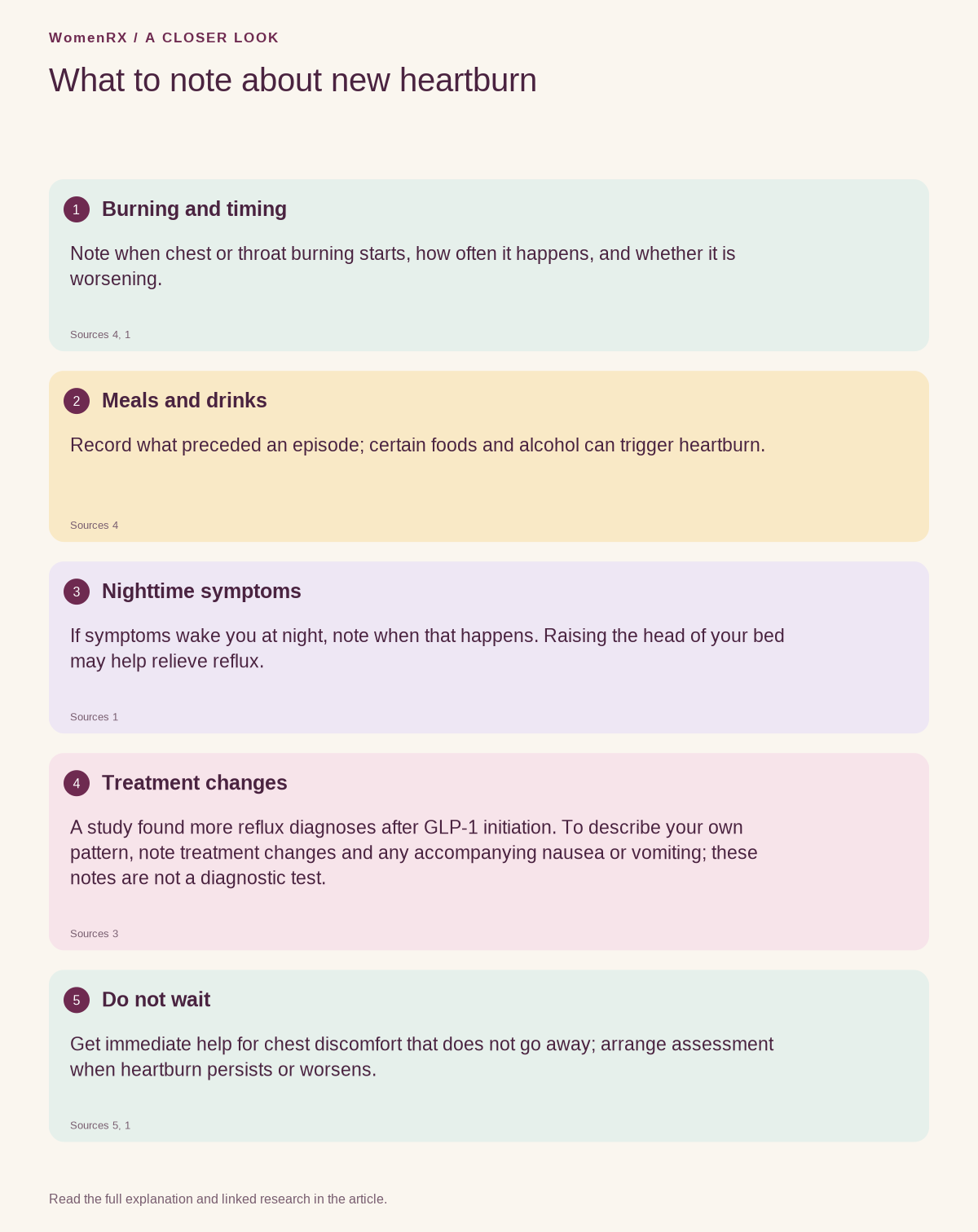
What to note about new heartburn
Burning and timing: Note when chest or throat burning starts, how often it happens, and whether it is worsening.41
Meals and drinks: Record what preceded an episode; certain foods and alcohol can trigger heartburn.4
Nighttime symptoms: If symptoms wake you at night, note when that happens. Raising the head of your bed may help relieve reflux.1
Treatment changes: A study found more reflux diagnoses after GLP-1 initiation. To describe your own pattern, note treatment changes and any accompanying nausea or vomiting; these notes are not a diagnostic test.3
Do not wait: Get immediate help for chest discomfort that does not go away; arrange assessment when heartburn persists or worsens.51
Read the figure as text
A brief record can separate the burning itself from possible meal, nighttime, and treatment patterns; it is not a diagnostic test.- Burning and timing: Note when chest or throat burning starts, how often it happens, and whether it is worsening.41
- Meals and drinks: Record what preceded an episode; certain foods and alcohol can trigger heartburn.4
- Nighttime symptoms: If symptoms wake you at night, note when that happens. Raising the head of your bed may help relieve reflux.1
- Treatment changes: A study found more reflux diagnoses after GLP-1 initiation. To describe your own pattern, note treatment changes and any accompanying nausea or vomiting; these notes are not a diagnostic test.3
- Do not wait: Get immediate help for chest discomfort that does not go away; arrange assessment when heartburn persists or worsens.51
Sources you can check
- Heartburn and acid reflux - NHSAccessed 2026-09-25Return to first citation
- Multi-Database Pharmacovigilance Analysis of Gastroesophageal Reflux Disease Associated with GLP-1 Receptor Agonists: A Cross-National Signal Validation Study.Choi JG, Gong EJ, Bang CS, Lee JJ. · Gut and liver · 2026Return to first citation
- Downstream Treatment Burden and Health-Care Utilization Following Initiation of GLP-1 Receptor Agonists or SGLT2 Inhibitors in Type 2 Diabetes.Alhamdan Y, Hsu JC, Lu CY. · Diabetes, obesity & metabolism · 2026Return to first citation
- Heartburn | Pyrosis | MedlinePlusAccessed 2026-09-25Return to first citation
- Chest pain - NHSAccessed 2026-09-25Return to first citation