Headaches on GLP-1 Medicines: What to Notice and When to Act
A headache after a new dose may be related to your medicine, but the timing is only one clue.
Headache has been reported with GLP-1 medicines, but a headache after starting or increasing one isn’t proof that the medicine caused it. Note when it began, whether you’ve been eating or drinking less, and any other symptoms. Contact your prescriber if headaches keep returning or worsen. Tell your healthcare provider about a sudden, severe headache; certain accompanying signs need immediate help. 735
Start with what changed, not an assumed cause
If your headache began soon after you started a GLP-1 medicine or increased its dose, write down the timing. Headache has been described as a possible adverse effect of GLP-1 receptor agonists. But a dose change and a headache can happen close together without one necessarily causing the other. 7
Look at the rest of the day, too. Liraglutide, for example, reduces calorie intake, and GLP-1 medicines can cause digestive symptoms. 6 Record whether you’ve felt too nauseated to eat, have been vomiting, or have had diarrhea. Those details matter when you describe the headache, but they don’t prove the medicine caused the symptoms or the pain.
Separate possible contributors
Food and fluids. Missing meals is associated with tension headaches. Dehydration means you’re losing more fluid than you take in; thirst and dizziness are possible signs. Vomiting or diarrhea can make it harder to keep up with fluids. If you feel sick but can drink, small sips may be easier than trying to drink a lot at once. None of these clues means every headache on a GLP-1 medicine is caused by dehydration or too little food. 312
Your usual headache pattern. Too little sleep and stress are also associated with tension headaches. Notice whether this pain resembles a headache you’ve had before or feels distinctly different. General headache measures, such as drinking water, avoiding skipped meals, making room for rest, and easing stress, may help with ordinary contributors. They aren’t a proven way to prevent a medicine-related headache. 35
Other changes in your life or treatment. Note any other medicines you take and recent changes to them. If your headaches usually follow a menstrual pattern, record where you are in your cycle. If you’re pregnant or postpartum, include that context when describing a new headache. These details help you compare patterns; they don’t establish that a GLP-1 medicine affects headaches differently in women.
For an ordinary headache, avoid long stretches of screen-related eye strain and avoid sleeping more than you usually do; both can make headaches worse. 9
Make a record that answers a useful question
You don’t need an elaborate diary. For each headache, jot down:
- When it began, how long it lasted, whether the pain came on suddenly or built gradually, and whether it feels different from your usual headaches.
- The medicine name, when you took it, and any recent dose change.
- Nausea, vomiting, diarrhea, thirst, dizziness, vision changes, fever, or neck stiffness.
- Whether you ate or drank less than usual, plus sleep and stress if either seems relevant.
After a few entries, you may be able to ask a more specific question: Does the headache repeatedly follow treatment timing? Does it coincide with days when nausea keeps you from eating? Or does it resemble your established headache pattern? A record can make a conversation more useful, but it cannot diagnose the cause. You don’t need to finish one before asking for help.
If headaches keep returning, get worse, or don’t improve, contact your prescriber to review the pattern and your treatment. Mention it sooner if vomiting or diarrhea is making it difficult to drink. Don’t change a prescription based on a diary alone. Regular or worsening headaches warrant medical review, and dehydration can become serious if fluid losses continue. 512
Don’t wait on a warning sign
Get emergency medical help for a headache that starts suddenly and is extremely painful, or a headache with a seizure, weakness or numbness, difficulty speaking or walking, confusion, unusual drowsiness, or loss of vision. A headache after a head injury in the past three months also needs emergency care. Very high fever, a stiff neck, or sensitivity to bright light are further emergency warning signs. Don’t drive yourself. 9
A headache with vomiting or other vision or eye problems needs urgent assessment, even when it does not match an emergency sign above. Don’t assume these symptoms are an expected medicine effect or wait to complete a diary. 9
If you’ve been unable to keep up with fluids and become confused, get emergency medical help. Confusion can signal severe dehydration; you don’t need to work out the cause before seeking help. 19
Reading headache reports carefully
One study analyzed Facebook posts about GLP-1 medicines. Among 4,202 posts referencing tirzepatide, 78 mentioned headache. That is a count of posts, not a rate among people taking the medicine: one person may post more than once, and the study can’t establish whether the medicine caused a reported headache. The reported findings don’t establish whether headache experiences differ by sex. 4
What if you’ve heard GLP-1 medicines can help headaches?
Some research has found better headache outcomes among people treated with GLP-1 medicines for idiopathic intracranial hypertension (IIH), a specific condition that can cause headaches and vision problems. In a small, open-label study of 39 people with IIH, most of whom were women, monthly headache days fell more in the group choosing a GLP-1 medicine than in the usual-care group over six months. That finding doesn’t mean these medicines treat ordinary headaches or rule out a possible adverse effect in someone taking one for another reason. 8
Research discussed here doesn’t establish that women have a different rate of medication-related headache. Your own cycle or life-stage context may still be useful to share, especially when the headache is new or unlike your usual pattern.
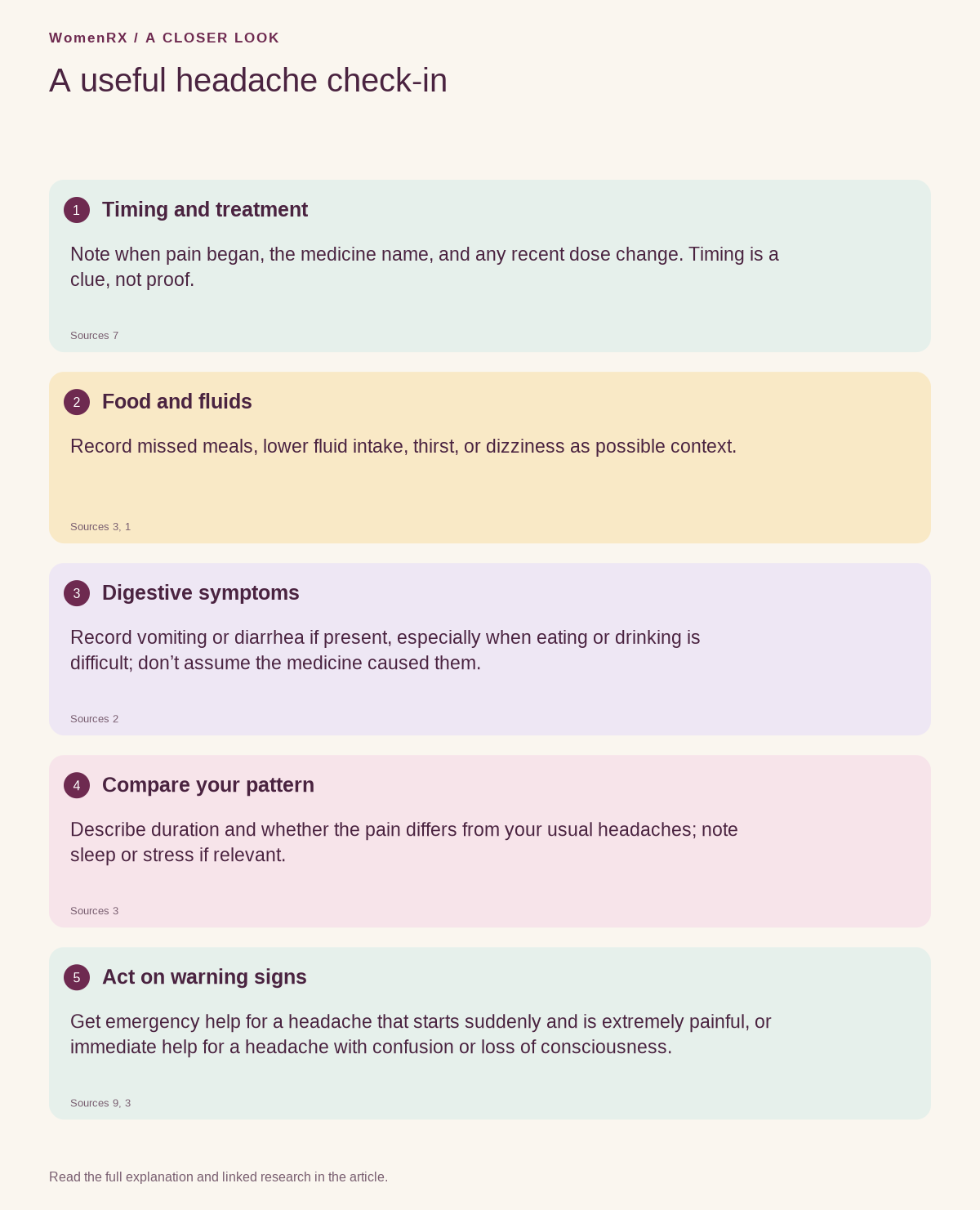
A useful headache check-in
Timing and treatment: Note when pain began, the medicine name, and any recent dose change. Timing is a clue, not proof.7
Food and fluids: Record missed meals, lower fluid intake, thirst, or dizziness as possible context.31
Digestive symptoms: Record vomiting or diarrhea if present, especially when eating or drinking is difficult; don’t assume the medicine caused them.2
Compare your pattern: Describe duration and whether the pain differs from your usual headaches; note sleep or stress if relevant.3
Act on warning signs: Get emergency help for a headache that starts suddenly and is extremely painful, or immediate help for a headache with confusion or loss of consciousness.93
Read the figure as text
Record the pattern without treating the checklist as a test for what caused the headache.- Timing and treatment: Note when pain began, the medicine name, and any recent dose change. Timing is a clue, not proof.7
- Food and fluids: Record missed meals, lower fluid intake, thirst, or dizziness as possible context.31
- Digestive symptoms: Record vomiting or diarrhea if present, especially when eating or drinking is difficult; don’t assume the medicine caused them.2
- Compare your pattern: Describe duration and whether the pain differs from your usual headaches; note sleep or stress if relevant.3
- Act on warning signs: Get emergency help for a headache that starts suddenly and is extremely painful, or immediate help for a headache with confusion or loss of consciousness.93
More questions, answered
Does a headache right after a dose mean I should stop the medicine?
Not on timing alone. Note what happened and contact your prescriber if the headache recurs, worsens, or doesn’t improve. Tell your healthcare provider about a sudden, severe headache, and seek immediate help for warning signs such as headache with confusion or a stiff neck. 35
Sources you can check
- Dehydration: MedlinePlusAccessed 2026-09-25Return to first citation
- Dehydration - NHSAccessed 2026-09-25Return to first citation
- Headache | MedlinePlusAccessed 2026-09-25Return to first citation
- Harnessing Facebook to Investigate Real-World Mentions of Adverse Events of Glucagon-Like Peptide-1 Receptor Agonist (GLP-1 RA) Medications: Observational Study of Facebook Posts From 2022 to 2024.Alibilli AS, Jain V, Mane H, Yue X, Ratzki-Leewing A, Merchant JS, Criss S, Nguyen QC, McCoy RG, Nguyen TT. · JMIR infodemiology · 2025Return to first citation
- Headaches - NHSAccessed 2026-09-25Return to first citation
- SAXENDA (LIRAGLUTIDE) INJECTION, SOLUTION [NOVO NORDISK PHARMACEUTICAL INDUSTRIES, LP] | US prescribing information and patient instructionsAccessed 2026-09-25Return to first citation
- Headache and GLP-1 receptor agonists: when medications are therapeutic and when they contribute to the symptom.Ferreira ET, Garcia LMP, Londero RG. · Arquivos de neuro-psiquiatria · 2025Return to first citation
- Treatment with GLP-1 receptor agonists is associated with significant weight loss and favorable headache outcomes in idiopathic intracranial hypertension.Krajnc N, Itariu B, Macher S, Marik W, Harreiter J, Michl M, Novak K, Wöber C, Pemp B, Bsteh G. · The journal of headache and pain · 2023Return to first citation
- HeadachesAccessed 2026-09-25Return to first citation