Perimenopause and Headaches: How to Read a Changing Pattern
Irregular cycles can make menstrual migraine harder to spot, but a headache during perimenopause isn’t automatically caused by hormones.
If a headache is migraine, an attack usually lasts 4 hours to 3 days. 3 Perimenopause may bring more frequent migraine for some women, especially those with menstrual migraine, but hormone changes don’t explain every headache. A diary that lines up headache days with bleeding, symptoms, sleep and medication use can reveal a recurring pattern without proving its cause. 4
Why a familiar migraine pattern can shift
If you’ve had migraines around your period, irregular cycles can make the timing less predictable. A review of research describes migraine as potentially becoming more frequent during perimenopause, particularly menstrual migraine. Fluctuating hormones may affect migraine for some women, but the relationship isn’t fully understood. 4
One proposed explanation is that a drop in estrogen before menstruation can trigger migraine in some people. When cycles become irregular, an attack may no longer arrive on a familiar schedule. That’s a possible explanation for a pattern, not proof that hormones caused an individual headache. 4 6
In a cross-sectional US study of 3,664 women with migraine, 12.2% of perimenopausal participants had at least 10 headache days per month, compared with 8.0% of premenopausal participants. After adjustment for several factors, including depression and medication overuse, perimenopause remained associated with higher odds of frequent headache. The study shows an association, not that perimenopause caused the headaches. 5
Keep a record that separates timing from cause
For each headache, note when it started and ended, how it felt, and whether you had nausea or sensitivity to light or sound. Add bleeding dates, hot flashes, sleep changes, missed meals, stress and medicines taken. A headache or migraine log can help you notice possible triggers and recurring timing. It can’t establish a diagnosis or show that hormones caused the pain. 1 2 3 4
Look across entries rather than treating one coincidence as a pattern. For example, if several headaches occur near bleeding, that timing may be a useful clue, even with irregular cycles. If headaches also happen at other times, or seem to cluster after short sleep or skipped meals, record that too.
Migraine often involves throbbing pain, sometimes on one side, and may come with nausea or sensitivity to light and sound. Tension headaches are another common type; they can involve tight muscles in the neck, shoulders, scalp or jaw, and may be associated with stress or not getting enough sleep. These features can help describe what you’re experiencing, but they don’t diagnose the headache on their own. 1 2
When a change deserves attention
If headaches are recurring, getting worse or becoming difficult to manage, getting the pattern assessed can help clarify what type of headache you have and what options fit. Include how often you take headache medicines in your record, since medication overuse can contribute to headaches. 1 2 3
A sudden, extremely painful headache needs emergency care. Seek immediate medical help for a headache after a blow to the head or with a stiff neck, fever, confusion or loss of consciousness. 1 3
The useful question isn’t whether every headache follows your cycle. It’s whether a repeated pattern is emerging, and whether the headache itself is changing in a way that calls for a closer look.
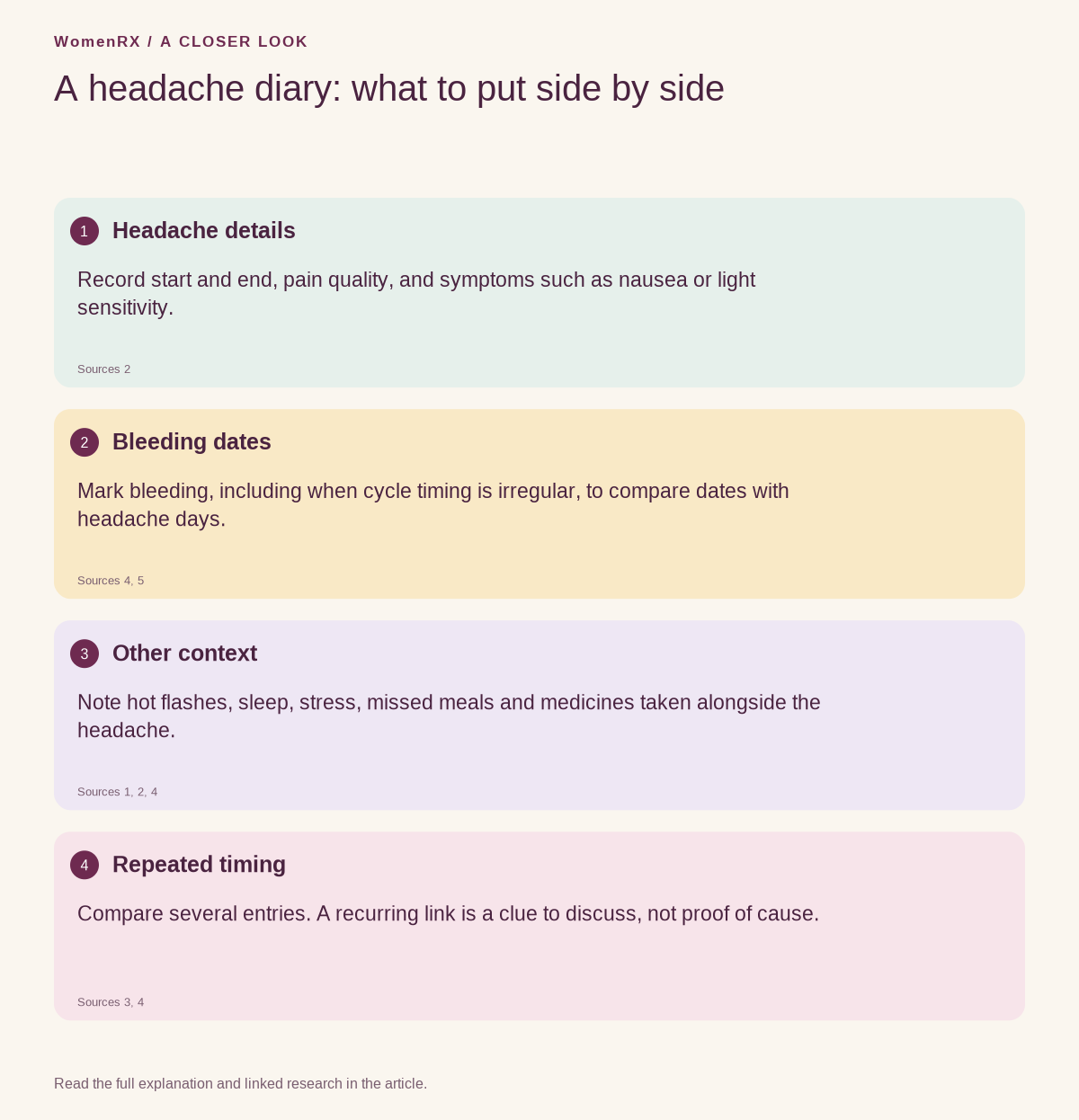
A headache diary: what to put side by side
Headache details: Record start and end, pain quality, and symptoms such as nausea or light sensitivity.2
Bleeding dates: Mark bleeding, including when cycle timing is irregular, to compare dates with headache days.45
Other context: Note hot flashes, sleep, stress, missed meals and medicines taken alongside the headache.124
Repeated timing: Compare several entries. A recurring link is a clue to discuss, not proof of cause.34
Read the figure as text
Record these details for each headache, then look across entries for repeated timing. The checklist helps describe a pattern; it can’t establish a hormonal cause.- Headache details: Record start and end, pain quality, and symptoms such as nausea or light sensitivity.2
- Bleeding dates: Mark bleeding, including when cycle timing is irregular, to compare dates with headache days.45
- Other context: Note hot flashes, sleep, stress, missed meals and medicines taken alongside the headache.124
- Repeated timing: Compare several entries. A recurring link is a clue to discuss, not proof of cause.34
More questions, answered
Does a headache near my period prove hormones caused it?
No. Repeated timing may point to a menstrual connection, but a diary can show a pattern, not prove its cause. Research describes the relationship between menstrual migraine and the menopause transition as incompletely explained. 4
Sources you can check
- Headache | MedlinePlusAccessed 2026-09-25Return to first citation
- Migraine | MedlinePlusAccessed 2026-09-25Return to first citation
- Migraine - NHSAccessed 2026-09-25Return to first citation
- Menopause, Perimenopause, and Migraine: Understanding the Intersections and Implications for Treatment.Waliszewska-Prosół M, Grandi G, Ornello R, Raffaelli B, Straburzyński M, Tana C, Martelletti P. · Neurology and therapy · 2025Return to first citation
- Perimenopause and Menopause Are Associated With High Frequency Headache in Women With Migraine: Results of the American Migraine Prevalence and Prevention Study.Martin VT, Pavlovic J, Fanning KM, Buse DC, Reed ML, Lipton RB. · Headache · 2016Return to first citation
- Migraine headache in perimenopausal and menopausal women.MacGregor EA. · Current pain and headache reports · 2009Return to first citation