Headaches in Perimenopause: Track the Pattern and Know the Red Flags
A flexible headache log can help you compare headaches with bleeding, sleep, and medicines without assuming hormones are the cause.
Migraine can worsen, improve, or stay much the same during perimenopause, and not every headache is hormone-related. Log headache dates, bleeding days, sleep, daily context, and medicines. Arrange routine care for a new or noticeably different pattern that persists or returns, or for headaches that worsen or don’t improve. A sudden, severe headache or one with serious neurologic symptoms needs urgent assessment. 1 2 3 5
Hormone shifts may matter, but they don’t explain every headache
If you’ve had menstrual migraine before, you may notice headaches still cluster around bleeding, even as your periods become less predictable. During perimenopause, migraine can worsen, improve, or stay much the same. Some people are sensitive to a drop in estrogen, but hormone effects vary, and a headache by itself can’t show what your hormone levels are or prove what caused the pain. 5
A headache can also have causes other than migraine or hormones. The useful question is not only “Did this happen near my period?” but also “Is this my familiar pattern, and what else was happening?” 1 5
Hormone treatment isn’t a guaranteed headache fix: the review describes people who don’t get relief and some whose headaches worsen. Don’t treat a headache alone as a reason to start estrogen; whether hormone treatment makes sense depends on your individual situation. 5
Make a log that works with irregular periods
You don’t need to calculate a cycle day if your periods are unpredictable. Instead, write down the date of each headache and mark bleeding days, including spotting if that helps you see your own pattern. After several episodes, you may notice a repeated connection, or none at all. A headache diary may help identify possible triggers, but a pattern is a clue, not proof. 2
Keep the log short enough that you’ll use it. For each headache, note:
- Start and finish: Did it come on suddenly or build over time? How long did it last?
- Bleeding: Was there bleeding, spotting, a delayed period, or no obvious connection?
- Sleep and daily context: Note unusual sleep, stress, missed meals, or other circumstances you want to compare with headache days. These are observations, not proof of a trigger. 2
- Medicines: Record what you took and when. Taking too many pain relievers can itself be associated with headaches. 2
- What felt different: Note whether this was like your usual headache or noticeably different in intensity, duration, or symptoms.
If you’ve had menstrual migraine, recording bleeding days may help show whether headaches still cluster around them as cycles change. If the timing is inconsistent, that doesn’t rule out migraine or prove another cause. 5
Decide whether to keep tracking or arrange care
A new or noticeably different headache pattern is worth discussing in routine care if it persists or returns, even when it doesn’t feel like an emergency. Arrange medical review as well if headaches happen regularly, are getting worse, or aren’t improving. Don’t wait for your log to establish a cycle connection before seeking care. General headache guidance supports review for regular, worsening, or non-improving headaches; it doesn’t make every change an emergency. 1 2
Bring the log if you do make an appointment. It can make it easier to describe how often headaches happen and how they relate, or don’t relate, to bleeding and daily context. The goal is to give a clear picture, not to diagnose yourself from the calendar.
Sudden or neurologically complicated headaches need urgent attention
A severe headache that starts abruptly, reaching its peak very quickly, needs emergency assessment. This kind of headache can have serious causes, including bleeding around the brain, and shouldn’t be attributed to perimenopause or watched at home. 3 4
Get medical help right away for a headache with new focal neurologic symptoms, confusion, loss of consciousness, a stiff neck, or fever, or one that follows a blow to the head. These features call for urgent attention, not more tracking. 1 3
The distinction is practical: a persistent or recurring change without emergency features is a reason to arrange routine review; sudden severe onset or serious accompanying symptoms calls for urgent assessment.
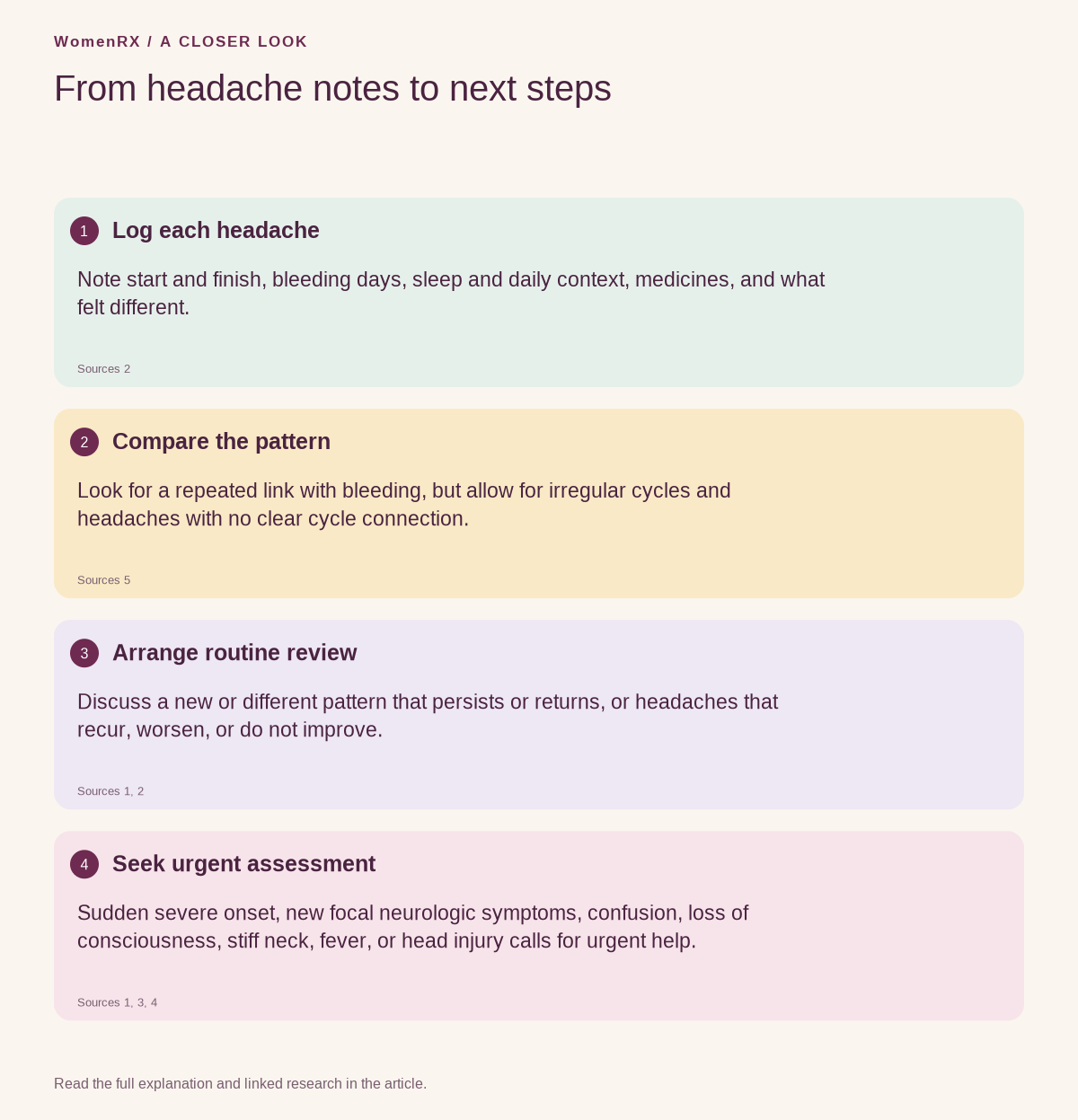
From headache notes to next steps
Log each headache: Note start and finish, bleeding days, sleep and daily context, medicines, and what felt different.2
Compare the pattern: Look for a repeated link with bleeding, but allow for irregular cycles and headaches with no clear cycle connection.5
Arrange routine review: Discuss a new or different pattern that persists or returns, or headaches that recur, worsen, or do not improve.12
Seek urgent assessment: Sudden severe onset, new focal neurologic symptoms, confusion, loss of consciousness, stiff neck, fever, or head injury calls for urgent help.134
Read the figure as text
Use bleeding dates and headache features as context, while letting urgent symptoms take priority over tracking.- Log each headache: Note start and finish, bleeding days, sleep and daily context, medicines, and what felt different.2
- Compare the pattern: Look for a repeated link with bleeding, but allow for irregular cycles and headaches with no clear cycle connection.5
- Arrange routine review: Discuss a new or different pattern that persists or returns, or headaches that recur, worsen, or do not improve.12
- Seek urgent assessment: Sudden severe onset, new focal neurologic symptoms, confusion, loss of consciousness, stiff neck, fever, or head injury calls for urgent help.134
More questions, answered
Does a headache near an irregular period mean my estrogen is low?
No. Hormone fluctuations may affect migraine for some people, but headache timing can’t tell you an estrogen level or prove the cause. Log bleeding and headache dates to see whether a pattern repeats. 5
Should I wait for my diary to show a pattern before getting help?
No. Seek urgent assessment for a sudden, severe headache or one with new focal neurologic symptoms, confusion, loss of consciousness, stiff neck, fever, or a recent head injury. Arrange routine care for a new or different pattern that persists or returns, or for headaches that worsen or don’t improve. 1 2 3 4
Sources you can check
- Headache | MedlinePlusAccessed 2026-09-25Return to first citation
- Headaches - NHSAccessed 2026-09-25Return to first citation
- Thunderclap headache management among Emergency Department visitors in tertiary care center in Makkah City: Retrospective cohort study.Althobaiti FS, Alsharif SY, Alhazmi MA, BinMelieh AH, Almqaiti AA, Alsaedi ZK, Alkhotani AM, Sef BG. · Neurosciences (Riyadh, Saudi Arabia) · 2025Return to first citation
- Evaluating thunderclap headache.Chen CY, Fuh JL. · Current opinion in neurology · 2021Return to first citation
- How Sex Hormones Affect Migraine: An Interdisciplinary Preclinical Research Panel Review.Godley F, Meitzen J, Nahman-Averbuch H, O'Neal MA, Yeomans D, Santoro N, Riggins N, Edvinsson L. · Journal of personalized medicine · 2024Return to first citation