Bloating During Perimenopause: How to Track Patterns and Decide What to Do
A simple record of cycle timing, digestion, and other changes can help you spot a pattern without assuming perimenopause is the cause.
Yes, bloating can occur around menstrual periods and has also been associated with the menopause transition in a longitudinal study. But a cycle connection doesn’t prove the cause, and recurring or persistent bloating shouldn’t automatically be written off as perimenopause. Track when it happens, what else changes, and seek medical assessment if it doesn’t go away or comes with concerning symptoms. 12

First, notice what “bloating” means for you
Bloating can feel like fullness or discomfort in your abdomen. It may come with more gas than usual. Common contributors include gas in the gut, some foods or drinks, and swallowing air while eating. Some people also notice bloating around their period. 1
There’s evidence that bloating can occur during the menopause transition, but it doesn’t show that menopause is the explanation for every new or ongoing episode. In a longitudinal study of 291 women, researchers found an association between early and late menopause-transition stages and greater bloating severity in their multivariable analysis. That finding describes a pattern in a group, not a way to diagnose the cause for an individual. 2
A small questionnaire study of 100 women aged 43 to 53 who visited a university hospital reported abdominal bloating among the prominent premenstrual symptoms. The study’s setting and size limit how much it can tell us about women more broadly. 3
Make a record that shows the pattern
For each episode, jot down a few details. You don’t need to score symptoms or track perfectly. The point is to capture enough context to see whether bloating tends to come at a certain point in your cycle, alongside a bowel change, or after a particular food or drink.
- Timing: Note when the bloating starts and settles, and the dates of any bleeding. If your periods are irregular, record that too.
- Digestion: Describe gas, constipation, diarrhea, or any change in your usual bowel pattern.
- Food and drink: Note what you ate or drank before the episode, including fizzy drinks if relevant. Foods and drinks can contribute to gas for some people. 1
- Other changes: Record discomfort, other symptoms, and any recent medication changes. A record can help you describe what’s happening; it can’t establish what caused it.
Look for repeated timing rather than drawing a conclusion from one episode. Bloating that repeatedly appears around a period is useful context to share, but it doesn’t rule out other explanations. A symptom survey of perimenopausal women found abdominal bloating among reported premenstrual symptoms, but it did not establish why any one participant experienced it. 3
When to get it checked
Arrange medical assessment if you’re often bloated or it doesn’t go away, rather than assuming it’s a menopause symptom. Also seek assessment if it occurs with unintentional weight loss or blood in your stool. 1
Get urgent medical help for bloating with vomiting, abdominal pain, fever, or a significant change such as diarrhea or constipation. Severe, sudden abdominal pain with a swollen abdomen needs emergency attention. 1
Your notes can make the conversation more specific: when the bloating began, how long it lasts, whether it follows your cycle, and what else changes. They’re a record of your experience, not a test that can rule out a medical cause.
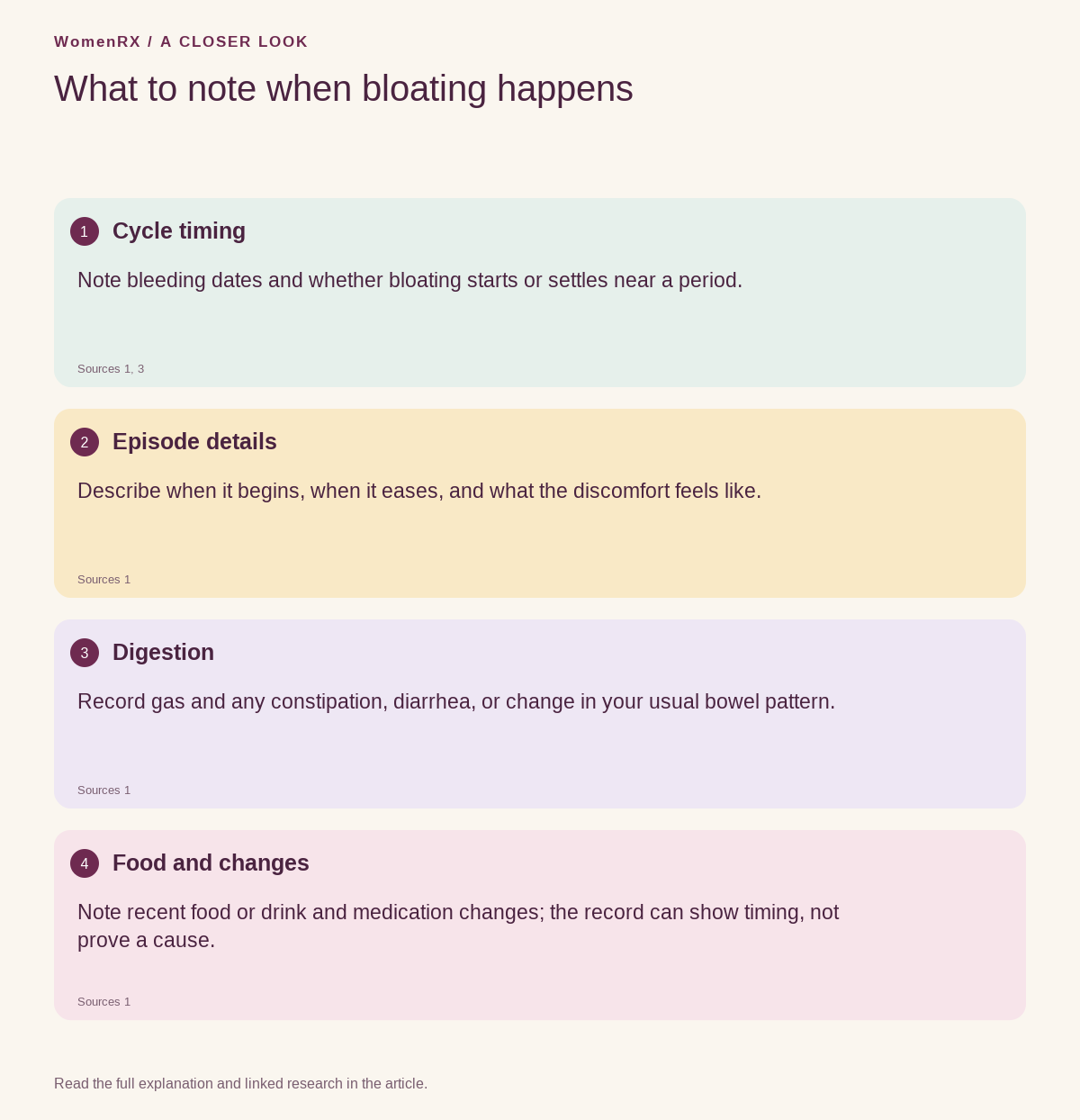
What to note when bloating happens
Cycle timing: Note bleeding dates and whether bloating starts or settles near a period.13
Episode details: Describe when it begins, when it eases, and what the discomfort feels like.1
Digestion: Record gas and any constipation, diarrhea, or change in your usual bowel pattern.1
Food and changes: Note recent food or drink and medication changes; the record can show timing, not prove a cause.1
Read the figure as text
Record a few details each time so you can describe the pattern clearly. This is an observation aid, not a diagnostic checklist.- Cycle timing: Note bleeding dates and whether bloating starts or settles near a period.13
- Episode details: Describe when it begins, when it eases, and what the discomfort feels like.1
- Digestion: Record gas and any constipation, diarrhea, or change in your usual bowel pattern.1
- Food and changes: Note recent food or drink and medication changes; the record can show timing, not prove a cause.1
More questions, answered
If bloating happens before my period, does that mean it’s PMS?
Not by itself. Bloating is reported as a premenstrual symptom, but timing alone doesn’t establish a diagnosis or explain every episode. Notice whether the pattern repeats and mention it if the bloating is persistent or concerning. 13
Sources you can check
- Bloating - NHSAccessed 2026-09-25Return to first citation
- Bloating During the Menopause Transition: Observations from the Seattle Midlife Women's Health Study.Kamp KJ, Callan NGL, Mitchell ES, Heitkemper MM, Woods NF. · Journal of women's health (2002) · 2026Return to first citation
- Premenstrual syndrome and premenstrual dysphoric disorder in perimenopausal women.Chung SH, Kim TH, Lee HH, Lee A, Jeon DS, Park J, Kim Y. · Journal of menopausal medicine · 2014Return to first citation