Breast Pain During Perimenopause: Patterns to Check
Pain that follows a menstrual pattern is different from pain that stays in one spot, and a new lump or other concerning change deserves assessment.
Breast soreness that affects both breasts and eases when your period ends often follows a menstrual pattern. As periods become less predictable near menopause, it may be harder to spot that connection, so note pain and bleeding dates. Pain that doesn’t improve, stays in one spot without a clear cycle connection, or comes with a lump, nipple discharge, redness, heat, or swelling should be assessed. 1 2 4
Start with the pattern, not a guess about hormones
Breast pain can be related to periods, but perimenopause by itself doesn’t explain every new or changing pain. Pain linked to periods often begins in the two weeks before bleeding, builds, then eases when the period ends. It commonly affects both breasts and may extend toward the armpit. 1
As menopause approaches, periods are more likely to become irregular. When bleeding is less predictable, it can be harder to tell whether breast soreness repeatedly comes before a period. That makes a simple record of pain and bleeding dates more useful than relying on memory. This is a way to notice a possible pattern, not proof that hormones are the cause. 1 2
What to note
For a few cycles, record when pain starts and eases, whether it affects one or both breasts, and whether it stays in one spot or spreads. Note when bleeding starts, too. If periods are irregular, the dates may not show a clear connection, and that’s useful information rather than a failed tracking effort. Period tracking can help reveal an irregular pattern. 2
Pain that moves with a period and settles afterward is different from pain that is consistently focused in one area or unrelated to bleeding. A clinician can assess pain that doesn’t improve or remains focused in one area without a clear cycle connection, and decide whether examination or imaging is appropriate. In one retrospective study of 236 women who came to a breast center with pain as their only complaint, imaging found a possible explanation for pain in 7 women with noncyclic, focal pain; one finding was cancer. Most pain had no imaging explanation. This study does not mean focal pain is usually cancer, or that everyone with breast pain needs imaging. 1 4
Know when not to wait for a pattern
Arrange an assessment for a new breast lump. Also seek medical advice if pain is not improving. A lump, persistent pain, or a change in the breast should not simply be attributed to perimenopause. 1 3
Seek urgent medical assessment if breast pain comes with a breast that is red, hot, or swollen, a very high temperature or shivering, a hard lump that does not move, or nipple discharge that may be blood-streaked. 1
Pain by itself is unlikely to be a sign of breast cancer, but that reassurance doesn’t replace checking a new lump or concerning change. 1
If it seems cyclical
A comfortable, well-fitting bra may help. If you use a period app or diary, adding pain dates can make it easier to see whether soreness repeatedly appears before bleeding and eases afterward. 1 2
Not all pain felt in the breast starts in breast tissue. An injury or strain involving the neck, shoulder, or back can be felt as breast pain, and some medicines can contribute. If the pain seems connected to movement or began after an injury, mention that when you describe it; don’t assume it rules out a breast cause. 1
Follow the pain pattern
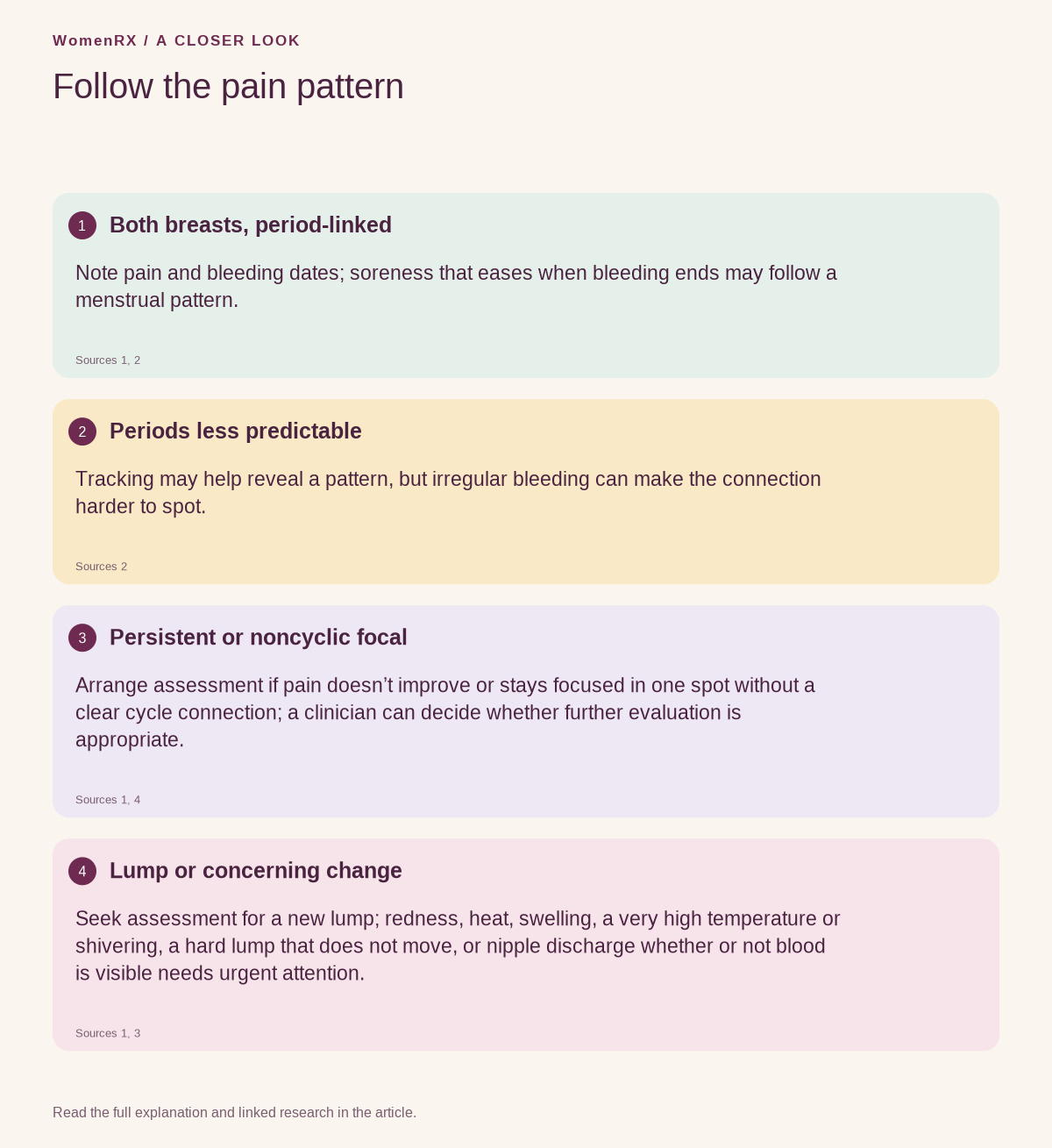
Both breasts, period-linked: Note pain and bleeding dates; soreness that eases when bleeding ends may follow a menstrual pattern.12
Periods less predictable: Tracking may help reveal a pattern, but irregular bleeding can make the connection harder to spot.2
Persistent or noncyclic focal: Arrange assessment if pain doesn’t improve or stays focused in one spot without a clear cycle connection; a clinician can decide whether further evaluation is appropriate.14
Lump or concerning change: Seek assessment for a new lump; redness, heat, swelling, a very high temperature or shivering, a hard lump that does not move, or nipple discharge whether or not blood is visible needs urgent attention.13
Read the figure as text
Use the pattern and any accompanying changes to choose a sensible next step. A possible cycle link does not rule out other causes.- Both breasts, period-linked: Note pain and bleeding dates; soreness that eases when bleeding ends may follow a menstrual pattern.12
- Periods less predictable: Tracking may help reveal a pattern, but irregular bleeding can make the connection harder to spot.2
- Persistent or noncyclic focal: Arrange assessment if pain doesn’t improve or stays focused in one spot without a clear cycle connection; a clinician can decide whether further evaluation is appropriate.14
- Lump or concerning change: Seek assessment for a new lump; redness, heat, swelling, a very high temperature or shivering, a hard lump that does not move, or nipple discharge whether or not blood is visible needs urgent attention.13
More questions, answered
Does breast pain on its own usually mean cancer?
No. Breast pain by itself is unlikely to be a sign of cancer. A new lump, pain that does not improve, or pain with concerning breast changes still needs assessment. 1
What if I can’t see a cycle pattern?
That can happen when periods are irregular, and pain may also have a cause unrelated to the menstrual cycle. Record what you can, but don’t wait for a pattern if the pain doesn’t improve, remains focused in one place without a clear cycle connection, or comes with a lump or other concerning change. 1 2 4
Sources you can check
- Breast pain - NHSAccessed 2026-09-25Return to first citation
- Irregular periods - NHSAccessed 2026-09-25Return to first citation
- Lumps - NHSAccessed 2026-09-25Return to first citation
- Mastalgia: Imaging Work-up Appropriateness.Chetlen AL, Kapoor MM, Watts MR. · Academic radiology · 2017Return to first citation