Hemorrhoids Around Menopause: What May Help
Constipation and straining are worth addressing, but menopause timing alone can’t explain a lump or rectal bleeding.
Hemorrhoids can cause itching, discomfort, bleeding, or a bulge. If hard stools and straining are part of the picture, fiber-rich foods and avoiding long toilet sessions may help. But symptoms alone can’t confirm hemorrhoids. Arrange an assessment for rectal bleeding, a sudden change in bowel habits, or a lump you can’t identify. 4 1 2 3
Menopause is context, not a diagnosis
Itching, discomfort, bleeding, or a bulge near the anus can occur with hemorrhoids, but these symptoms don’t confirm the cause. A lump in this area can have other explanations, including rectal prolapse. Hemorrhoid guidance focuses on symptoms, bowel habits, and examination; menopause timing alone can’t tell you whether a symptom is a hemorrhoid or why it started. 4 3
Constipation occurs across ages. It may involve hard, dry stools, straining, or going less often than usual. You don’t need to have a bowel movement every day, but a change from your usual pattern is worth noticing. 1 2
If you had hemorrhoids during pregnancy, that history may be useful to mention: hemorrhoids are common during pregnancy, and symptoms can persist postpartum. But past pregnancy symptoms don’t establish the cause of a new midlife or postmenopausal symptom. 4
Make bowel movements easier
For mild symptoms that seem consistent with hemorrhoids, start with bowel habits. Fiber-rich foods such as fruits, vegetables, and grains can help prevent constipation; regular activity and making time to go when you feel the urge are useful measures too. For hemorrhoid symptoms, avoid straining and spending a long time on the toilet. 1 4
If constipation continues, ask whether a medicine you take could be contributing. Don’t stop a prescribed medicine on your own; ask your clinician or pharmacist about next steps. MedlinePlus advises using laxatives only if a health care provider says to. 1 2
Warm sitz baths are often suggested for symptom relief, though scientific evidence for their benefit is limited. Topical treatments can also be considered, but evidence that they work is limited. If you use a topical steroid, American Gastroenterological Association advice says not to use it for more than two weeks at a time. 4
Bleeding deserves a separate look
Hemorrhoids can bleed, but seeing blood doesn’t prove that hemorrhoids are the source. Contact a clinician for assessment if you notice blood in your stool, a sudden change in bowel habits, or constipation along with abdominal pain, persistent bloating, fatigue, or unexplained weight loss. These symptoms don’t identify one cause on their own; they’re reasons not to rely on self-diagnosis. 2 4
When hemorrhoids are suspected for the first time, an examination can help confirm the diagnosis. American Gastroenterological Association advice recommends anoscopy, an examination of the anal canal, when possible before treatment. A new or persistent lump also deserves assessment if you’re unsure what it is. 4 3
Pain can be another clue, but it isn’t a diagnosis. Hemorrhoids tend to cause significant pain when a clot forms in one, while sharp pain during a bowel movement is more likely to come from an anal fissure. If pain is severe or continues, get the area assessed rather than trying to identify the cause by symptoms alone. 4
If self-care doesn’t settle it
If symptoms persist, an examination can clarify what’s causing them and which treatment fits. For some internal hemorrhoids, office procedures such as rubber-band ligation or infrared coagulation may be options. The appropriate approach depends on what an examination finds and how the symptoms are affecting you. 4
When describing the problem, be specific about what has changed: whether stools are hard or painful, whether you’re straining, and whether there’s bleeding or a lump. Those details give the clinician a clearer picture than the timing around menopause alone. 2 4
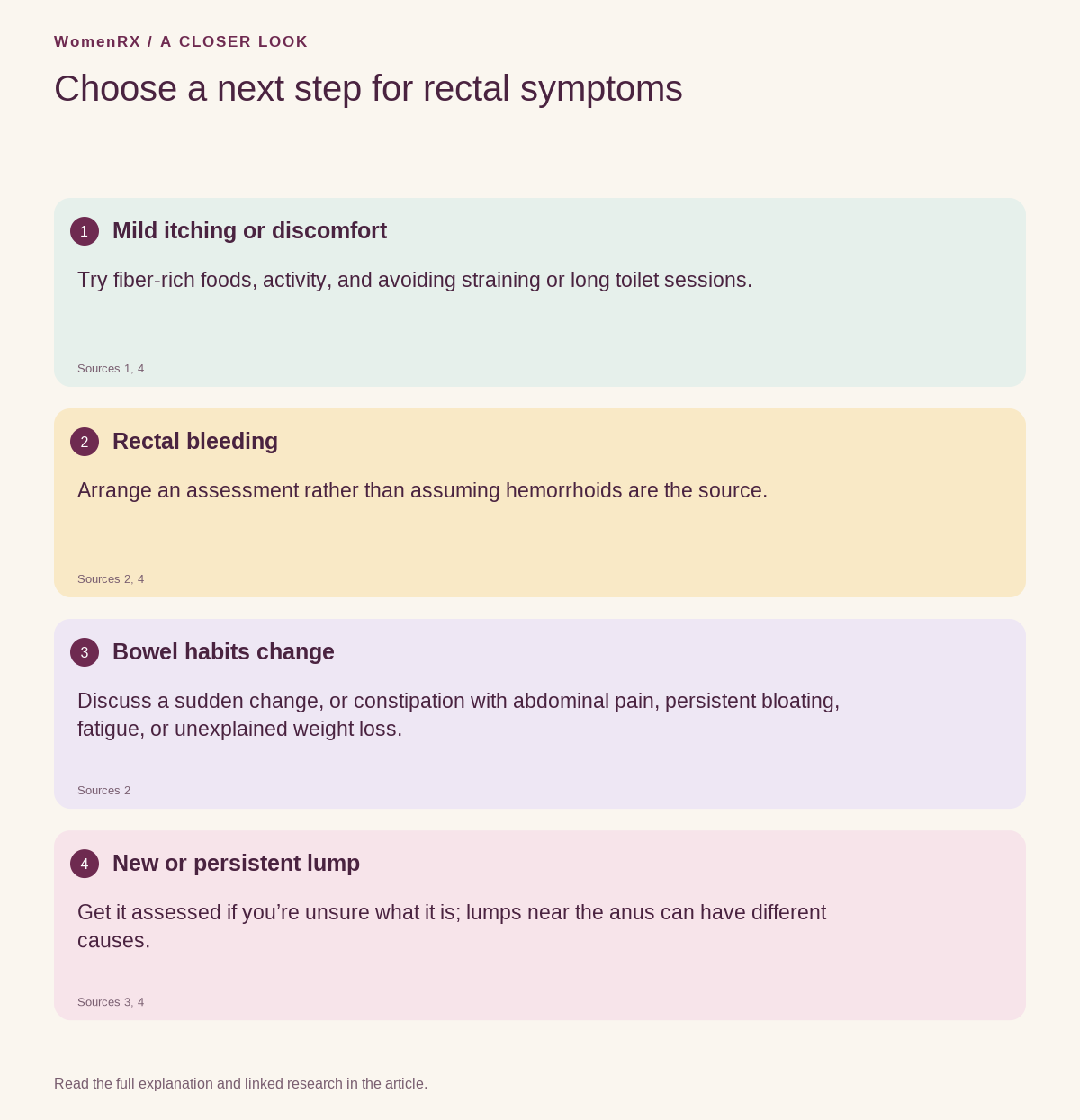
Choose a next step for rectal symptoms
Mild itching or discomfort: Try fiber-rich foods, activity, and avoiding straining or long toilet sessions.14
Rectal bleeding: Arrange an assessment rather than assuming hemorrhoids are the source.24
Bowel habits change: Discuss a sudden change, or constipation with abdominal pain, persistent bloating, fatigue, or unexplained weight loss.2
New or persistent lump: Get it assessed if you’re unsure what it is; lumps near the anus can have different causes.34
Read the figure as text
Symptoms can guide a next step, but they can’t confirm hemorrhoids on their own.- Mild itching or discomfort: Try fiber-rich foods, activity, and avoiding straining or long toilet sessions.14
- Rectal bleeding: Arrange an assessment rather than assuming hemorrhoids are the source.24
- Bowel habits change: Discuss a sudden change, or constipation with abdominal pain, persistent bloating, fatigue, or unexplained weight loss.2
- New or persistent lump: Get it assessed if you’re unsure what it is; lumps near the anus can have different causes.34
More questions, answered
Does menopause itself cause hemorrhoids?
Hemorrhoid guidance doesn’t establish menopause itself as a cause. Constipation and straining are useful factors to address, but a new symptom still needs to be judged on its own rather than attributed to menopause. 4 1
Can I assume bleeding is from hemorrhoids if I feel a lump?
No. Hemorrhoids can cause bleeding and a bulge, but a lump can have other causes and symptoms alone don’t confirm where bleeding comes from. Arrange an assessment for rectal bleeding. 4 3 2
Sources you can check
- Constipation | MedlinePlusAccessed 2026-09-25Return to first citation
- Constipation - NHSAccessed 2026-09-25Return to first citation
- Lumps - NHSAccessed 2026-09-25Return to first citation
- AGA Clinical Practice Update on Diagnosis and Treatment of Hemorrhoids: Expert Review.Qureshi W, Hoang S, Frye J, Rao SS. · Clinical gastroenterology and hepatology : the official clinical practice journal of the American Gastroenterological Association · 2026Return to first citation