Why Alcohol May Feel Different Around Menopause
A drink may coincide with a hot flash, a racing heart, or a rough night’s sleep without meaning menopause has changed how your body processes alcohol.
Yes, alcohol can feel different during perimenopause or after menopause, but that doesn’t establish a new alcohol intolerance. Alcohol may be a personal hot-flash trigger and can raise heart rate, while menopausal hot flashes themselves can bring sweating, palpitations, and disrupted sleep. Research findings on menopausal symptoms and sleep are mixed, and they do not establish that menopause changes alcohol metabolism or tolerance. 6785
A hot flash and a reaction to a drink can look alike
Imagine you have a glass of wine with dinner, feel suddenly hot, then wake up sweaty later. It’s reasonable to wonder whether the wine is affecting you differently. Hot flashes can bring a rush of heat in the face, neck, or chest, sweating, dizziness, anxiety, and a noticeable heartbeat. Night sweats can interrupt sleep. These symptoms can begin in perimenopause and continue after menopause, so their timing can overlap with drinking even when alcohol isn’t the whole explanation. 8
Alcohol is also worth considering as a possible trigger. Menopause guidance suggests reducing potential hot-flash triggers, including alcohol, if you notice a connection. But the research is mixed: a 2026 scoping review of 57 studies found inconsistent results for alcohol and vasomotor symptoms or sleep, and perimenopausal women were underrepresented. That means a pattern you notice matters for your choices, but it isn’t proof that alcohol triggers hot flashes for everyone. 75
Notice what happens, not just when it happens
The symptom can offer a better clue than the phrase “I can’t tolerate alcohol anymore.” Alcohol itself can raise heart rate and blood pressure, so a pounding heartbeat after a drink isn’t necessarily a hot flash. A brief wave of heat with sweating and a noticeable heartbeat could fit a hot flash, whether or not the drink helped set it off. And waking sweaty after drinking could involve a night sweat rather than a distinct reaction to alcohol. These are possibilities, not a way to diagnose the cause at home. 687
Sleep adds another layer. In a study of 239 women ages 40 to 60, poorer sleep quality was associated with later menopause substages, independently of age. The study did not test whether alcohol caused those sleep changes. If your sleep is already unsettled, a bad night after a drink may feel especially striking without telling you exactly what caused it. 2
What about tolerance, medicines, or something else?
Feeling worse after your usual drink is real, but it doesn’t by itself show that menopause has slowed alcohol metabolism. Research on alcohol, menopausal symptoms, and sleep has produced mixed findings. Those findings do not establish that menopause changes alcohol metabolism or tolerance. Alcohol’s effects also vary from person to person. Rather than assuming one explanation, consider whether the change began alongside new symptoms, a change in how much or how often you drink, or a new medicine. 56
Medicines need a more specific look than a general warning about “interactions.” For example, SSRIs and SNRIs used for mood symptoms can cause dizziness, shakiness, or nausea, while clonidine, sometimes used for hot flashes, can cause drowsiness. Those effects could be mistaken for a change in how a drink affects you. This does not establish that alcohol interacts with your particular prescription. A pharmacist or prescriber can check the medicines you actually take rather than guessing from symptoms alone. 1
Don’t automatically put every new palpitation down to menopause or a drink, either. Menopause symptoms can include a faster or more noticeable heartbeat, and alcohol can raise heart rate, but neither fact identifies the cause of your palpitations. If they’re new, recurring, or happening when you haven’t been drinking, bring that up with a clinician. 86
A small comparison can be more useful than a perfect diary
If you want to test whether there’s a repeatable pattern, jot down the drink and approximate amount, when symptoms started, whether the episode felt like a sudden heat-and-sweat wave or mainly a racing heart, and whether it also happens on alcohol-free days. Note any recently started medicine. You don’t need to keep drinking to gather more evidence. The point is to separate a possible personal trigger from symptoms that deserve attention in their own right. 7861
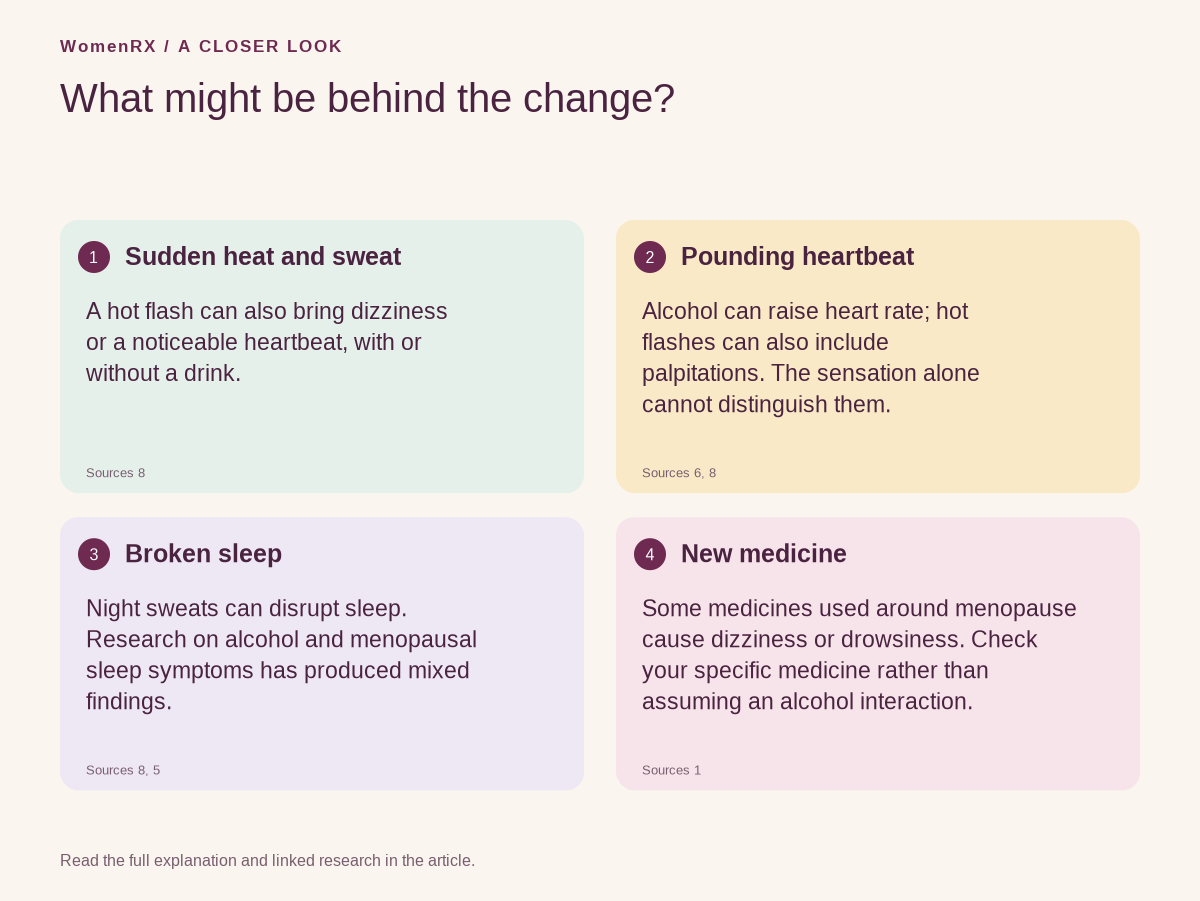
What might be behind the change?
Sudden heat and sweat: A hot flash can also bring dizziness or a noticeable heartbeat, with or without a drink.8
Pounding heartbeat: Alcohol can raise heart rate; hot flashes can also include palpitations. The sensation alone cannot distinguish them.68
Broken sleep: Night sweats can disrupt sleep. Research on alcohol and menopausal sleep symptoms has produced mixed findings.85
New medicine: Some medicines used around menopause cause dizziness or drowsiness. Check your specific medicine rather than assuming an alcohol interaction.1
Read the figure as text
These clues can help describe what happened, but they cannot identify a cause on their own.- Sudden heat and sweat: A hot flash can also bring dizziness or a noticeable heartbeat, with or without a drink.8
- Pounding heartbeat: Alcohol can raise heart rate; hot flashes can also include palpitations. The sensation alone cannot distinguish them.68
- Broken sleep: Night sweats can disrupt sleep. Research on alcohol and menopausal sleep symptoms has produced mixed findings.85
- New medicine: Some medicines used around menopause cause dizziness or drowsiness. Check your specific medicine rather than assuming an alcohol interaction.1
More questions, answered
Does avoiding alcohol treat menopause hot flashes?
If alcohol repeatedly seems to trigger yours, drinking less or skipping it may help you avoid that personal trigger. But avoiding triggers has not been established as a reliable treatment for hot flashes overall. For bothersome symptoms, evidence-supported treatment options include hormone therapy and several nonhormone approaches. 743
Sources you can check
- Other medicines for menopause symptoms - NHSAccessed 2026-09-25Return to first citation
- Leveraging STRAW +10 criteria to evaluate menopause stage effects on sleep quality.Wood SC, van Doorn JL, Bookheimer SY, Nichols TE, Ances BM, Welsh RC, Maki PM. · Climacteric : the journal of the International Menopause Society · 2026Return to first citation
- The 2022 hormone therapy position statement of The North American Menopause Society.“The 2022 Hormone Therapy Position Statement of The North American Menopause Society” Advisory Panel. · Menopause (New York, N.Y.) · 2022Return to first citation
- The 2023 nonhormone therapy position statement of The North American Menopause Society.Menopause (New York, N.Y.) · 2023Return to first citation
- The Relationship Between Menopause, Perimenopause and Alcohol Use: A Scoping Review.Teixeira FMAA, Picior M, Ajewole O. · Substance use & addiction journal · 2026Return to first citation
- Alcohol | Drinking | MedlinePlusAccessed 2026-09-25Return to first citation
- Things you can do to help menopause and perimenopause symptoms - NHSAccessed 2026-09-25Return to first citation
- Symptoms of menopause and perimenopause - NHSAccessed 2026-09-25Return to first citation