Bupropion and Alcohol: What Changes Seizure Risk
The biggest concern may be heavy drinking or suddenly stopping, not just whether you have a drink.
Bupropion can raise seizure risk, and heavy alcohol use or abrupt alcohol withdrawal can add concern. The prescribing information for Contrave, a product containing bupropion and naltrexone, advises minimizing or avoiding alcohol and talking with a prescriber before suddenly stopping heavy drinking. It doesn’t define a universally safe amount, and a mouse study can’t tell us the risk from a particular amount in people. 1 2
Why your drinking pattern matters
Bupropion can cause seizures, and the risk is affected by more than the medicine alone. The prescribing information for Contrave, which combines bupropion with naltrexone, identifies excessive alcohol use and abrupt alcohol discontinuation as seizure-risk concerns. It also advises people who drink a lot to talk with their prescriber before suddenly stopping. 1
That makes two situations especially worth discussing: drinking heavily while taking a bupropion-containing medicine, and planning to stop heavy drinking. If you drink heavily and want to cut down or quit, contact your prescriber before making a sudden change. Don’t stop or change your bupropion on your own to try to manage the situation; ask for a plan that considers both the medication and your alcohol use. 1
What the evidence says about occasional drinking
The Contrave prescribing information says alcohol use during treatment should be minimized or avoided. It also describes rare postmarketing reports of adverse neuropsychiatric events or reduced alcohol tolerance in people drinking during bupropion treatment. Those reports don’t tell us how often a problem occurs for an individual, or establish a safe amount of alcohol. The information is for Contrave specifically, so ask about your own bupropion product and circumstances rather than assuming the combination product’s advice answers every personal question. 1
A small animal study offers a reason for caution, but not a human risk estimate. In that experiment, ethanol increased bupropion-related seizures in mice given single, injected doses. The researchers noted that the interaction had not been specifically studied for seizure risk in people. The mouse results can’t predict whether a particular drink, drinking pattern, or bupropion prescription will cause a seizure in a person. 2
For occasional drinking, the Contrave prescribing information doesn’t identify an amount that is safe for everyone. Ask your prescriber or pharmacist what they recommend for your medication and health history. If alcohol affects you differently than usual while taking bupropion, mention that too; reduced alcohol tolerance is described in the product information. 1
Other factors to bring into the conversation
Alcohol isn’t the only consideration. Contrave’s prescribing information lists factors that can raise seizure risk, including a past seizure or head injury, certain metabolic problems, excessive use of sedatives, and other medicines that may lower the seizure threshold. It also identifies a current or past diagnosis of anorexia nervosa or bulimia as a contraindication for Contrave. Because that information is specific to the combination product, ask your prescriber how your own history applies to your bupropion medication. 1
If you’re pregnant, planning a pregnancy, or breastfeeding, include that in the medication review. The details can depend on the product and why you take it, so don’t assume that advice about Contrave’s weight-management use applies to bupropion prescribed for another reason. 1
Questions that can make the discussion useful
You might ask:
- “Does the guidance for my specific bupropion product recommend avoiding alcohol or minimizing it?”
- “How do my drinking pattern, past seizures or head injuries, and other medicines affect my risk?”
- “I’m thinking about stopping or cutting down heavy drinking. How should I plan that safely while taking this medication?”
- “If I notice reduced alcohol tolerance or another unexpected effect, what should I do?”
- “Does pregnancy, planning a pregnancy, or breastfeeding change the medication review for my situation?”
The key distinction is between an occasional drink and heavy use or sudden withdrawal: the Contrave prescribing information doesn’t quantify a safe amount for occasional drinking, while it specifically flags heavy use and abrupt stopping as concerns. Your prescriber or pharmacist can help apply that distinction to your exact medication and health history. 1
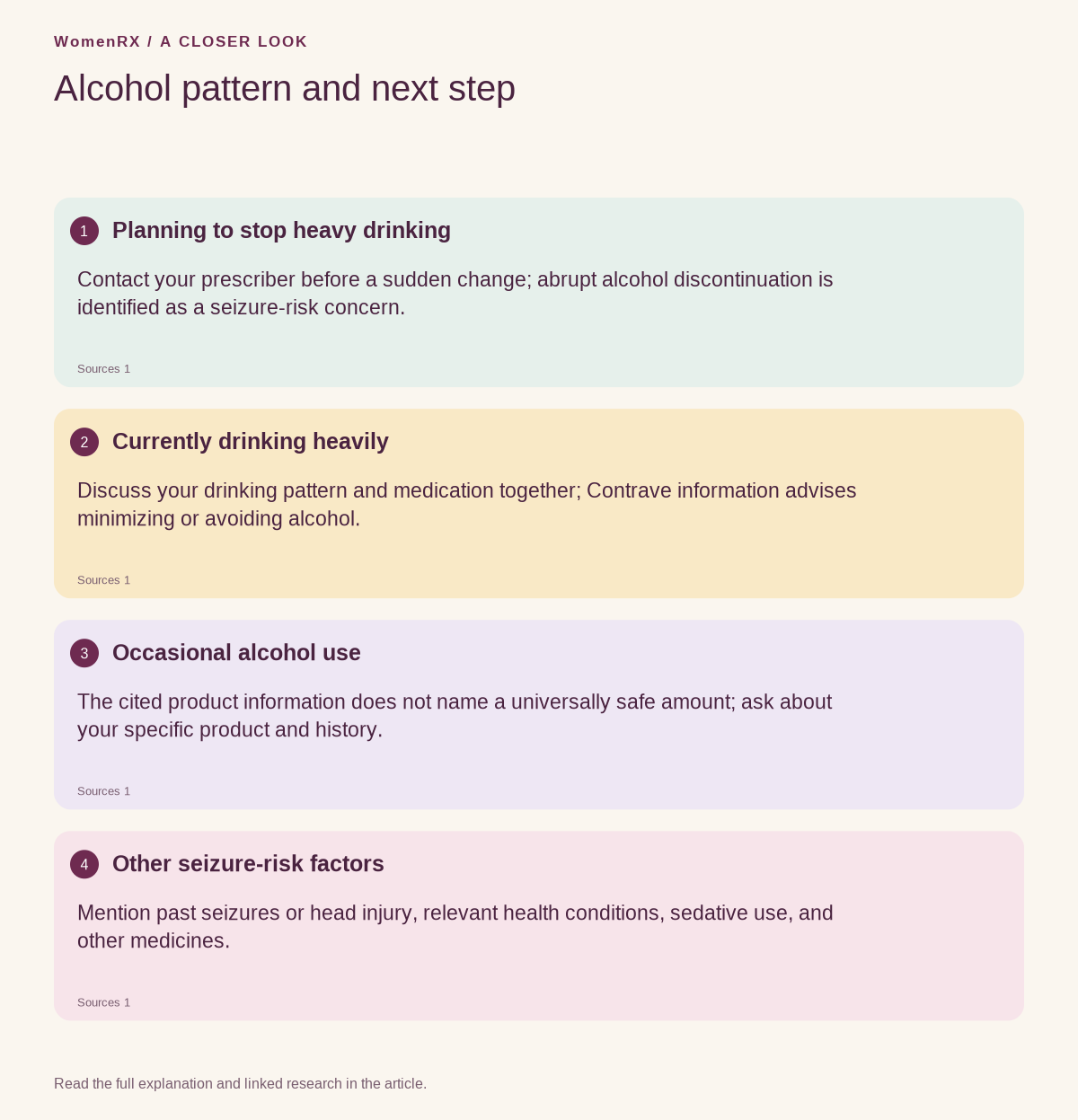
Alcohol pattern and next step
Planning to stop heavy drinking: Contact your prescriber before a sudden change; abrupt alcohol discontinuation is identified as a seizure-risk concern.1
Currently drinking heavily: Discuss your drinking pattern and medication together; Contrave information advises minimizing or avoiding alcohol.1
Occasional alcohol use: The cited product information does not name a universally safe amount; ask about your specific product and history.1
Other seizure-risk factors: Mention past seizures or head injury, relevant health conditions, sedative use, and other medicines.1
Read the figure as text
Use this distinction to decide what to raise promptly with your prescriber or pharmacist; it is not a risk score.- Planning to stop heavy drinking: Contact your prescriber before a sudden change; abrupt alcohol discontinuation is identified as a seizure-risk concern.1
- Currently drinking heavily: Discuss your drinking pattern and medication together; Contrave information advises minimizing or avoiding alcohol.1
- Occasional alcohol use: The cited product information does not name a universally safe amount; ask about your specific product and history.1
- Other seizure-risk factors: Mention past seizures or head injury, relevant health conditions, sedative use, and other medicines.1
More questions, answered
Should I stop bupropion before I stop drinking?
Don’t stop or change your bupropion on your own. If you drink heavily and are considering stopping, contact your prescriber first to discuss a plan; Contrave’s prescribing information warns that abrupt alcohol discontinuation can increase seizure risk. 1
Does the mouse study show that a drink will cause a seizure?
No. It found increased seizure activity in mice given ethanol and injected bupropion, but it cannot estimate a person’s risk from a particular amount of alcohol. The study authors also noted that this seizure interaction had not been specifically studied in people. 2
Sources you can check
- CONTRAVE EXTENDED-RELEASE (NALTREXONE HYDROCHLORIDE AND BUPROPION HYDROCHLORIDE) TABLET, EXTENDED RELEASE [NALPROPION PHARMACEUTICALS LLC] | US prescribing information and patient instructionsAccessed 2026-09-25Return to first citation
- Alcohol significantly lowers the seizure threshold in mice when co-administered with bupropion hydrochloride.Silverstone PH, Williams R, McMahon L, Fleming R, Fogarty S. · Annals of general psychiatry · 2008Return to first citation