Dizziness in Perimenopause and After Menopause: Does Timing Matter?
Cycle timing adds context, but the feeling and circumstances of a dizzy spell offer better clues about what to check next.
Perimenopause is the transition when periods may become irregular. Postmenopause follows menopause, identified after 12 consecutive months without a period when no other cause explains the absence. Dizziness can occur in either stage, and its timing doesn’t reliably identify the cause. Note what it feels like, when it happens, whether your cycles are changing, and any other symptoms. 124
What your cycle can tell you
Perimenopause is the transition toward menopause, when periods may become irregular. Menopause is identified after 12 consecutive months without menstruation when no other cause explains the absence; postmenopause is the stage that follows. These are reproductive stages, not ages. 24
Dizziness isn’t a reliable way to tell the stages apart. In a retrospective study of 1,225 women attending a hospital in China, dizziness and 13 other assessed symptoms were more prevalent in the postmenopausal group than in the perimenopausal group. That comparison doesn’t show that menopause caused the dizziness or establish a symptom pattern that can identify an individual woman’s stage. A review of menopause and vestibular symptoms found that clinical studies are scarce and detailed descriptions of symptoms during the transition are lacking. 34
So if a spell happens near an irregular period, record that timing without assuming hormones caused it. If spells continue after periods have stopped, don’t assume menopause explains them either. Causes unrelated to reproductive stage may need attention in both situations. 14
A side-by-side timing guide
| During perimenopause | After menopause | |
|---|---|---|
| Stage context | Periods may become irregular during the transition. | Menopause has been identified after 12 months without a period, with no other explanation for its absence. |
| Useful timing detail | Note bleeding dates and whether spells appear to cluster around them. | Note whether spells are new, recurring, or changing, even without a cycle to compare. |
| What timing cannot prove | A spell near bleeding doesn’t confirm a hormonal cause. | A spell after menopause doesn’t confirm a menopausal cause. |
| What else to consider | Standing up, ear symptoms, and a new medicine may offer clues. | The same clues remain relevant. |
This is a way to organize what you notice, not a stage-based test for dizziness. 1234
Describe the spell, not just the date
“Dizzy” can mean lightheaded or giddy, unsteady, or as though you or the room is spinning. Those sensations don’t diagnose a cause by themselves, but they’re more descriptive than “I felt dizzy.” 1
For example, a brief lightheaded feeling when you stand up is a different clue from a spinning feeling with ringing in your ears. A sudden blood-pressure drop can cause dizziness on standing; inner-ear problems can come with imbalance, spinning, or ear symptoms. Dizziness after starting a prescription medicine may be a side effect. Any of these possibilities can matter whether you still have periods or not. 1
A short phone note can capture the details while they’re fresh: what the spell felt like, when it began and ended, what you were doing, whether it has happened before, and whether you noticed ringing in your ears, vision changes, nausea, headache, fainting, or a change in your pulse. Add bleeding dates if you still have periods, and note a recently started prescription medicine. Tracking periods can help you see whether your usual cycle pattern has changed. 12
When the pattern needs assessment
Arrange an assessment if dizziness won’t go away, keeps returning, or worries you. Don’t wait for a clearer connection to your cycle if you also have ringing in your ears, vision changes, numbness or weakness in your face, arms, or legs, fainting or collapse, a change in your pulse, headache, or nausea or vomiting. 1
While a spell is passing, lie down until it eases and get up slowly. Avoid driving, climbing a ladder, or other activities that could be dangerous while you’re dizzy. 1
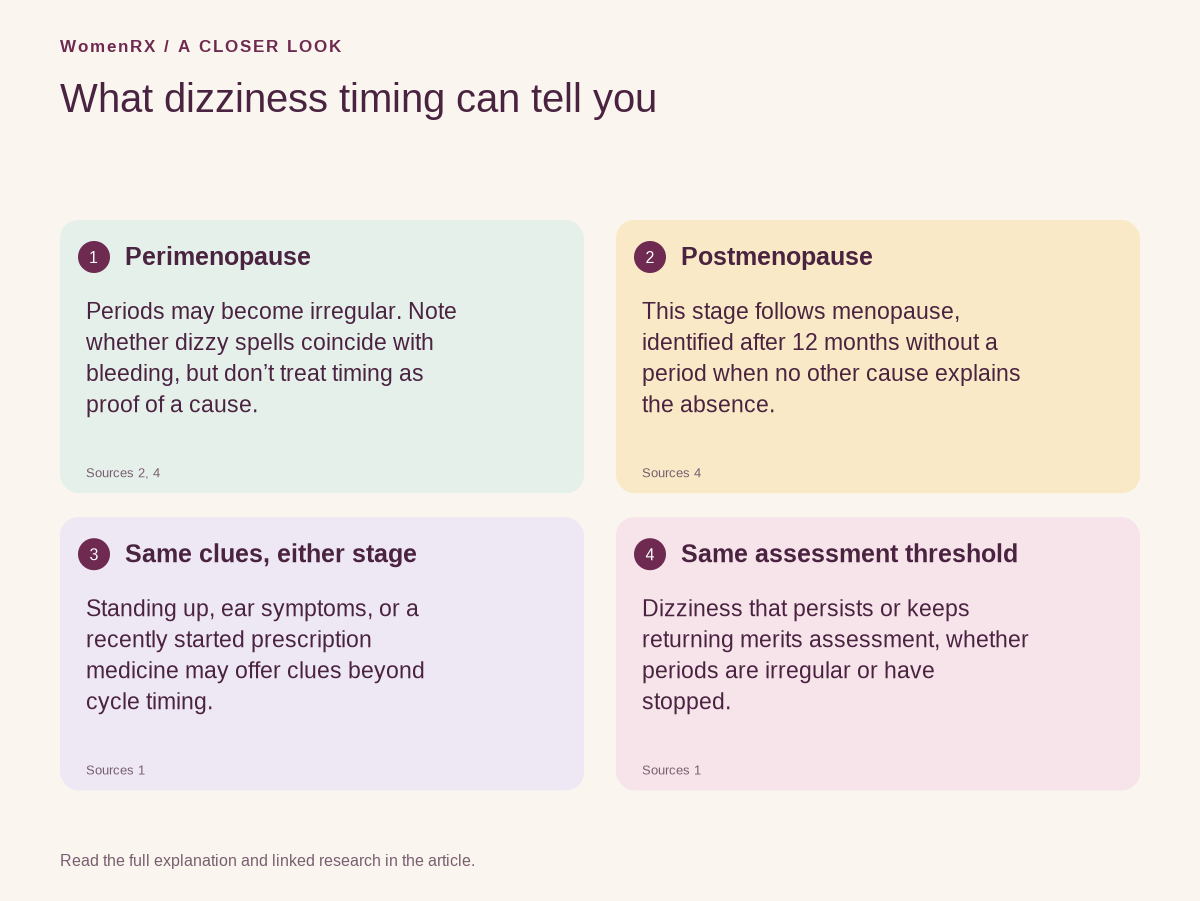
What dizziness timing can tell you
Perimenopause: Periods may become irregular. Note whether dizzy spells coincide with bleeding, but don’t treat timing as proof of a cause.24
Postmenopause: This stage follows menopause, identified after 12 months without a period when no other cause explains the absence.4
Same clues, either stage: Standing up, ear symptoms, or a recently started prescription medicine may offer clues beyond cycle timing.1
Same assessment threshold: Dizziness that persists or keeps returning merits assessment, whether periods are irregular or have stopped.1
Read the figure as text
Compare reproductive-stage context with clues that matter in either stage.- Perimenopause: Periods may become irregular. Note whether dizzy spells coincide with bleeding, but don’t treat timing as proof of a cause.24
- Postmenopause: This stage follows menopause, identified after 12 months without a period when no other cause explains the absence.4
- Same clues, either stage: Standing up, ear symptoms, or a recently started prescription medicine may offer clues beyond cycle timing.1
- Same assessment threshold: Dizziness that persists or keeps returning merits assessment, whether periods are irregular or have stopped.1
Sources you can check
- Dizziness - NHSAccessed 2026-09-25Return to first citation
- Irregular periods - NHSAccessed 2026-09-25Return to first citation
- Prevalence of climacteric symptoms comparing perimenopausal and postmenopausal Chinese women.Ruan X, Cui Y, Du J, Jin F, Mueck AO. · Journal of psychosomatic obstetrics and gynaecology · 2017Return to first citation
- Is there any relationship between the menopause transition and dizziness?Mangia LRL, Bittar RSM. · Brazilian journal of otorhinolaryngology · 2026Return to first citation