Always Tired? What to Check Before Trying Supplements
Persistent fatigue has many possible causes, so look for the reason before choosing a supplement.
If you’ve felt tired for weeks, start with an assessment rather than trying iron, B12, or vitamin D at random. Fatigue can relate to sleep, stress, pregnancy, anemia, or other health conditions, and the right next step depends on the cause. A clinician can review your history and decide whether an exam or blood tests are useful. 2
Start with how long it’s been going on
A rough night or a demanding stretch can leave you tired; fatigue that lasts for weeks and disrupts your usual activities deserves a closer look. Fatigue is a symptom, not a diagnosis. Sleep problems, stress, depression or anxiety, pregnancy, anemia, thyroid or other chronic conditions, and some lifestyle habits are among its possible causes. 2
If fatigue has lasted several weeks, arrange a medical assessment. Expect questions about sleep, daily activity, appetite, and exercise, and possibly an exam or lab tests. That can help distinguish a nutrition problem from another cause that a supplement won’t address. 2
Make the history specific
Before the visit, consider what has changed: sleep quality, food intake, exercise, stress, alcohol use, or medicines. Mention pregnancy or a recent birth, heavy menstrual bleeding, and whether you’re in the menopause transition. These details are context for an assessment, not proof that any one of them explains the fatigue. Pregnancy is one recognized possible cause of fatigue, and heavy periods can increase the chance of low iron. 2 4
Heavy periods matter because blood loss is one possible cause of iron deficiency. Low iron may progress to iron-deficiency anemia, which can cause fatigue, weakness, and trouble concentrating. Iron stores can be low even before hemoglobin falls, so a single normal anemia screening result may not tell the whole story. Clinicians may use ferritin, which reflects iron stores, alongside other measurements; inflammation can affect ferritin. 3 4
Match a supplement to a demonstrated need
Iron: Low iron is one reason iron supplements may be appropriate, but fatigue alone doesn’t show that your iron is low. Taking too much can cause stomach and bowel symptoms, and excessive iron can harm the body. It’s better to establish whether iron deficiency is present and consider why, including heavy bleeding, diet, or absorption, before choosing a supplement. 3 4
Vitamin B12: B12 deficiency can contribute to anemia, but fatigue by itself doesn’t establish a deficiency or identify its cause. A targeted evaluation is more useful than assuming B12 is the answer. 3
Vitamin D: One study comparing 240 older adults with fatigue and 240 without it found lower vitamin D levels in the fatigue group. That observational finding shows an association, not that low vitamin D caused the fatigue or that a supplement would relieve it. The abstract doesn’t report a women’s subgroup. MedlinePlus describes supplementation as treatment for vitamin D deficiency and advises checking the amount and duration with a provider. 5 1
What to do while you look for the cause
If fatigue is recent and you can still manage your usual activities, review the basics that may be contributing: sleep habits, regular physical activity, stress, diet, and alcohol. These steps may help, but they don’t replace assessment if the fatigue persists. A short note of when you feel most tired and what affects your energy can help you spot patterns and describe them clearly. 2
The useful question isn’t “Which supplement gives energy?” It’s “Is there a specific deficiency or another cause to address?” If testing identifies a deficiency, treatment can be matched to it. If it doesn’t, that’s a reason to look more broadly, not to keep adding products. Fatigue can have multiple causes, and treating anemia alone doesn’t necessarily explain or resolve every person’s fatigue. 2 6
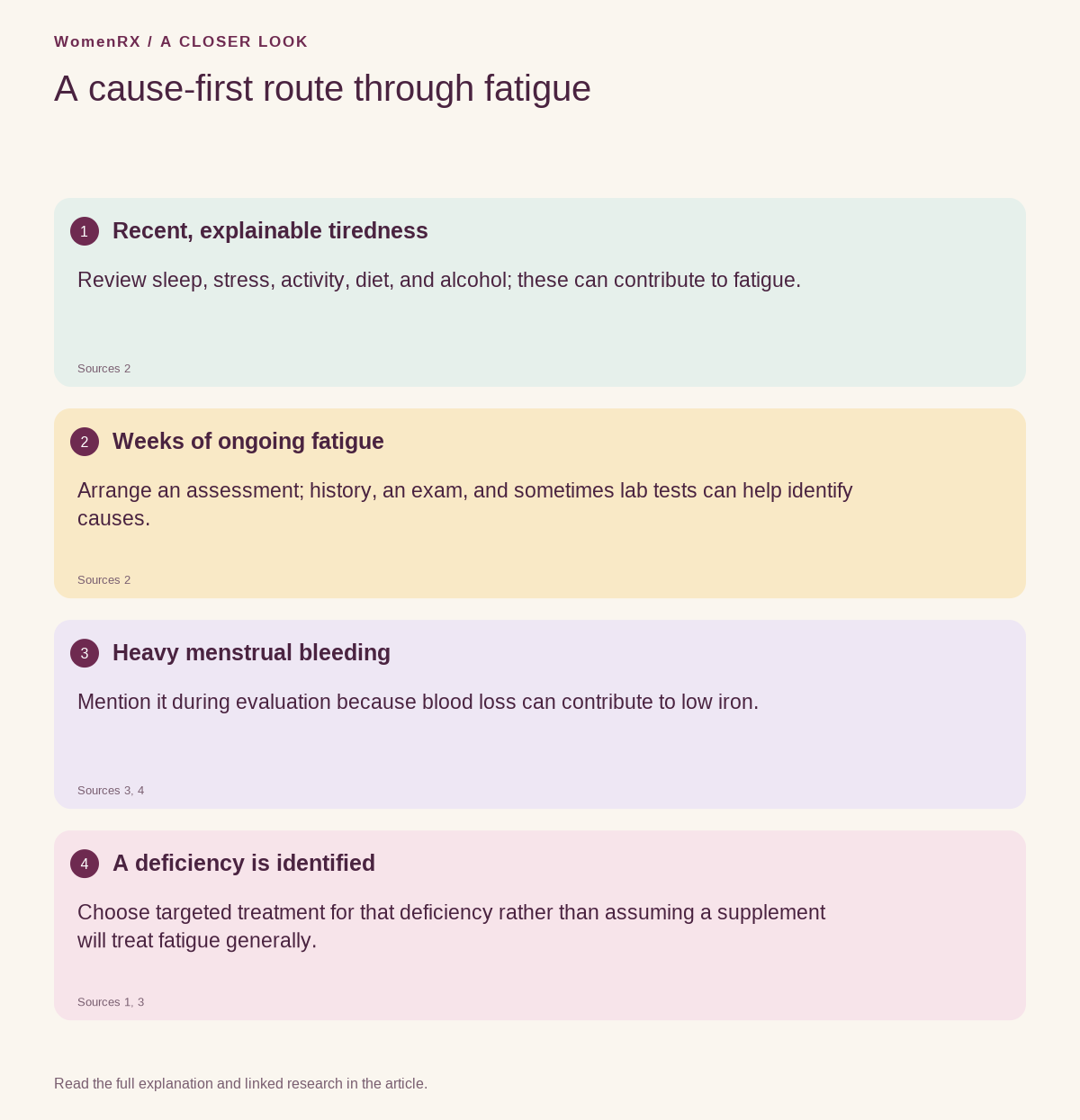
A cause-first route through fatigue
Recent, explainable tiredness: Review sleep, stress, activity, diet, and alcohol; these can contribute to fatigue.2
Weeks of ongoing fatigue: Arrange an assessment; history, an exam, and sometimes lab tests can help identify causes.2
Heavy menstrual bleeding: Mention it during evaluation because blood loss can contribute to low iron.34
A deficiency is identified: Choose targeted treatment for that deficiency rather than assuming a supplement will treat fatigue generally.13
Read the figure as text
Use the duration and likely context of fatigue to choose an assessment or a practical first step, rather than starting with a supplement.- Recent, explainable tiredness: Review sleep, stress, activity, diet, and alcohol; these can contribute to fatigue.2
- Weeks of ongoing fatigue: Arrange an assessment; history, an exam, and sometimes lab tests can help identify causes.2
- Heavy menstrual bleeding: Mention it during evaluation because blood loss can contribute to low iron.34
- A deficiency is identified: Choose targeted treatment for that deficiency rather than assuming a supplement will treat fatigue generally.13
More questions, answered
Can low iron cause fatigue even without anemia?
Iron depletion can occur before hemoglobin falls, and ferritin is used to assess iron stores. A clinician may consider more than one measurement when evaluating iron status. 3
Does feeling tired mean I should take vitamin D?
No. Fatigue alone doesn’t establish vitamin D deficiency. A study in older adults found an association between lower vitamin D and fatigue, but it didn’t show that supplements treat fatigue. 5
Sources you can check
- Vitamin D Deficiency: MedlinePlusAccessed 2026-09-25Return to first citation
- Fatigue: MedlinePlusAccessed 2026-09-25Return to first citation
- Iron - Health Professional Fact SheetAccessed 2026-09-25Return to first citation
- Iron: MedlinePlusAccessed 2026-09-25Return to first citation
- Decrease in Serum Vitamin D Level of Older Patients with Fatigue.Pennisi M, Malaguarnera G, Di Bartolo G, Lanza G, Bella R, Chisari EM, Cauli O, Vicari E, Malaguarnera M. · Nutrients · 2019Return to first citation
- Fatigue and acute/chronic anaemia.Bager P. · Danish medical journal · 2014Return to first citation