Pregnancy After Menopause: What Is Possible and What Is Not
Natural conception can still be possible during the transition, but established menopause ends that possibility; donor-egg IVF is a separate, treatment-assisted route.
If you haven’t reached 12 months without a period, pregnancy may still be possible, even if your cycles are irregular. Once menopause is established, natural conception is no longer possible. Pregnancy after menopause can occur through assisted reproduction, including IVF with a donor egg, but it involves medical screening and pregnancy risks that need individual assessment. 1 3 4
The 12-month marker separates transition from menopause
During perimenopause, periods may become irregular, and the transition can last several years. Menopause is reached after 12 months without a period. That distinction matters: until menopause is established, pregnancy may still be possible. Irregular cycles alone don’t show that fertility has ended. 1
After established menopause, natural conception is no longer possible. MedlinePlus describes menopause as the point when you stop having periods and can no longer get pregnant. 1
If you’re trying to avoid pregnancy and haven’t reached the 12-month mark, don’t treat skipped or unpredictable periods as proof that pregnancy can’t happen. The 12-month definition doesn’t give a method-specific rule for when to stop contraception, so ask for guidance that fits your contraception method and circumstances.
How pregnancy can happen after menopause
Assisted reproductive technology is different from natural conception. One route described in research is IVF using a donor egg: an egg from a donor is used to create an embryo, which is transferred to the person hoping to become pregnant. A review of assisted reproduction in postreproductive women and a study of donor-egg IVF recipients include women with age-related menopause. 3 4
This means pregnancy after menopause is possible through fertility treatment, not because ovulation and natural conception have resumed. Treatment is not a guarantee of pregnancy, and whether it’s an option depends on an individual health assessment. A review of care for postreproductive women describes limited guidance on candidacy and emphasizes counseling about pregnancy risks at older ages. 3
Donor-egg pregnancy has risks worth understanding
Pregnancy after menopause through assisted reproduction is not simply a way around the effects of age. A review reports higher maternal and fetal risks in postmenopausal women who become pregnant through assisted reproductive technology than in younger, healthy pregnant women. That comparison doesn’t predict an individual outcome, but it makes screening and a clear discussion of risks part of the decision. 3
There is also a specific finding about donor eggs and preeclampsia, a serious pregnancy-related blood-pressure condition. A meta-analysis of six retrospective studies found higher odds of preeclampsia in donor-egg pregnancies than in IVF pregnancies using the recipient’s own eggs (odds ratio 4.50; 95% confidence interval 3.28-6.19). This is a relative comparison from observational studies, not an estimate of any one person’s absolute risk or proof that donor eggs alone cause preeclampsia. 2
If you’re considering pregnancy after menopause, a fertility specialist can discuss whether assisted reproduction is suitable and what health screening is needed. If you’re focused on preventing pregnancy, the key distinction is simpler: the transition is not the same as confirmed menopause, and irregular periods do not confirm that pregnancy is impossible. 1 3
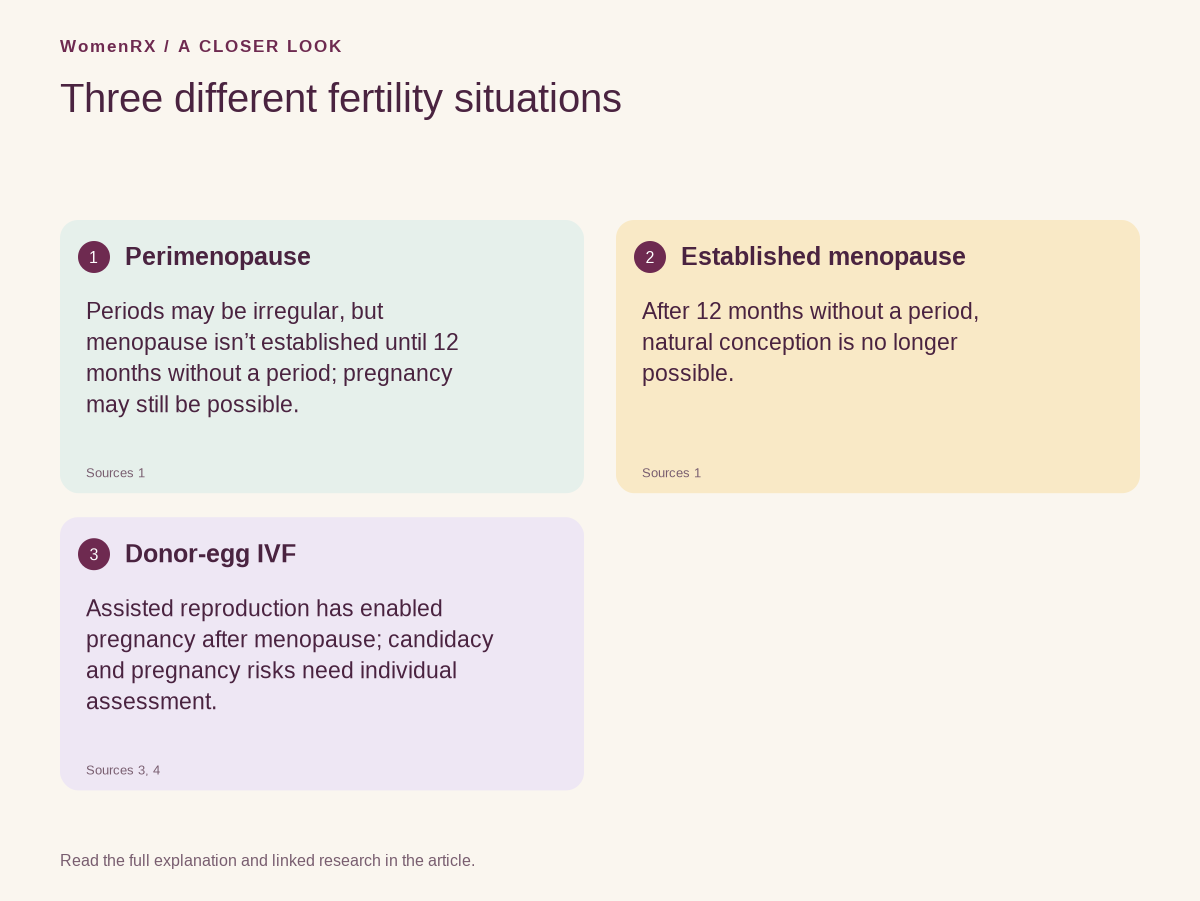
Three different fertility situations
Perimenopause: Periods may be irregular, but menopause isn’t established until 12 months without a period; pregnancy may still be possible.1
Established menopause: After 12 months without a period, natural conception is no longer possible.1
Donor-egg IVF: Assisted reproduction has enabled pregnancy after menopause; candidacy and pregnancy risks need individual assessment.34
Read the figure as text
Compare the possibility of natural conception during the transition, after established menopause, and with assisted reproduction.- Perimenopause: Periods may be irregular, but menopause isn’t established until 12 months without a period; pregnancy may still be possible.1
- Established menopause: After 12 months without a period, natural conception is no longer possible.1
- Donor-egg IVF: Assisted reproduction has enabled pregnancy after menopause; candidacy and pregnancy risks need individual assessment.34
More questions, answered
Is primary ovarian insufficiency the same as menopause?
No. Primary ovarian insufficiency involves reduced ovarian function before age 40, but it isn’t the same as early menopause. Some people with this condition still have periods and may still become pregnant, so a diagnosis doesn’t automatically mean pregnancy is impossible. 1
Sources you can check
- Menopause | Menopause Symptoms | MedlinePlusAccessed 2026-09-25Return to first citation
- Is the risk of preeclampsia higher in donor oocyte pregnancies? A systematic review and meta-analysis.Schwarze JE, Borda P, Vásquez P, Ortega C, Villa S, Crosby JA, Pommer R. · JBRA assisted reproduction · 2018Return to first citation
- Menopausal women requesting egg/embryo donation: examining health screening guidelines for assisted reproductive technology.MacArthur T, Bachmann G, Ayers C. · Menopause (New York, N.Y.) · 2016Return to first citation
- In vitro fertilisation (IVF) with donor eggs in post-menopausal women: are there differences in pregnancy outcomes in women with premature ovarian failure (POF) compared with women with physiological age-related menopause?Ameratunga D, Weston G, Osianlis T, Catt J, Vollenhoven B. · Journal of assisted reproduction and genetics · 2009Return to first citation