Low Sexual Desire Around Menopause: When to Seek Support
A change in desire is worth discussing when it bothers you, comes with pain or dryness, or seems tied to mood, medication, or relationship strain.
There isn’t one “normal” level of sexual desire for perimenopause or after menopause. Consider seeking support if the change causes distress, affects a relationship in a way you want help with, or comes with vaginal dryness or pain. Desire can reflect physical symptoms, sleep and general health, mood, medicines, and relationship factors, so the conversation doesn’t have to focus only on hormones. 3 1
Start with what you want help with
A lower level of desire isn’t automatically a problem to fix. Some women have less desire during menopause, while others have stable or increased desire. What matters for deciding whether to seek support is whether the change feels troubling to you, or whether something connected to it, such as pain, is getting in the way. 3
You can bring up the concern even if you’re not sure what’s causing it. Perimenopause and postmenopause can involve several overlapping influences, and a conversation can start with the part that matters most to you: for example, sex has become uncomfortable, you miss wanting intimacy, or a change in medication seemed to coincide with a change in desire.
Think across four connected areas
Physical symptoms: Vaginal dryness and pain with sex can affect desire, and other menopausal symptoms, sleep disruption, and general health are also associated with changes in desire. If discomfort is part of the picture, say so directly. It gives a clinician a specific symptom to assess rather than treating the issue as desire alone. 3
Medicines: Some medicines can affect sexual desire or performance. If the timing seems relevant, mention what changed and when. A medication may be one factor among several, so it’s useful to discuss the whole picture rather than assume it explains everything. 1 3
Mood and how you feel about yourself: Anxiety and depression are strongly associated with lower desire in the menopause research reviewed; body image and attitudes about sex may matter too. If stress or mood is affecting you, that belongs in the conversation, not off to the side. 3
Relationship and circumstances: Relationship dissatisfaction and relationship length have been associated with changes in desire. You might consider whether the concern feels specific to sexual activity, connected to tension or distance, or part of a broader change in how you’re feeling together. There’s no need to assign blame to yourself or a partner. 3
These areas can overlap. For instance, pain may lead someone to avoid sex, and that avoidance can become part of the relationship’s experience. The useful next step is identifying which parts you’d like help with, not deciding on your own which one is the “real” cause.
What support can address
If vaginal dryness or pain is a major part of the concern, ask about evaluating and treating those symptoms. Menopause guidance includes options for bothersome genitourinary symptoms, including vaginal treatments; these address a specific symptom pattern and shouldn’t be presented as a guaranteed way to restore desire. 2
Hormones aren’t the only possible focus. A review of menopause-related desire describes biological, psychological, and social factors, and an individualized approach may be more useful than assuming that one hormone explains every change. 3 If medication or mood seems relevant, raise that as part of the same conversation. 1 3
You can seek support because the change is distressing, because sex is painful, or simply because you want to understand your options. You don’t have to wait until the concern fits a particular label.
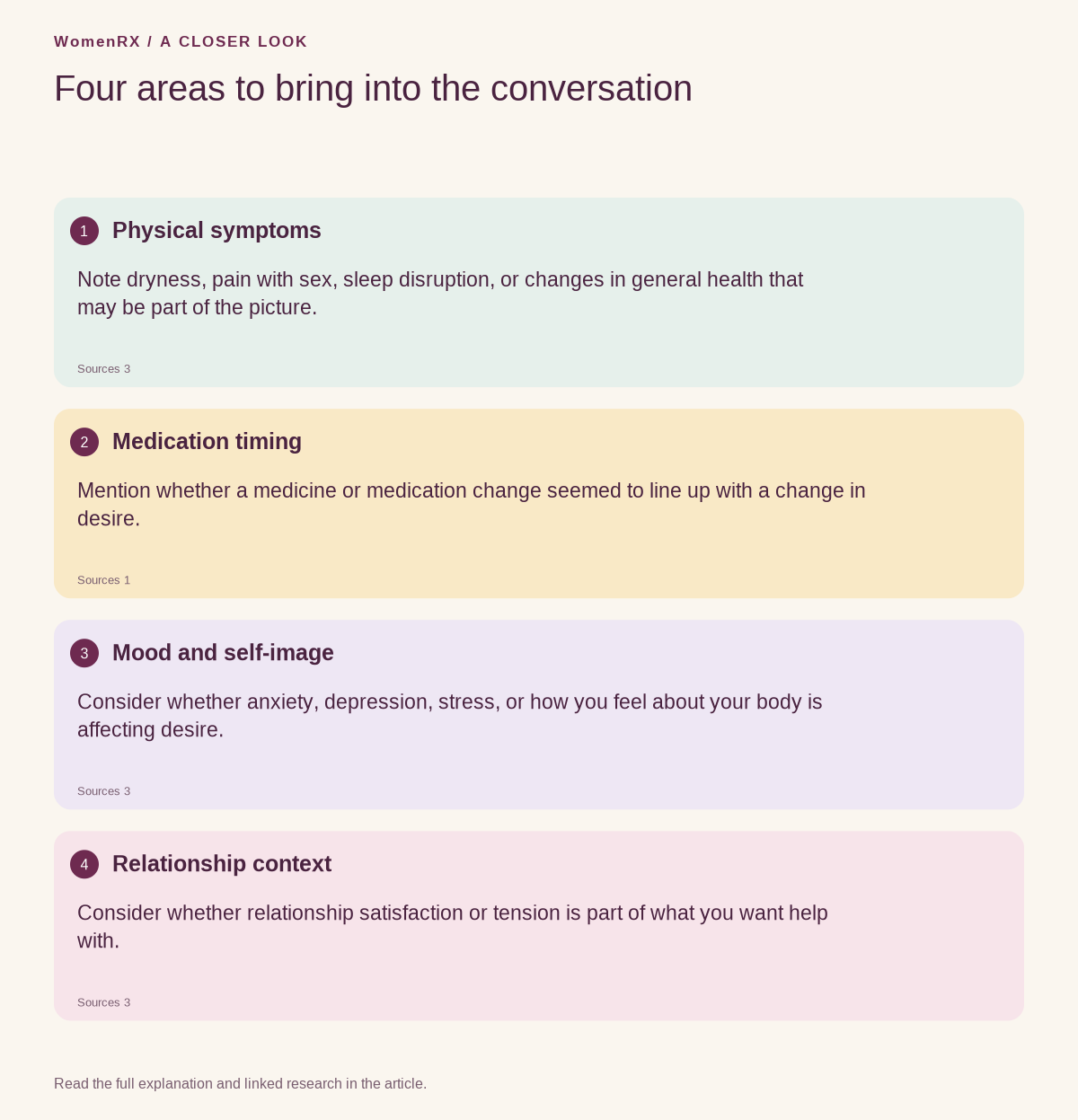
Four areas to bring into the conversation
Physical symptoms: Note dryness, pain with sex, sleep disruption, or changes in general health that may be part of the picture.3
Medication timing: Mention whether a medicine or medication change seemed to line up with a change in desire.1
Mood and self-image: Consider whether anxiety, depression, stress, or how you feel about your body is affecting desire.3
Relationship context: Consider whether relationship satisfaction or tension is part of what you want help with.3
Read the figure as text
Use these prompts to identify what you want addressed. They are discussion points, not a diagnostic checklist.- Physical symptoms: Note dryness, pain with sex, sleep disruption, or changes in general health that may be part of the picture.3
- Medication timing: Mention whether a medicine or medication change seemed to line up with a change in desire.1
- Mood and self-image: Consider whether anxiety, depression, stress, or how you feel about your body is affecting desire.3
- Relationship context: Consider whether relationship satisfaction or tension is part of what you want help with.3
More questions, answered
Does low desire automatically mean my hormones are low?
No. Hormonal changes can contribute, but menopause-related desire is also associated with vaginal symptoms, sleep and general health, mood, and relationship factors. A hormone-only explanation may miss something that could be addressed directly. 3
Can vaginal dryness or pain affect desire?
Yes. Menopause research links vaginal dryness and pain with changes in sexual desire, and guidance recognizes genitourinary symptoms as a treatment focus in their own right. Mention discomfort when seeking help, even if your main concern is desire. 3 2
Sources you can check
- Sexual Health | MedlinePlusAccessed 2026-09-25Return to first citation
- The 2022 hormone therapy position statement of The North American Menopause Society.“The 2022 Hormone Therapy Position Statement of The North American Menopause Society” Advisory Panel. · Menopause (New York, N.Y.) · 2022Return to first citation
- A scoping review of the biopsychosocial factors influencing sexual desire in menopause.Metcalfe KB, Meston CM. · Sexual medicine reviews · 2026Return to first citation