Tingling in Midlife: What the Pattern Can Tell You
Pins and needles can happen during the menopause transition, but where they occur and what comes with them matter more than your age.
Tingling, numbness or burning in midlife isn’t automatically caused by menopause. Nerve pressure, diabetes, low vitamin B12, an underactive thyroid and certain medicines are among the other possibilities.27 Call 911 if tingling comes with weakness, slurred speech, a vision change or trouble walking. If it persists, keeps returning or worsens, arrange a symptom review.7
A hand that briefly tingles after you’ve leaned on it is different from burning in both feet that keeps returning. Both can feel like “pins and needles,” but their patterns point to different questions. Start with when it began, where you feel it, whether it goes away, and whether you have weakness or another new symptom.7
First, check what’s happening alongside the tingling
Call 911 if numbness or tingling comes with weakness or an inability to move, slurred speech, a change in vision, difficulty walking, confusion or loss of consciousness. Emergency care is also warranted if it starts just after a head, neck or back injury, or comes with loss of bladder or bowel control. Don’t wait to see whether those symptoms pass or attribute them to the menopause transition.7
If sensation is changing quickly or symptoms are markedly different on one side, seek medical assessment rather than putting them on a routine follow-up list. If weakness accompanies tingling, use the emergency route above. A clinical review of peripheral neuropathy identifies rapid progression, asymmetry and prominent motor problems as reasons to escalate evaluation; it does not give a universal timetable for every pattern.57
Where you feel it offers a clue, not a diagnosis
Pressure on a nerve can cause a localized sensation. For example, tingling in the fingers may come from nerve compression at the wrist, while a neck or lower-back problem can send altered sensation into an arm or leg. Staying in one position for a long time can also make a hand or foot “fall asleep.” A sensation that clears after you change position has a different context from one that persists or repeatedly returns without an obvious trigger.47
Tingling or burning in the feet, especially with reduced ability to feel temperature or pain, can fit a peripheral nerve problem. Balance changes or weakness add useful information because nerves involved in sensation and movement can both be affected. Those features deserve assessment rather than a guess based on age.34
Diabetes, low vitamin B12 and an underactive thyroid are possible causes of peripheral neuropathy. Long-term heavy alcohol use and certain medicines can contribute, too. Examples of medicines associated with neuropathy include some cancer chemotherapy drugs and, sometimes, metronidazole or nitrofurantoin taken for months. A medicine’s presence on that list doesn’t establish that it caused your symptoms; don’t stop a prescribed medicine on your own.27
Not every unusual sensation starts with a damaged peripheral nerve. Reduced blood supply and Raynaud phenomenon are among the other possible explanations for numbness or tingling. That’s another reason the location, trigger and accompanying symptoms matter.7
Does the menopause transition explain it?
Tingling can be reported during perimenopause and after menopause. In a two-year study of 4,063 women attending a menopause clinic in China, questionnaires included limb pain and paresthesia among the symptoms reported. That observation doesn’t show that hormone changes caused the sensation in any individual woman, and a specialty-clinic group may not reflect women more broadly.6
You can hold both thoughts at once: the timing may be worth mentioning, and a new or persistent sensory symptom still needs its own explanation. If you’ve also noticed a change in periods, bring that context to the conversation. It shouldn’t replace questions about nerve pressure, metabolic conditions, medicines or circulation.27
What a symptom review can sort out
A clinician will usually ask where the sensation began, whether it is constant or intermittent, and what makes it better or worse, then check the affected area and your sensation, strength and reflexes. Depending on the history and examination, testing may look for diabetes or vitamin B12 deficiency. A clinical review also lists hemoglobin A1c, vitamin B12 and thyroid-stimulating hormone among possible initial tests when peripheral neuropathy is suspected. Not everyone needs every test or a nerve study.157
For that conversation, the most useful detail is the pattern: Which fingers or toes? One side or both? Did it follow a position, injury or new medicine? Is it spreading, affecting your balance or making you weaker? Those answers help distinguish a localized nerve problem from a more widespread one and help determine what should happen next.457
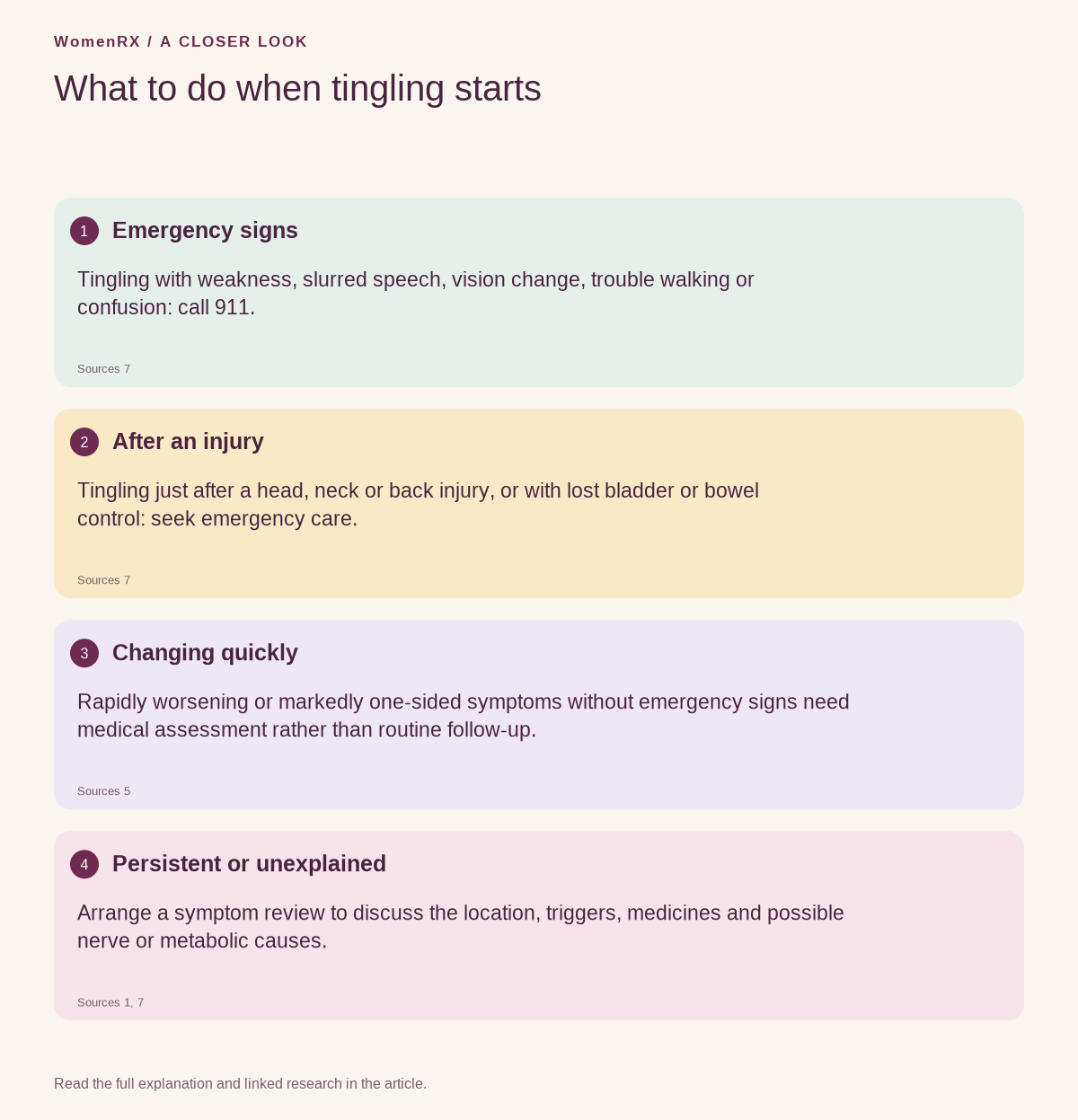
What to do when tingling starts
Emergency signs: Tingling with weakness, slurred speech, vision change, trouble walking or confusion: call 911.7
After an injury: Tingling just after a head, neck or back injury, or with lost bladder or bowel control: seek emergency care.7
Changing quickly: Rapidly worsening or markedly one-sided symptoms without emergency signs need medical assessment rather than routine follow-up.5
Persistent or unexplained: Arrange a symptom review to discuss the location, triggers, medicines and possible nerve or metabolic causes.17
Read the figure as text
Follow the accompanying symptoms and the way the sensation changes, not the assumption that midlife is the cause.- Emergency signs: Tingling with weakness, slurred speech, vision change, trouble walking or confusion: call 911.7
- After an injury: Tingling just after a head, neck or back injury, or with lost bladder or bowel control: seek emergency care.7
- Changing quickly: Rapidly worsening or markedly one-sided symptoms without emergency signs need medical assessment rather than routine follow-up.5
- Persistent or unexplained: Arrange a symptom review to discuss the location, triggers, medicines and possible nerve or metabolic causes.17
More questions, answered
Should I take vitamin B12 for tingling?
Low vitamin B12 is one possible cause, but tingling alone can’t tell you whether your level is low. Testing may be part of an evaluation; taking large doses of vitamins before discussing them with your clinician can complicate a sensible next step.17
Sources you can check
- Peripheral neuropathy - Diagnosis - NHSAccessed 2026-09-25Return to first citation
- Peripheral neuropathy - Causes - NHSAccessed 2026-09-25Return to first citation
- Peripheral neuropathy - NHSAccessed 2026-09-25Return to first citation
- Peripheral neuropathy - Symptoms - NHSAccessed 2026-09-25Return to first citation
- Peripheral Neuropathy: A Phenotype-Driven Review for Diagnosis and Management.Yuba T, Dabbagh A, Sabouri AS. · Revista de neurologia · 2026Return to first citation
- Menopausal symptoms among Chinese peri- and postmenopausal women: a large prospective single-center cohort study.Zhang L, Ruan X, Cui Y, Gu M, Mueck AO. · Gynecological endocrinology : the official journal of the International Society of Gynecological Endocrinology · 2021Return to first citation
- Numbness and tingling: MedlinePlus Medical EncyclopediaAccessed 2026-09-25Return to first citation