Tingling Around Menopause: What Else to Consider
A brief pins-and-needles feeling after pressure often passes quickly, but sudden one-sided numbness or weakness needs emergency attention.
Tingling can be reported during the menopause transition, but that timing alone doesn’t explain its cause. Brief pins and needles after leaning or sleeping on a limb often fade within minutes. Repeated or long-lasting symptoms deserve medical assessment. Sudden numbness or weakness, especially on one side, facial drooping, or slurred speech can signal a stroke: call 911. 1 2 3
First, notice how it starts and stops
If an arm or leg “falls asleep” after you’ve been leaning on it or sleeping in an awkward position, the sensation often clears within a few minutes once the pressure is off. This common, short-lived pattern happens when the blood supply to nerves is temporarily reduced. 1
That pattern is different from tingling that keeps returning, stays present, or has no clear positional trigger. Those symptoms deserve medical assessment rather than being automatically attributed to menopause. NHS guidance recommends assessment when pins and needles are constant or keep coming back. 1
When sudden symptoms mean 911
Call 911 if numbness or weakness begins suddenly, particularly on one side, or comes with facial drooping or slurred speech. These are recognized stroke warning signs, and calling 911 immediately is the appropriate action when a stroke is suspected. Don’t wait to see whether menopause, posture, or stress explains them. 2
A US national survey asked adults what to do about sudden facial drooping, one-sided arm or leg numbness or weakness, slurred speech, and suspected stroke; the appropriate response in each case was to call 911 or another emergency number immediately. 2
Menopause is context, not a diagnosis
A study of 4,063 women attending a menopause clinic in China recorded limb pain or paresthesia among the symptoms assessed in peri- and postmenopause. It shows that these sensations were reported in that group; it doesn’t show that menopause caused them, or establish what a particular person’s tingling means. 3
So it’s reasonable to mention the timing of your symptoms, including whether they began during perimenopause or after your periods stopped. But don’t let that timing stand in for an explanation, especially if the sensation is persistent or recurring.
The pattern can offer clues
The location and what happens alongside the tingling can help distinguish possible causes. For example, tingling or numbness in the hands and feet can occur with diabetes. Fingers or toes that tingle and change color can fit a different pattern, while rapid breathing with trembling hands and tingling may point to another possibility. Pain and tingling that travel from the back down a leg to the foot are also a recognizable pattern. These clues don’t diagnose the cause, but they’re useful details to share during an assessment. 1
When you describe an episode, note where it starts, which side is affected, whether it follows pressure or a position, how long it lasts, and what else happens at the same time. If it keeps returning or doesn’t go away, arrange medical assessment instead of relying on a symptom log alone. 1
A practical decision path
Use the pattern to choose a next step, not to make a diagnosis: sudden stroke-like symptoms mean 911; ongoing or recurring symptoms call for medical assessment; a brief episode after pressure that clears in minutes is more consistent with ordinary pins and needles. The menopause transition can be part of the history, but it shouldn’t override those distinctions. 1 2 3
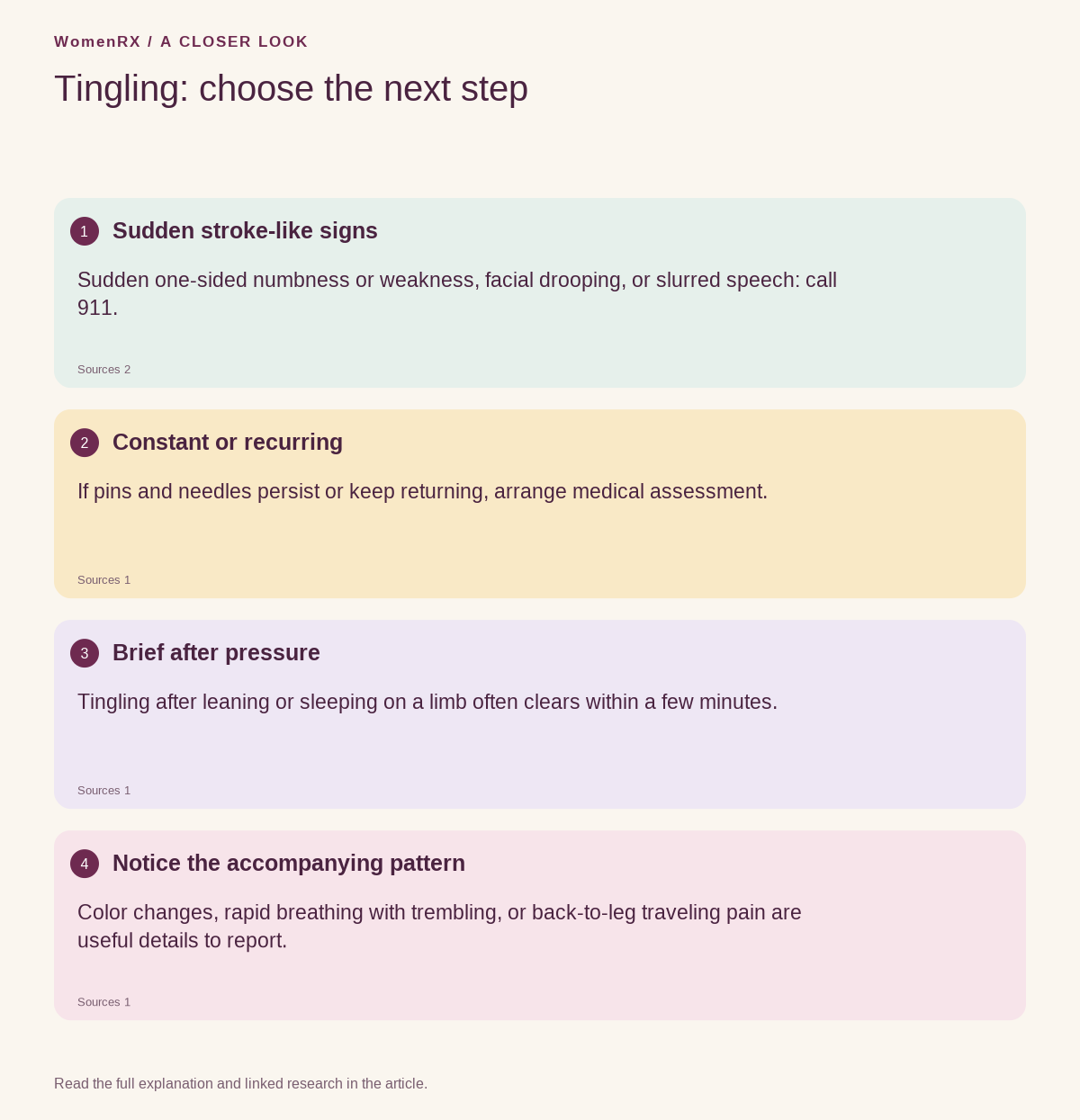
Tingling: choose the next step
Sudden stroke-like signs: Sudden one-sided numbness or weakness, facial drooping, or slurred speech: call 911.2
Constant or recurring: If pins and needles persist or keep returning, arrange medical assessment.1
Brief after pressure: Tingling after leaning or sleeping on a limb often clears within a few minutes.1
Notice the accompanying pattern: Color changes, rapid breathing with trembling, or back-to-leg traveling pain are useful details to report.1
Read the figure as text
Use how the sensation begins, what accompanies it, and whether it clears to decide what kind of follow-up is appropriate.- Sudden stroke-like signs: Sudden one-sided numbness or weakness, facial drooping, or slurred speech: call 911.2
- Constant or recurring: If pins and needles persist or keep returning, arrange medical assessment.1
- Brief after pressure: Tingling after leaning or sleeping on a limb often clears within a few minutes.1
- Notice the accompanying pattern: Color changes, rapid breathing with trembling, or back-to-leg traveling pain are useful details to report.1
More questions, answered
Does tingling mean I’m in perimenopause?
No. A menopause-clinic study recorded limb pain or paresthesia among symptoms reported by peri- and postmenopausal women, but it doesn’t establish that menopause causes tingling or explain an individual episode. 3
What details should I tell a clinician?
Describe where the sensation occurs, whether it affects one side or both, how long it lasts, whether a position or pressure brings it on, and any accompanying symptoms. Patterns such as color changes in fingers or toes, rapid breathing with trembling, or pain traveling from the back down a leg can be relevant clues. 1
Sources you can check
- Pins and needles - NHSAccessed 2026-09-25Return to first citation
- Think FAST: Knowledge of Appropriate Action of Stroke Signs and Symptoms Among US Adults, February-March 2025.Vaughan AS, Valteau T, Jackson SL, Wall HK, Loustalot F, Coronado F. · Journal of the American Heart Association · 2026Return to first citation
- Menopausal symptoms among Chinese peri- and postmenopausal women: a large prospective single-center cohort study.Zhang L, Ruan X, Cui Y, Gu M, Mueck AO. · Gynecological endocrinology : the official journal of the International Society of Gynecological Endocrinology · 2021Return to first citation