Skin-Crawling Sensations in Perimenopause: What Else to Consider
A crawling feeling has been recorded in menopause research, but the sensation alone can’t tell you whether hormones are the cause.
Formication describes a feeling like insects crawling on or under your skin. It’s a symptom, not a diagnosis.8 Researchers have recorded it in a menopause-clinic sample and in women with premature ovarian insufficiency, but neither finding establishes a hormonal cause.34 Note where it happens, when it started, and whether numbness, skin changes, or other symptoms come with it.
What the menopause research actually shows
Formication is the name for a feeling like insects crawling on or under your skin. The feeling can be vivid and upsetting, but the word describes a symptom, not its cause. It doesn’t, by itself, point to a hormonal, skin, nerve, or mental health diagnosis.8
In a study of 423 women ages 40 to 60 attending a menopause clinic in Beijing, researchers included formication among the symptoms they asked about. In their analysis of how reported symptoms related to one another, formication appeared independent of the other menopause, anxiety, and depression symptoms studied. That finding doesn’t explain what caused it in any one woman.3
Another study found moderate-to-severe formication in 17.4% of 293 Chinese women with premature ovarian insufficiency (POI). POI involves loss of ovarian function before age 40, so this result shouldn’t be used as an estimate for women going through perimenopause at the usual age. The study was cross-sectional: it recorded symptoms, rather than testing whether hormone changes caused them.41
The useful distinction is that formication has been reported alongside menopause-related symptoms, but it isn’t a way to confirm perimenopause. If your periods are changing or you’re having hot flashes, that’s relevant context to share, not a reason to dismiss a new crawling sensation.347
The location and other symptoms can change the conversation
Try to describe the feeling before deciding what it means. Is it on your scalp, face, arms, legs, or vulva? Does it stay in one place or move? Do you see a rash or another skin change, or is it a sensation without a visible change? When did it start, and is it recurring? If you also feel numbness, say so. These details make it easier to discuss possibilities beyond menopause. Dry or itchy skin can occur during perimenopause, but noticing dryness doesn’t establish the cause of a crawling feeling.78
If it’s on the vulva, the location matters. A review of chronic vulvar discomfort includes formication among the sensations women may experience and describes several possibilities, including skin disease, vulvovaginal infection, neuropathy, and pelvic floor muscle dysfunction. A vulvar crawling feeling doesn’t identify which, if any, applies to you; visible skin changes and other vulvar symptoms are worth describing rather than grouping everything under “menopause.”5
If you mean tingling or pins and needles more generally, say that too. In a cross-sectional study of postmenopausal Colombian women, a symptom recorded as paresthesia was reported among women with subclinical hypothyroidism. The study did not specifically measure formication, and the association doesn’t show that thyroid disease causes a crawling feeling. It’s one reason not to assume every altered sensation in midlife is hormonal.2
If you’re receiving taxane chemotherapy, that treatment history matters when discussing a new altered sensation. Taxane-related peripheral neuropathy is a recognized treatment concern. That’s a specific medication history with practical relevance, not a reason to suspect chemotherapy-related neuropathy if you haven’t had that treatment.6
When to get help
If the feeling is new or keeps returning, arrange a medical evaluation rather than assuming it’s perimenopause. Mention if it began after a new medication; medications, vitamin deficiencies, and other medical conditions are among the possible causes of formication.8
A suddenly appearing crawling sensation needs emergency care if it comes with a drooping face, new weakness on one side, or trouble speaking. Those are possible stroke signs, whatever you think is behind the skin sensation.8
For a non-emergency evaluation, describe where the feeling happens, when it began, whether there’s anything visible on the skin, and whether numbness or other symptoms come with it. Mention changing periods if they’re part of the picture, along with relevant treatment history. The goal is to look at the whole pattern, not to prove or rule out menopause with one symptom.358
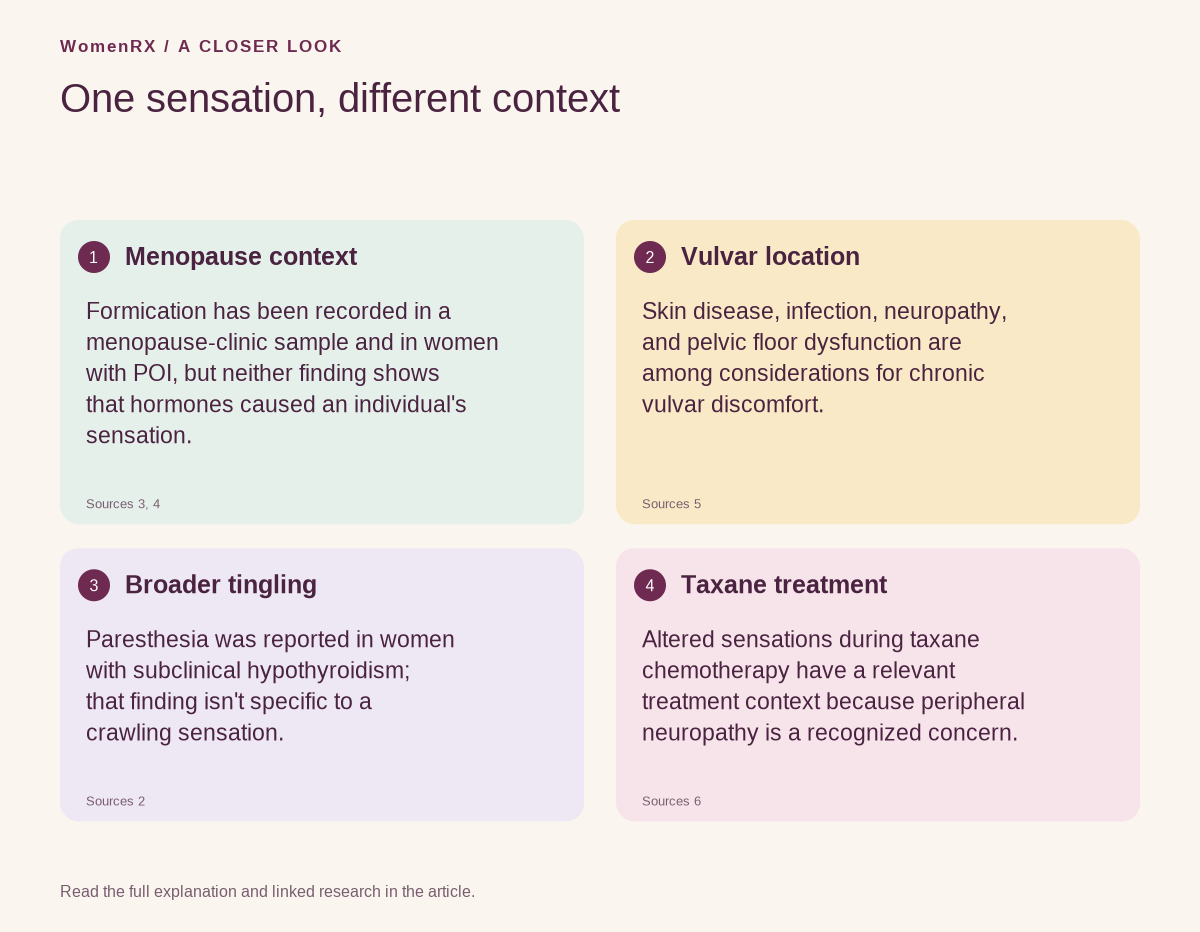
One sensation, different context
Menopause context: Formication has been recorded in a menopause-clinic sample and in women with POI, but neither finding shows that hormones caused an individual's sensation.34
Vulvar location: Skin disease, infection, neuropathy, and pelvic floor dysfunction are among considerations for chronic vulvar discomfort.5
Broader tingling: Paresthesia was reported in women with subclinical hypothyroidism; that finding isn't specific to a crawling sensation.2
Taxane treatment: Altered sensations during taxane chemotherapy have a relevant treatment context because peripheral neuropathy is a recognized concern.6
Read the figure as text
Where the feeling occurs and what accompanies it can make different explanations worth discussing; none of these clues diagnoses a cause.- Menopause context: Formication has been recorded in a menopause-clinic sample and in women with POI, but neither finding shows that hormones caused an individual's sensation.34
- Vulvar location: Skin disease, infection, neuropathy, and pelvic floor dysfunction are among considerations for chronic vulvar discomfort.5
- Broader tingling: Paresthesia was reported in women with subclinical hypothyroidism; that finding isn't specific to a crawling sensation.2
- Taxane treatment: Altered sensations during taxane chemotherapy have a relevant treatment context because peripheral neuropathy is a recognized concern.6
More questions, answered
Does formication mean I have anxiety?
No. Formication has several possible causes, and the sensation alone doesn’t identify a mental health condition.8 In one menopause-clinic study, it appeared independent of the anxiety and depression symptoms examined in the researchers’ symptom analysis. That finding also can’t diagnose the cause for an individual.3
Sources you can check
- Premature ovarian insufficiency diagnosis and management in general practice: A review based on the 2024 international guideline.Vincent AJ, Ee C. · Australian journal of general practice · 2026Return to first citation
- Possible association between subclinical hypothyroidism and age at menopause in Colombian women.Monterrosa-Castro Á, Monterrosa-Blanco A, Sánchez-Zarza S. · Gynecological endocrinology : the official journal of the International Society of Gynecological Endocrinology · 2024Return to first citation
- The psychological side of menopause: evidence from the comorbidity network of menopausal, anxiety, and depressive symptoms.Wen J, Wang W, Liu K, Sun X, Zhou J, Hu H, Liang J, Bi X, Li R, Miao M. · Menopause (New York, N.Y.) · 2024Return to first citation
- Menopausal symptoms in women with premature ovarian insufficiency: prevalence, severity, and associated factors.Huang Y, Qi T, Ma L, Li D, Li C, Lan Y, Chu K, Chen P, Xu W, Cao Y, Ying Q, Xu L, Zhou J. · Menopause (New York, N.Y.) · 2021Return to first citation
- Management of vulvar pain.Fischer G. · Dermatologic therapy · 2004Return to first citation
- [Expert consensus on standardized management of taxane-related peripheral neuropathy].Taxane-related Peripheral Neuropathy Standardized Management Group. · Zhonghua zhong liu za zhi [Chinese journal of oncology] · 2020Return to first citation
- Symptoms of menopause and perimenopause - NHSAccessed 2026-09-25Return to first citation
- Tactile Hallucinations (Formication): Causes & TreatmentAccessed 2026-09-25Return to first citation