Breast Screening, Pain, or a New Change: Where to Start
A screening mammogram, breast pain, and a new lump call for different next steps, even when they happen around the same time.
If you feel well and have no new breast change, your question is about preventive screening and personal risk. Pain without another change often has a different explanation, but pain that persists deserves an appointment. A new lump, nipple change, or unusual discharge needs evaluation rather than a wait for screening. Seek prompt advice for a hard, unmoving lump, bloody discharge, dimpling, breast-shape change, nipple rash or new inversion, or a hot, swollen breast with fever.2456
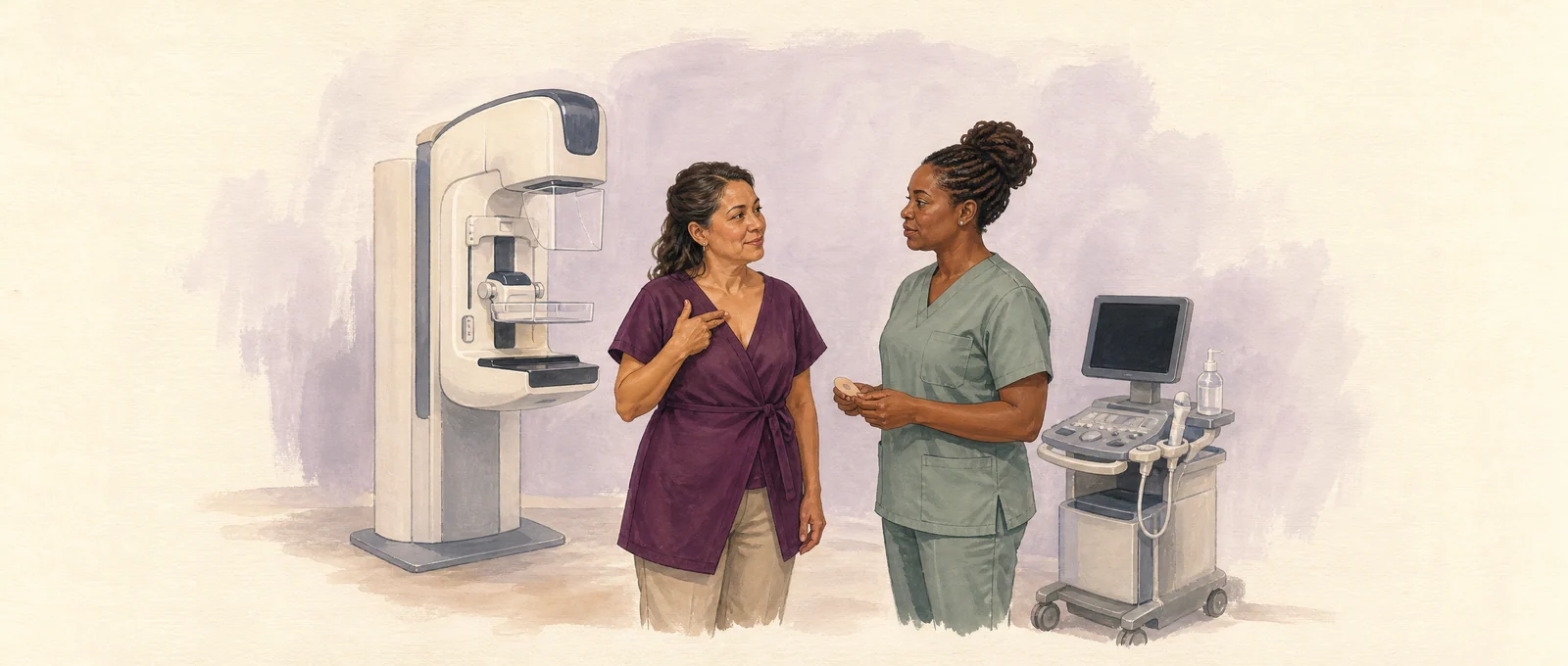
First, separate screening from symptoms
Screening is for finding cancer before you notice a problem. If you’ve found a new lump or seen a change in your breast or nipple, tell the office about the change when you make an appointment. That starts an evaluation of that specific concern, which may include an exam and diagnostic imaging. For a lump that can be felt, the American College of Radiology (ACR) describes diagnostic mammography and targeted ultrasound as imaging options; the choice depends in part on age and what the evaluation shows. A suspicious finding may need a biopsy.56
That distinction matters even if a screening mammogram is already on your calendar. Don’t leave a new symptom unmentioned and assume the screening appointment will address it. Likewise, if you’ve recently had a mammogram, a new lump still deserves an evaluation focused on the place you feel it.5
If you’re feeling well, ask about your screening plan
Your age is one part of the conversation, but it isn’t the whole plan. Screening recommendations differ according to breast cancer risk. The ACR recommends mammography or digital breast tomosynthesis as screening options for people assigned female at birth with native breast tissue across risk categories; it also recommends breast MRI for some people at high risk. The appropriate starting age and combination of tests depend on the type of risk.6
Bring up any known inherited risk and breast or ovarian cancer in your family rather than assuming an average-risk plan fits you. Inherited changes such as BRCA1 and BRCA2 can raise breast cancer risk. If you’re unsure whether your history changes your screening plan, that’s a useful question for the clinician helping you plan it.346
If the main issue is pain, look for a pattern and other changes
Breast pain by itself is unlikely to be a sign of cancer. During the years you have periods, pain can begin before a period, affect both breasts, and ease when the period ends. Pain can also be felt in the breast when it comes from a neck, shoulder, or back injury. Some medicines and hormonal changes around menopause are other possible contributors.2
For example, soreness in both breasts that repeatedly settles after your period is a different situation from pain alongside a new lump or nipple change. If pain isn’t improving, arrange an appointment. If you also notice a lump, discharge, dimpling, a newly inverted nipple, or another change that isn’t normal for you, mention that change when you seek care rather than describing the problem only as pain.24
Get prompt assessment if pain comes with a breast that is red, hot, or swollen, or with a high temperature or feeling shivery. These symptoms can signal a more serious problem.2
If something looks or feels new, get it evaluated
A new lump or thickening in the breast or armpit, a change in breast shape, skin dimpling, a nipple that has newly turned inward, or a rash or scaling around the nipple all warrant an appointment. A breast skin color change may look darker than usual on brown or Black skin rather than red. Many breast changes have causes other than cancer, but appearance alone can’t settle what a new change means.34
Seek prompt clinical advice if a lump feels hard and doesn’t move, discharge contains blood, or you notice a breast-shape change, skin dimpling, a nipple rash, or a nipple that has newly turned inward. Don’t wait for a routine screening appointment to raise these changes.2
Nipple discharge also deserves a conversation with a clinician. Leakage can happen during pregnancy or breastfeeding and has several possible causes, including a blocked duct, infection, medicines, and noncancerous breast changes. Tell the clinician if discharge happens on its own, comes from one breast, or contains blood, along with whether you’re pregnant or breastfeeding. Those details help describe the concern; they aren’t a reason to dismiss a change that’s unusual for you.13
The useful first move is to name which of the three questions you have: Am I due for preventive screening? Why do my breasts hurt? Or what is this new change? That lets you ask for the right kind of appointment without having to decide for yourself what caused the symptom.2456
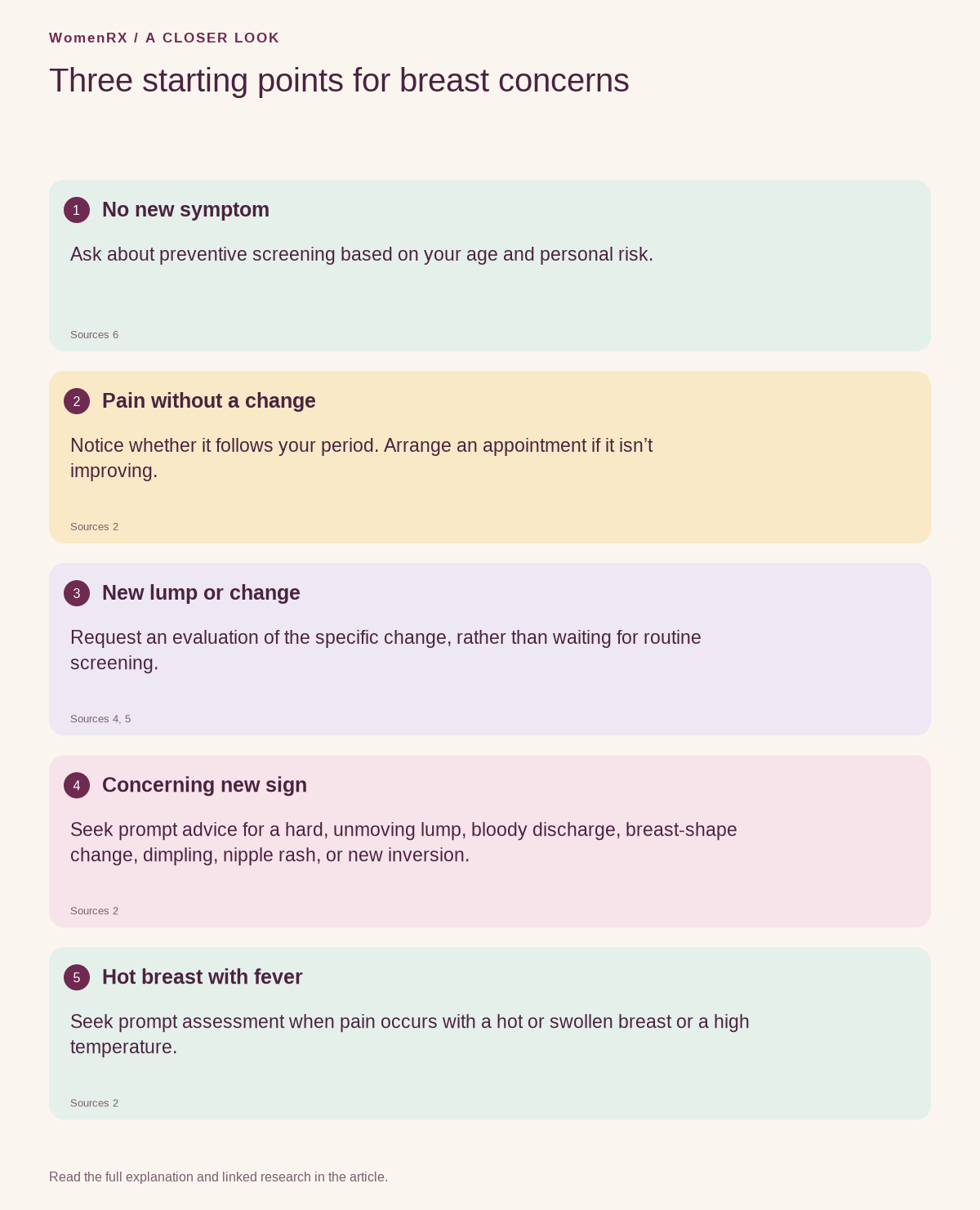
Three starting points for breast concerns
No new symptom: Ask about preventive screening based on your age and personal risk.6
Pain without a change: Notice whether it follows your period. Arrange an appointment if it isn’t improving.2
New lump or change: Request an evaluation of the specific change, rather than waiting for routine screening.45
Concerning new sign: Seek prompt advice for a hard, unmoving lump, bloody discharge, breast-shape change, dimpling, nipple rash, or new inversion.2
Hot breast with fever: Seek prompt assessment when pain occurs with a hot or swollen breast or a high temperature.2
Read the figure as text
Start with the reason you’re concerned, then choose the kind of conversation or assessment it calls for.- No new symptom: Ask about preventive screening based on your age and personal risk.6
- Pain without a change: Notice whether it follows your period. Arrange an appointment if it isn’t improving.2
- New lump or change: Request an evaluation of the specific change, rather than waiting for routine screening.45
- Concerning new sign: Seek prompt advice for a hard, unmoving lump, bloody discharge, breast-shape change, dimpling, nipple rash, or new inversion.2
- Hot breast with fever: Seek prompt assessment when pain occurs with a hot or swollen breast or a high temperature.2
More questions, answered
Does a recent mammogram rule out a new lump?
No. A lump you can feel calls for a clinical evaluation directed at that lump, usually with imaging to characterize it. Tell the clinician where you feel it even if you’ve had a recent screening mammogram.5
Sources you can check
- Nipple discharge - NHSAccessed 2026-09-25Return to first citation
- Breast pain - NHSAccessed 2026-09-25Return to first citation
- Breast Cancer | Breast Cancer Symptoms | MedlinePlusAccessed 2026-09-25Return to first citation
- Symptoms of breast cancer in women - NHSAccessed 2026-09-25Return to first citation
- ACR Appropriateness Criteria® Palpable Breast Masses.Expert Panel on Breast Imaging:, Moy L, Heller SL, Bailey L, D'Orsi C, DiFlorio RM, Green ED, Holbrook AI, Lee SJ, Lourenco AP, Mainiero MB, Sepulveda KA, Slanetz PJ, Trikha S, Yep... · Journal of the American College of Radiology : JACR · 2017Return to first citation
- ACR Appropriateness Criteria® Female Breast Cancer Screening: 2025 Update.Expert Panel on Breast Imaging, Yeh ED, Brown A, Freer PE, Bahl M, Bennett DL, Darbha L, Dibble EH, Greenwood HI, Hill FM, Ivansco LK, Kremer ME, Minami CA, Mullen LA, Neal CH, New... · Journal of the American College of Radiology : JACR · 2025Return to first citation