Could This New Change Be Perimenopause?
Hot flashes have a strong menopause link, but sleep, memory, weight, and bleeding changes call for a closer look.
A new symptom could overlap with perimenopause without being caused by it. Hot flashes and night sweats are well-recognized menopause-related symptoms; sleep and body-composition changes are less specific, and evidence about cognitive changes is still developing. Unusual bleeding deserves particular attention because hormonal changes and structural conditions can coexist. The symptom’s pattern and other possible causes matter more than whether it appears on a menopause list. 2 3 4 5
If a change catches you off guard, it’s reasonable to wonder about perimenopause. The useful next question is more precise: How strongly is this change linked to the transition, and what else might explain it? A symptom can be real and worth addressing even when its cause isn’t clear.
Which changes offer a stronger clue?
These are practical evidence distinctions, not a diagnostic score. “Well recognized” means a symptom has an established menopause association, not that menopause explains every instance of it.
| Change you’ve noticed | Strength of the link | What else to consider |
|---|---|---|
| Hot flashes or night sweats | Well recognized. Vasomotor symptoms are a central concern in menopause guidance. 2 | They offer a stronger clue than a vague change in energy or focus, but they cannot establish your menopause stage or prove the cause on their own. |
| Vaginal or urinary changes | Recognized in menopause care. Guidance addresses genitourinary syndrome of menopause, though this broad evidence does not establish when a particular symptom first appears. 2 | A new vaginal or urinary symptom should not automatically receive a menopause label. This broad guidance doesn’t tell you what caused a particular new symptom. |
| Disrupted sleep or a changing waistline | Associated, but less specific. A review describes sleep disruption and body-composition shifts across the transition. Whether hormonal changes independently alter resting energy expenditure, apart from aging and body composition, remains debated. 4 | For a changing waistline, age, body composition, and lifestyle also matter. For poor sleep, notice whether it occurs alongside night sweats or has a different pattern; that observation is a clue, not proof. 4 |
| Memory or concentration concerns | Preliminary. In an online study of 687 participants, a combined perimenopause group performed less well on a learning-efficiency measure than reproductive-age and postmenopausal groups. 5 | That finding does not identify the cause of your own lapses. The study assessed mood and menopause symptoms but did not establish a single explanation for an individual complaint. 5 |
| Unusual bleeding | Possible overlap, not a safe assumption. Hormonal disturbance can occur alongside fibroids, adenomyosis, endometriosis, other structural problems, or endometrial lesions. 3 | Bleeding needs attention to its cause rather than being written off as a routine part of the transition. 3 |
Why timing doesn’t settle the cause
Perimenopause is not simply a steady drop in estradiol. Hormone levels vary during the transition, sometimes including intermittent estradiol surges. That makes a changing symptom pattern plausible, but it doesn’t mean every new symptom in midlife is hormone-driven. 4
A changing waistline shows why the distinction matters. Body composition may shift around the menopause transition, while aging, existing body composition, and lifestyle can also influence what you notice. Research has not cleanly separated all those contributions to resting energy expenditure. Treat the change as something worth understanding, not as a test for perimenopause. 4
Memory concerns require a different distinction: feeling less sharp is not the same measure as performance on a cognitive test. The online study found a difference in one learning measure when perimenopause stages were combined. It found no significant difference between early and late perimenopause in self-reported memory complaints or objective cognitive performance. That’s a reason to take a concern seriously without assuming a missed word or forgotten task has one hormonal explanation. 5
Look for a competing explanation when one is available
Sometimes the alternative is concrete. If shakiness, dizziness, or reduced sex drive began after starting an SSRI or SNRI antidepressant, those are recognized possible medication side effects. That timing doesn’t prove the medicine is responsible, but it gives you a specific possibility to raise rather than calling the change a perimenopause symptom by default. 1
For bleeding, the competing explanations are especially consequential. A review of gynecologic conditions in perimenopause notes that hormonal disturbance, structural conditions, and precancerous or cancerous endometrial changes may coexist. If bleeding is unusual for you, seek an assessment of the bleeding itself instead of waiting for a menopause explanation to fit. 3
For other changes, the honest answer may be less tidy. The menopause guidance establishes that genitourinary symptoms deserve care, but it cannot tell whether your particular urinary or vaginal change has that cause. Likewise, disrupted sleep may occur during the transition without identifying what is disrupting your sleep. Describe the specific change and what accompanies it. A night sweat followed by waking is a different observation from waking without one, even though neither pattern settles the cause. 2 4
The aim isn’t to dismiss a symptom because it isn’t a classic hot flash, or to claim every change as a hidden sign of perimenopause. It’s to use the strength of the link appropriately: recognize a possible pattern, then give a new or troublesome symptom the attention its own details deserve.
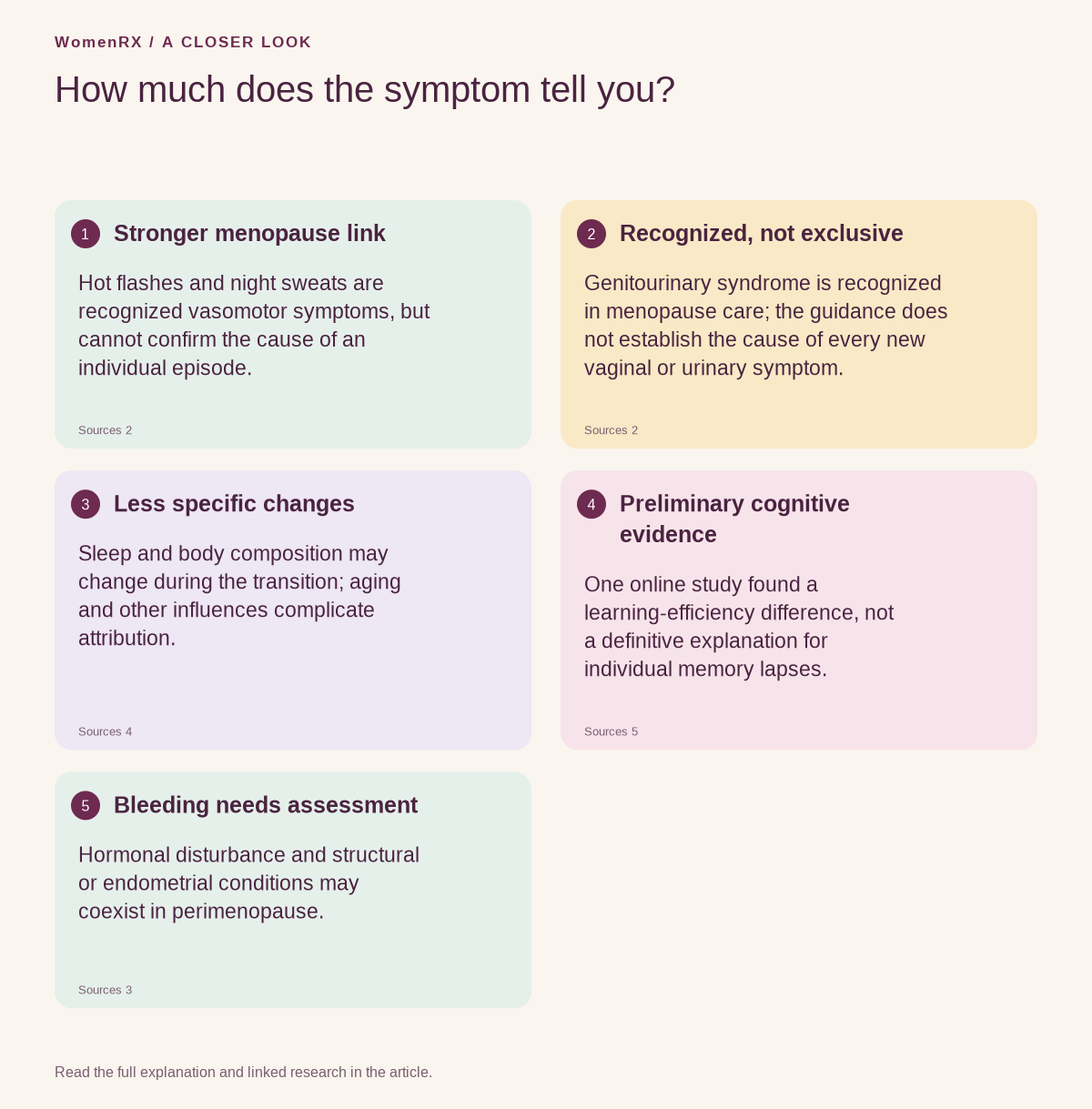
How much does the symptom tell you?
Stronger menopause link: Hot flashes and night sweats are recognized vasomotor symptoms, but cannot confirm the cause of an individual episode.2
Recognized, not exclusive: Genitourinary syndrome is recognized in menopause care; the guidance does not establish the cause of every new vaginal or urinary symptom.2
Less specific changes: Sleep and body composition may change during the transition; aging and other influences complicate attribution.4
Preliminary cognitive evidence: One online study found a learning-efficiency difference, not a definitive explanation for individual memory lapses.5
Bleeding needs assessment: Hormonal disturbance and structural or endometrial conditions may coexist in perimenopause.3
Read the figure as text
An evidence map showing why some changes offer a stronger menopause clue while others need a wider explanation.- Stronger menopause link: Hot flashes and night sweats are recognized vasomotor symptoms, but cannot confirm the cause of an individual episode.2
- Recognized, not exclusive: Genitourinary syndrome is recognized in menopause care; the guidance does not establish the cause of every new vaginal or urinary symptom.2
- Less specific changes: Sleep and body composition may change during the transition; aging and other influences complicate attribution.4
- Preliminary cognitive evidence: One online study found a learning-efficiency difference, not a definitive explanation for individual memory lapses.5
- Bleeding needs assessment: Hormonal disturbance and structural or endometrial conditions may coexist in perimenopause.3
Sources you can check
- Other medicines for menopause symptoms - NHSAccessed 2026-09-25Return to first citation
- The 2022 hormone therapy position statement of The North American Menopause Society.“The 2022 Hormone Therapy Position Statement of The North American Menopause Society” Advisory Panel. · Menopause (New York, N.Y.) · 2022Return to first citation
- Complex benign gynecology in perimenopause: current evidence and future directions.Goren R, Shats M, Ciesielski K, Siedhoff M, Meyer R. · Current opinion in obstetrics & gynecology · 2026Return to first citation
- Metabolic Changes of Perimenopause and Nutritional Advice.Bonnes SLR, Nordhues H, Sood R, Kulick D, Muratore A, Bischof E. · Current nutrition reports · 2026Return to first citation
- Subjective cognition and objective cognitive performance in early versus late perimenopause.Furey RT, Zhu C, Li Q, Gurvich C. · Journal of clinical and experimental neuropsychology · 2026Return to first citation