Menopause Hormone Therapy: How to Decide Whether to Discuss It
Start with the symptom you want help with, then weigh the treatment type against your health history, timing, and preferences.
Menopause hormone therapy is most effective for bothersome vasomotor symptoms and can also help with menopause-related vaginal and urinary symptoms and prevent bone loss. The options depend partly on your goal: systemic therapy is used for symptoms affecting the body more broadly, while lower-dose vaginal options may suit vaginal or urinary symptoms alone. Age, time since menopause, health history, and preferences all shape the conversation. 1
Begin with the symptom you want to change
Hormone therapy is not a general-purpose treatment for every change that happens in midlife. It is most effective for bothersome vasomotor symptoms and can treat genitourinary symptoms of menopause. It also helps prevent bone loss and fractures. That makes the first question practical: which symptom is affecting your life, and what would improvement look like to you? 1
In perimenopause, symptoms can arise before periods have stopped; after menopause, bothersome symptoms may continue. The stage of menopause is part of the picture, but it doesn’t decide the choice on its own. Age, time since menopause, health history, and what matters most to you also count. 14
The broad options depend on the treatment goal
Systemic hormone therapy is generally the option to discuss for symptoms such as vasomotor symptoms that call for treatment throughout the body. It uses estrogen. If you have a uterus, a progestogen, such as progesterone or a progestin, is generally included. The exact type and route are choices to discuss rather than a one-size-fits-all formula. 14
Vaginal treatments may be a better fit when vaginal or urinary symptoms are the main concern and you don’t otherwise need systemic therapy. For bothersome genitourinary symptoms not relieved by over-the-counter options, the North American Menopause Society lists low-dose vaginal estrogen, vaginal dehydroepiandrosterone, and oral ospemifene as options. 1
These choices aren’t interchangeable: the right discussion starts with whether your main goal is relief of broader symptoms or treatment of genitourinary symptoms specifically. 1
Timing changes the benefit-risk discussion
For women younger than 60 or within 10 years of menopause onset who have no contraindications, the NAMS position statement describes the benefit-risk balance as favorable when treating bothersome vasomotor symptoms or preventing bone loss. Starting more than 10 years after menopause or after age 60 has a less favorable balance, in part because the absolute risks of coronary heart disease, stroke, blood clots, and dementia are greater in these groups. These are broad findings, not a personal prediction. 1
Hormone therapy should not be started to prevent cardiovascular disease. Evidence and guidance support using it for appropriate symptoms and, in some cases, bone-loss prevention, not as a primary heart-disease prevention strategy. 13
Bring your history and priorities into the choice
Your clinician needs the context that can change which options are suitable: your symptoms and how much they affect daily life, whether you have a uterus, your age and time since menopause, and relevant health conditions. For example, the NAMS nonhormone statement names estrogen-dependent cancers and cardiovascular disease among situations that can make someone a poor candidate for hormone therapy. The exact assessment depends on your individual history. 2
It also helps to say what tradeoffs you’re most concerned about and whether you’d prefer to avoid hormones. If hormone therapy isn’t a fit or isn’t your preference, evidence-supported nonhormonal options for vasomotor symptoms include cognitive behavioral therapy, clinical hypnosis, certain prescription medicines, and weight loss. Which, if any, makes sense depends on your circumstances. 2
You might ask: “Which of my symptoms could this option reasonably help?” “Would local or systemic treatment fit my goal?” “How does my health history affect the balance?” and “When should we revisit whether it’s still helping?” Longer use for persistent vasomotor symptoms should have a documented reason and involve shared decisions and periodic reevaluation. 1
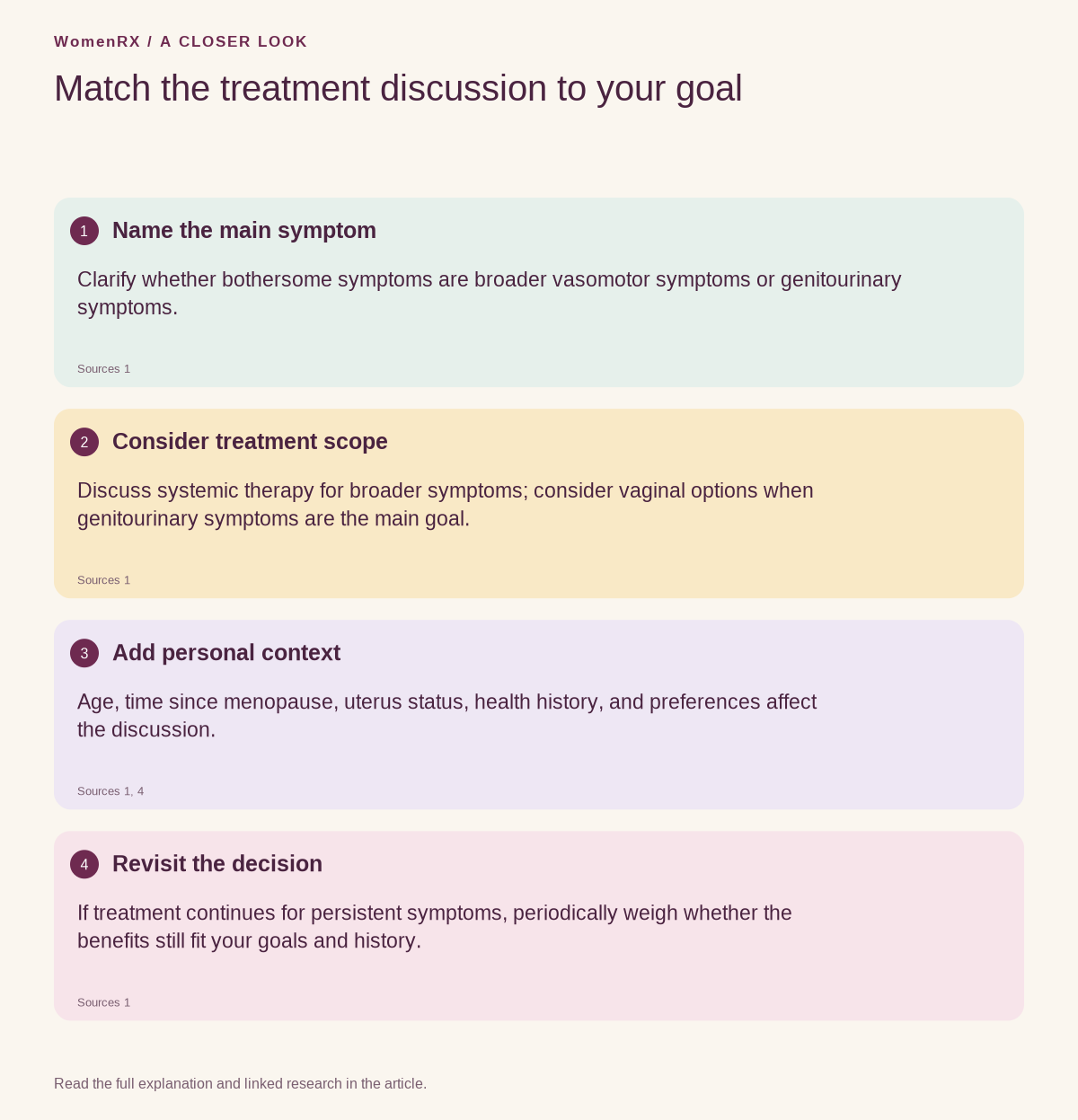
Match the treatment discussion to your goal
Name the main symptom: Clarify whether bothersome symptoms are broader vasomotor symptoms or genitourinary symptoms.1
Consider treatment scope: Discuss systemic therapy for broader symptoms; consider vaginal options when genitourinary symptoms are the main goal.1
Add personal context: Age, time since menopause, uterus status, health history, and preferences affect the discussion.14
Revisit the decision: If treatment continues for persistent symptoms, periodically weigh whether the benefits still fit your goals and history.1
Read the figure as text
A goal-first route through the main menopause hormone therapy questions, without implying that one option suits everyone.- Name the main symptom: Clarify whether bothersome symptoms are broader vasomotor symptoms or genitourinary symptoms.1
- Consider treatment scope: Discuss systemic therapy for broader symptoms; consider vaginal options when genitourinary symptoms are the main goal.1
- Add personal context: Age, time since menopause, uterus status, health history, and preferences affect the discussion.14
- Revisit the decision: If treatment continues for persistent symptoms, periodically weigh whether the benefits still fit your goals and history.1
More questions, answered
Does hormone therapy prevent heart disease?
No. It may be used for appropriate menopause symptoms and can help prevent bone loss, but it isn’t recommended as a primary strategy to prevent cardiovascular disease. 13
Does vaginal treatment mean the same thing as systemic hormone therapy?
No. Low-dose vaginal estrogen is one option for bothersome genitourinary symptoms when systemic therapy isn’t otherwise indicated. Vaginal dehydroepiandrosterone and oral ospemifene are other options listed for these symptoms. 1
Sources you can check
- The 2022 hormone therapy position statement of The North American Menopause Society.“The 2022 Hormone Therapy Position Statement of The North American Menopause Society” Advisory Panel. · Menopause (New York, N.Y.) · 2022Return to first citation
- The 2023 nonhormone therapy position statement of The North American Menopause Society.Menopause (New York, N.Y.) · 2023Return to first citation
- Management of menopausal hormone therapy.Switzer J, Vignali L, Vignali J, Jackson R. · Current opinion in obstetrics & gynecology · 2026Return to first citation
- Demystifying menopausal hormone therapy prescribing.Magraith K, Jang C. · Australian journal of general practice · 2026Return to first citation