Stopping menopause hormone therapy: symptoms, options, and follow-up
Symptoms can return after stopping, but evidence doesn’t show that tapering reliably prevents them, so plan the change around why you take therapy and what you’ll do if symptoms bother you.
Hot flashes and night sweats may return after you stop menopause hormone therapy, but not everyone has a difficult time. Small and limited studies don’t establish that tapering works better than stopping at once. Before changing treatment, review why you started it, what symptoms matter most now, and how you’ll revisit the plan if they return. 2 6 7
Begin with what the therapy is doing for you
The decision to stop looks different depending on why you started hormone therapy. Some people use it mainly for hot flashes and night sweats; others also consider its role in vaginal or urinary symptoms, or bone protection. Hormone therapy is effective for menopausal vasomotor symptoms and genitourinary symptoms, and it helps prevent bone loss and fracture. Its benefits and risks vary by treatment type, dose, duration, route, timing, and whether a progestogen is used. 1 3
At a review, name the original reason for treatment and what it’s helping with now. If bone protection was part of the reason, ask how that fits into your bone-health plan if you stop. If vaginal or urinary symptoms are the main concern, discuss them separately from hot flashes: options for bothersome genitourinary symptoms can differ from options for whole-body symptoms. 3
What might change after stopping
Hot flashes and night sweats are the symptoms most directly addressed in discontinuation studies. They may return, especially when they were the reason you began treatment, but some people stop without major difficulty. Older evidence reviews describe symptoms improving or resolving over time for many women, while also noting that some find symptoms troublesome when they stop. The research doesn’t let anyone predict exactly what will happen for you. 2 7
A return of symptoms doesn’t by itself mean you have to restart hormone therapy. It does give you a reason to reassess how much they affect sleep and daily life, what other options fit your situation, and whether the benefits and risks of continuing still make sense for you. Hormone therapy decisions should be individualized and reviewed periodically. 3
Tapering or stopping at once: what the evidence can tell you
There isn’t a clearly established best method for everyone. In a randomized study of 70 patients, researchers found no statistically significant difference in symptom frequency or severity between stopping immediately and tapering at the two- and four-week checks. The study was small and its follow-up was short, so it can’t settle what works best over a longer period or for every treatment regimen. 6
An observational survey of women veterans who stopped combined estrogen and medroxyprogesterone found that tapering might lessen symptom recurrence, but the study wasn’t randomized. A separate, much smaller survey of women veterans reported recurrence in both groups and didn’t find that tapering reduced it. These different findings are one reason not to promise that a gradual reduction will prevent symptoms. 5 8
So the useful comparison is practical: stopping at once is a simpler change, while tapering spreads the change over time. Neither approach is proven to spare everyone from symptoms. Ask the prescriber who knows your treatment what approach is appropriate for your specific medication and health history; don’t change a prescribed regimen without agreeing on a plan.
Make the follow-up specific
Before the change, write down the symptoms you most want to watch, such as hot flashes, night sweats, or sleep disruption. For a few weeks after the change, note when they happen and whether they interfere with sleep or daily activities. This isn’t a diagnostic test; it’s a practical way to make the next conversation about what changed rather than relying on memory.
Agree on how and when you’ll review the plan. If symptoms return, the next step could be to consider a supported nonhormonal treatment, revisit hormone therapy’s benefits and risks, or discuss another option for the symptom that matters most. The Menopause Society lists cognitive behavioral therapy, clinical hypnosis, and several prescription treatments among evidence-supported approaches for vasomotor symptoms. For bothersome genitourinary symptoms, it describes separate treatment options, including low-dose vaginal estrogen for some people. Which option fits depends on the symptom and the person. 3 4
A useful review question is: “If the symptoms I treated come back, what are the reasonable options for me, and how will we decide whether to stay with the plan?” That keeps the focus on your original goals and gives you a next step without assuming either that symptoms will return or that restarting is the only answer.
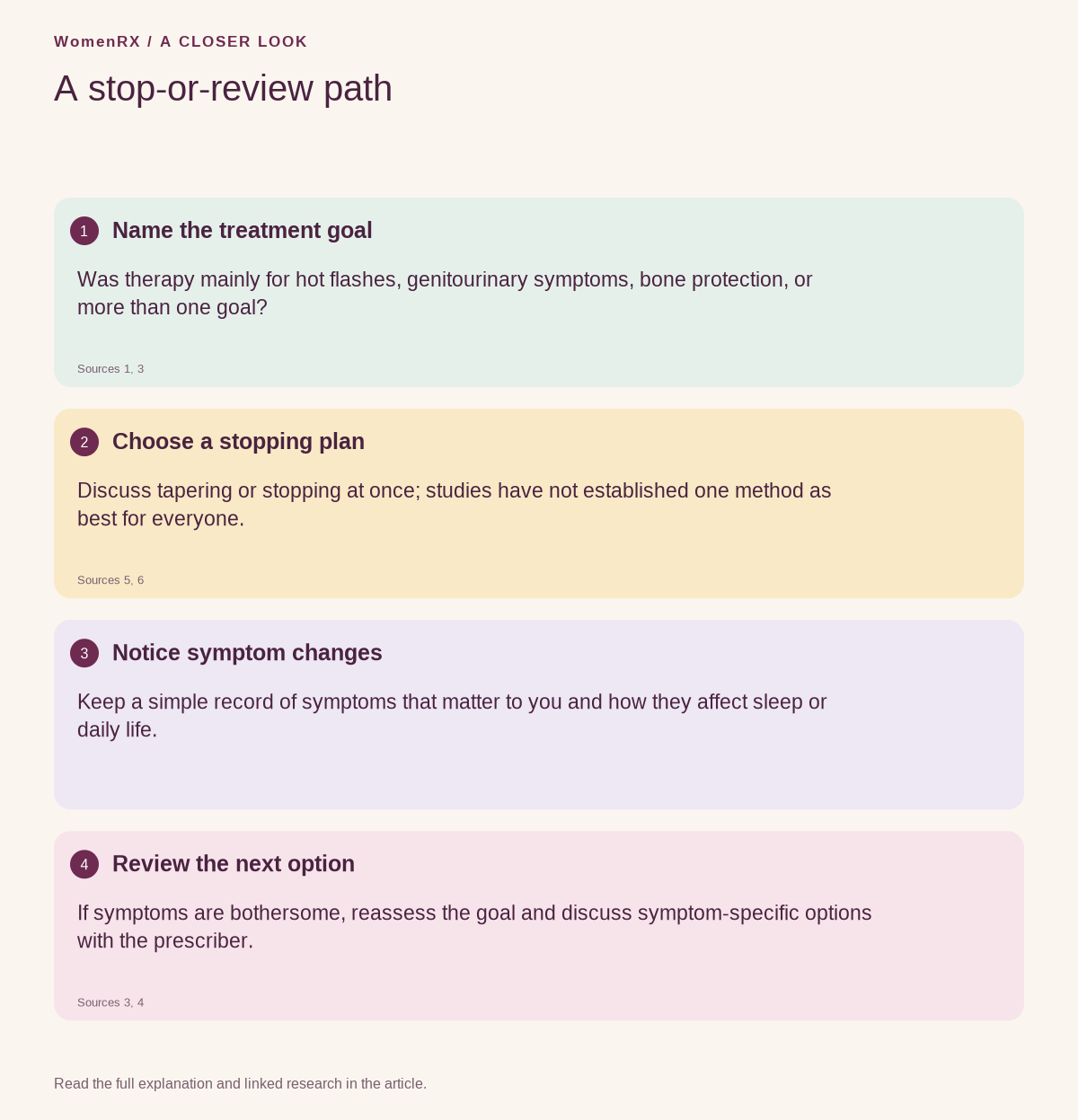
A stop-or-review path
Name the treatment goal: Was therapy mainly for hot flashes, genitourinary symptoms, bone protection, or more than one goal?13
Choose a stopping plan: Discuss tapering or stopping at once; studies have not established one method as best for everyone.56
Notice symptom changes: Keep a simple record of symptoms that matter to you and how they affect sleep or daily life.
Review the next option: If symptoms are bothersome, reassess the goal and discuss symptom-specific options with the prescriber.34
Read the figure as text
Separate the reason for treatment from what you want to monitor, then make a follow-up decision based on what changes.- Name the treatment goal: Was therapy mainly for hot flashes, genitourinary symptoms, bone protection, or more than one goal?13
- Choose a stopping plan: Discuss tapering or stopping at once; studies have not established one method as best for everyone.56
- Notice symptom changes: Keep a simple record of symptoms that matter to you and how they affect sleep or daily life.
- Review the next option: If symptoms are bothersome, reassess the goal and discuss symptom-specific options with the prescriber.34
More questions, answered
If symptoms return, does that mean I need to restart hormone therapy?
No. It’s a reason to review how bothersome they are and compare options, which may include evidence-supported nonhormonal treatments or revisiting hormone therapy’s benefits and risks. The right choice depends on your symptoms and individual situation. 3 4
Are vaginal symptoms and hot flashes the same treatment question?
Not necessarily. Guidance distinguishes genitourinary symptoms from vasomotor symptoms and describes options for bothersome vaginal or urinary symptoms that may be considered separately from systemic hormone therapy. 3
Sources you can check
- Hormone Therapy for Menopause | MedlinePlusAccessed 2026-09-25Return to first citation
- Menopause | Menopause Symptoms | MedlinePlusAccessed 2026-09-25Return to first citation
- The 2022 hormone therapy position statement of The North American Menopause Society.“The 2022 Hormone Therapy Position Statement of The North American Menopause Society” Advisory Panel. · Menopause (New York, N.Y.) · 2022Return to first citation
- The 2023 nonhormone therapy position statement of The North American Menopause Society.Menopause (New York, N.Y.) · 2023Return to first citation
- Discontinuing postmenopausal hormone therapy: an observational study of tapering versus quitting cold turkey: is there a difference in recurrence of menopausal symptoms?Haskell SG, Bean-Mayberry B, Gordon K. · Menopause (New York, N.Y.) · 2009Return to first citation
- How best is to discontinue postmenopausal hormone therapy: immediate or tapered?Aslan E, Bagis T, Kilicdag EB, Tarim E, Erkanli S, Kuscu E. · Maturitas · 2007Return to first citation
- Discontinuation of postmenopausal hormone therapy.Grady D, Sawaya GF. · The American journal of medicine · 2005Return to first citation
- After the Women's Health Initiative: Postmenopausal women's experiences with discontinuing estrogen replacement therapy.Haskell SG. · Journal of women's health (2002) · 2004Return to first citation