Do Supplements Need to Change Across Your Cycle?
Studies that measure results during different cycle phases haven’t shown that you need to switch supplement products or doses between them.
There’s no clear evidence from the relevant trials that supplements need to change between the follicular and luteal phases. A fish-oil trial measured results at different points in the cycle, but participants took the oil daily. A trial of calcium and vitamin D in women with PCOS also used daily supplements. Neither compared phase-specific use with continuous use. 1 2
Being measured in a phase isn’t the same as taking a supplement in that phase
Here’s the distinction behind many cycle-syncing claims: when researchers measure a result may not be when participants take a supplement. A study can collect blood during the follicular phase while participants take the supplement every day. That study may tell us something about the measured result, but it can’t tell us whether follicular-only dosing works better than daily dosing.
In one randomized trial, 21 university basketball players with regular cycles took either EPA-rich fish oil or a control oil every day for two menstrual cycles. Researchers measured oxidative-stress-related markers during menstrual and follicular phases. Some markers changed from before to after the intervention, but the reported treatment-by-time comparisons did not show a significant difference between the groups. The study didn’t test taking fish oil only in either phase, and its laboratory markers don’t establish a broader health benefit from cycle-based timing. 2
The researchers used temperature patterns and ovulation tests to help identify cycle features in these participants. That care with measurement is useful, but it doesn’t turn daily supplementation into a test of phase-specific dosing. It also means the findings don’t establish a timing plan for someone whose cycles are irregular. 2
The PCOS study asked a different question
A separate randomized trial enrolled women with PCOS and low or insufficient vitamin D. Both groups took metformin; one group also took calcium and vitamin D daily for eight weeks, while the other took a placebo alongside metformin. Researchers assessed menstrual irregularity and hormone-related measures. They did not compare follicular-phase supplementation with luteal-phase supplementation. 1
The researchers collected some blood samples in the early follicular phase. That was a measurement schedule, not a schedule for taking calcium and vitamin D. Nor does the trial show that every participant had irregular cycles: it assessed menstrual irregularity in a group enrolled for PCOS and low or insufficient vitamin D. 1
These distinctions matter if you’re trying to apply a study to your own cycle. The fish-oil trial selected people with confirmed regular cycles. The PCOS trial excluded people using hormonal therapy. Neither provides a tested phase-switching schedule for people with irregular cycles or those using hormonal contraception. 1 2
What would actually test a timing claim?
To find out whether timing makes a difference, a trial would need to compare schedules for the same supplement, such as phase-specific use versus continuous use. It would need to establish how phases were identified and measure the result the timing claim promises. If the promise is relief from a symptom, a change in a laboratory marker alone wouldn’t answer it.
So when a supplement plan tells you to switch at ovulation or start a new product in the luteal phase, look for the comparison it rests on. Did researchers test that switch against taking the same supplement throughout the cycle? Or did they simply measure participants during a particular phase? In these trials, it was the latter. There’s no demonstrated reason here to change a supplement you take solely because the calendar says your phase has changed. 1 2
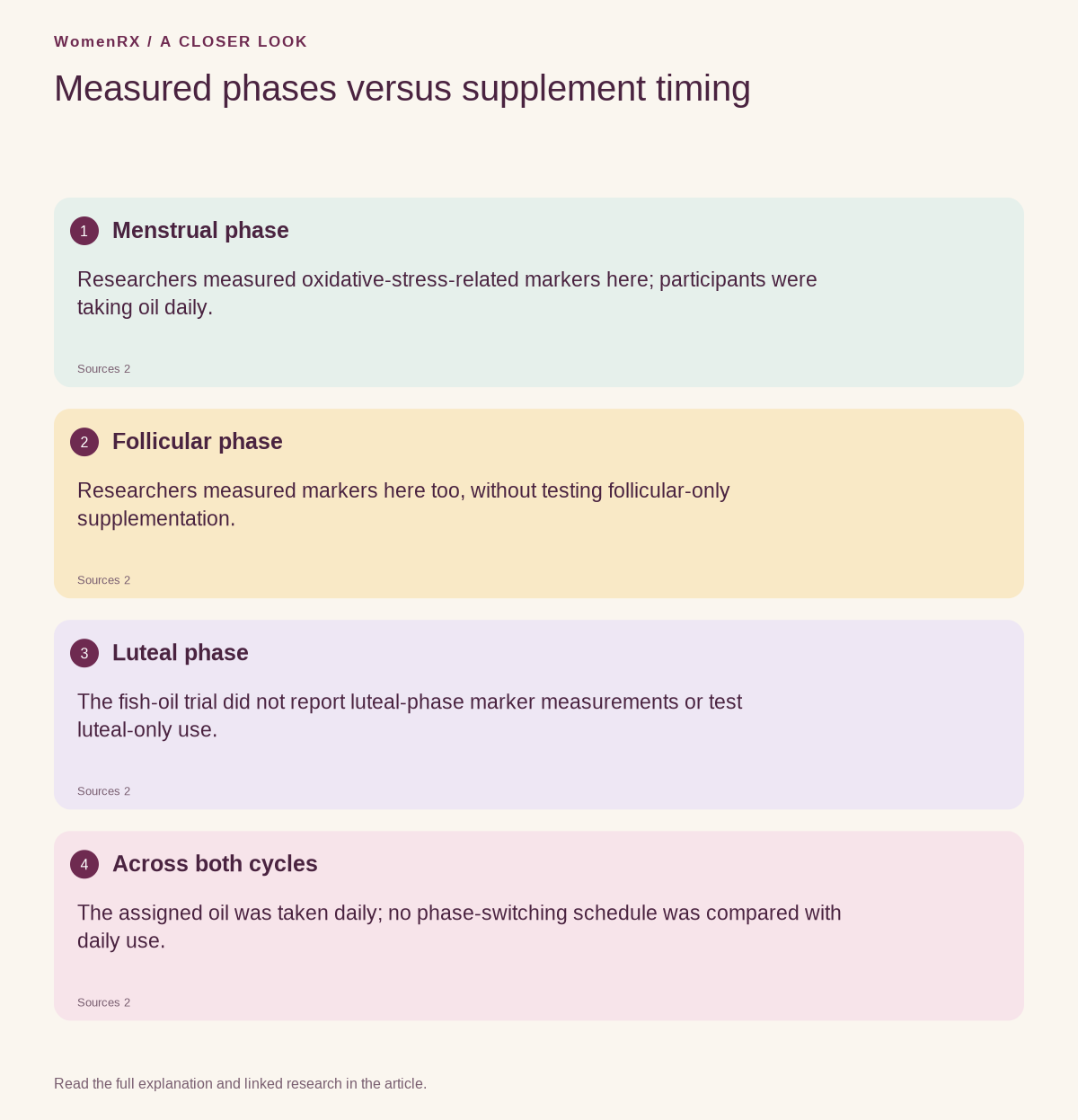
Measured phases versus supplement timing
Menstrual phase: Researchers measured oxidative-stress-related markers here; participants were taking oil daily.2
Follicular phase: Researchers measured markers here too, without testing follicular-only supplementation.2
Luteal phase: The fish-oil trial did not report luteal-phase marker measurements or test luteal-only use.2
Across both cycles: The assigned oil was taken daily; no phase-switching schedule was compared with daily use.2
Read the figure as text
The fish-oil trial measured results at two points in the cycle, while participants took their assigned oil every day.- Menstrual phase: Researchers measured oxidative-stress-related markers here; participants were taking oil daily.2
- Follicular phase: Researchers measured markers here too, without testing follicular-only supplementation.2
- Luteal phase: The fish-oil trial did not report luteal-phase marker measurements or test luteal-only use.2
- Across both cycles: The assigned oil was taken daily; no phase-switching schedule was compared with daily use.2
Sources you can check
- Effect of Calcium and Vitamin D Supplements as an Adjuvant Therapy to Metformin on Menstrual Cycle Abnormalities, Hormonal Profile, and IGF-1 System in Polycystic Ovary Syndrome Patients: A Randomized, Placebo-Controlled Clinical Trial.Kadoura S, Alhalabi M, Nattouf AH. · Advances in pharmacological sciences · 2019Return to first citation
- Influence of Ingestion of Eicosapentaenoic Acid-Rich Fish Oil on Oxidative Stress at the Menstrual Phase: A Randomized, Double-Blind, Placebo-Controlled, Parallel-Group Trial.Mano Y, Kato A, Fukuda N, Yamada K, Yanagimoto K. · Women's health reports (New Rochelle, N.Y.) · 2022Return to first citation