Do Supplements Actually Improve Hormone-Related Symptoms?
A supplement claim is only useful when it names the ingredient, the people studied, and the symptom or outcome it was tested against.
“Hormone balance” is too broad to tell you whether a supplement works. Look for trials of the exact ingredient in people with the same condition and life stage, measuring the symptom you want to change. Menopause studies suggest some herbal products may help some symptoms, but varied products and methods make the overall result uncertain; PCOS studies show some lab-marker changes without significant differences in several sex hormones. 1 2
Start with the outcome, not the promise
“Supports hormone balance” doesn’t tell you which hormone, which symptom, or what improvement to expect. A more testable claim sounds like: this ingredient was studied for hot flashes in postmenopausal women or this supplement changed a specified lab marker in women with PCOS. Those are different claims, and neither automatically proves that a product relieves symptoms for you.
A useful first question is: What exact outcome did the study measure? Symptom frequency, sleep, menstrual patterns, and a blood test are not interchangeable. A change in a lab value doesn’t by itself establish that someone feels better or has a meaningful health benefit.
Menopause: promising findings, hard to generalize
A 2026 systematic review included 30 randomized trials of non-soy oral herbal supplements for menopausal symptoms. Twenty-eight trials reported improvement in at least some symptoms, often vasomotor symptoms such as hot flashes. But the trials covered 19 different herbs, varied in product, dose, duration, and measurement, and mostly involved healthy peri-, meno-, or postmenopausal women over 40. The reviewers said that this variation made it difficult to reach an overall conclusion about whether herbal supplements work. A count of positive trials isn’t the same as reliable proof that any one product works. 1
So check whether the claim names the same herb and the same symptom as the research. Evidence about one botanical doesn’t establish an effect for another, and results from menopause studies don’t automatically apply during the cycling years, pregnancy, or postpartum. This review also can’t tell you which current retail product matches a studied formulation.
PCOS: a lab change isn’t the same as symptom relief
A 2025 network meta-analysis combined 79 randomized trials involving 5,501 women aged 18-49 with diagnosed PCOS. It compared supplements across metabolic and hormone-related measurements. Some supplement comparisons suggested changes in particular metabolic or oxidative-stress markers, but the analysis found no significant differences from placebo for total testosterone, sex hormone-binding globulin, or DHEAS. These findings don’t establish that a supplement relieves a particular PCOS symptom just because it affects another marker. 2
The distinction matters if a product advertises that it “balances hormones.” Ask which hormone or outcome changed, compared with what, and whether the study measured a symptom you care about. The PCOS findings apply to people with diagnosed PCOS, not to everyone with irregular periods, acne, or fatigue.
Separate deficiency claims from hormone claims
A claim about correcting a diagnosed nutrient deficiency is not the same claim as changing hormones or treating a hormone-related symptom. To judge a deficiency claim, look for evidence that the specific deficiency was identified, that the supplement corrected it, and that the outcome you care about improved. The menopause and PCOS reviews discussed here don’t establish which deficiencies cause hormone-related symptoms or which supplements treat them.
That gap is a reason to ask for a more specific explanation, not to assume that a supplement is necessary or that a deficiency has been ruled out. The evidence question changes with the person, the nutrient, and the outcome.
A four-part check before you trust the claim
- Ingredient: Does the research test this specific ingredient or botanical, rather than a different one in the same broad category?
- People: Were participants in the same situation, such as menopause or diagnosed PCOS? Don’t treat life stages as interchangeable.
- Outcome: Did the study measure your symptom, or only a lab marker or another health measure?
- Product and safety: Does the product match the studied formulation, and is there relevant safety information for your circumstances? A review reporting no major adverse effects in its included trials does not establish the safety of every product, dose, or combination. 1
If a claim can’t answer those questions, “hormone balance” is marketing language, not a clear summary of evidence. The most useful next step is to identify the symptom or diagnosed deficiency at issue, then look for evidence tied to that specific situation.
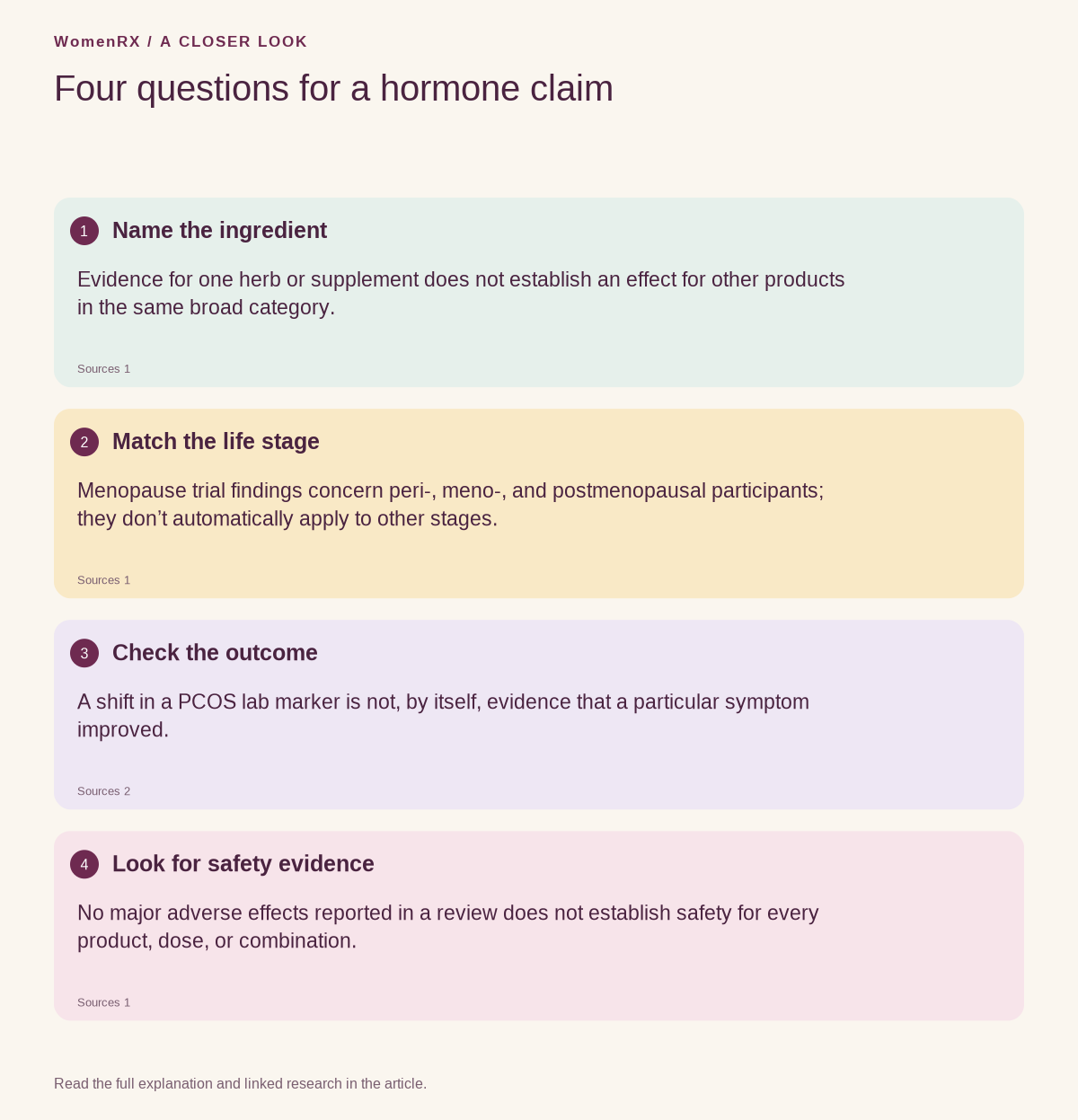
Four questions for a hormone claim
Name the ingredient: Evidence for one herb or supplement does not establish an effect for other products in the same broad category.1
Match the life stage: Menopause trial findings concern peri-, meno-, and postmenopausal participants; they don’t automatically apply to other stages.1
Check the outcome: A shift in a PCOS lab marker is not, by itself, evidence that a particular symptom improved.2
Look for safety evidence: No major adverse effects reported in a review does not establish safety for every product, dose, or combination.1
Read the figure as text
Check whether the evidence matches the ingredient, the people, the outcome, and the product you’re considering.- Name the ingredient: Evidence for one herb or supplement does not establish an effect for other products in the same broad category.1
- Match the life stage: Menopause trial findings concern peri-, meno-, and postmenopausal participants; they don’t automatically apply to other stages.1
- Check the outcome: A shift in a PCOS lab marker is not, by itself, evidence that a particular symptom improved.2
- Look for safety evidence: No major adverse effects reported in a review does not establish safety for every product, dose, or combination.1
More questions, answered
If a supplement changes a hormone lab result, does that mean it works?
Not on its own. A lab change and improvement in a symptom are separate outcomes. In the PCOS analysis, several metabolic or other markers showed potential changes, while total testosterone, SHBG, and DHEAS did not differ significantly from placebo. 2
Can menopause supplement findings be applied during pregnancy or postpartum?
Not from these findings. The menopause review studied peri-, meno-, and postmenopausal women; it doesn’t establish effectiveness or safety in pregnancy or postpartum. 1
Sources you can check
- The Effectiveness of Non-Soy Oral Herbal Supplements for Menopausal Symptoms: A Systematic Review.Jing G, Keane CM, Reynolds CM. · Nutrients · 2026Return to first citation
- The effectiveness of nutritional supplements in improving polycystic ovary syndrome in women: a systematic review and network meta-analysis.Zhao G, Fan Y, Li R, Huang Y, Li W, Zhao Y, Zhou M, He J. · Reproductive biology and endocrinology : RB&E · 2025Return to first citation