Can Supplements Improve Weight or Metabolic Health?
A change on the scale doesn’t tell you whether a supplement improved blood sugar, cholesterol, or blood pressure.
Some ingredients have shown small or inconsistent effects on weight, but that doesn’t establish a benefit for blood sugar, insulin, lipids, or blood pressure. Glucomannan may affect blood glucose and blood lipids, but the size and reliability of those effects aren’t established here. Compare the specific outcome studied with the one you care about, and check the full ingredient list and safety concerns. 1
A supplement can affect one health measure without changing another. A small difference in weight does not, by itself, show that blood sugar, cholesterol, or blood pressure improved. If your concern is metabolic health, the useful question isn’t simply “Does it help with weight?” It’s “Which outcome changed, in whom, and by how much?”
Metabolic syndrome involves a group of risk factors, and assessment can include measurements and blood tests. Lifestyle changes are central to treatment, and some people also need medicine to address issues such as cholesterol or blood pressure. A supplement shouldn’t stand in for that evaluation or treatment. 2
What the ingredient evidence can tell you
Chromium: In a review of nine randomized trials involving 622 adults with overweight or obesity, chromium picolinate led to about 1.1 kg more weight loss than placebo. The evidence quality was low, and the review questioned whether the difference mattered in practice. That finding is about weight, not proof that chromium improves blood sugar or prevents diabetes. Reported side effects in trials included nausea, headache, and watery stools. 1
Glucomannan: Studies have not shown a reliable weight-loss benefit. The NIH Office of Dietary Supplements describes possible benefits for blood glucose and blood lipids, but doesn’t quantify those effects or establish how dependable they are. Glucomannan can cause digestive symptoms, and tablet forms have been linked to esophageal blockage. 1
Green tea preparations: A review of 14 trials of green tea preparations found about 0.95 kg more weight loss than placebo across studies, but a separate analysis of six studies conducted outside Japan found no significant difference. The preparations varied, and most included caffeine, so these findings shouldn’t be treated as results for green tea extract alone. Separately, a trial of green tea extract in postmenopausal women found no overall effect on weight. Extracts also raise a different concern from brewed tea: reports link them to liver injury, and one year-long study in postmenopausal women found increased liver enzymes, with some participants developing liver-function abnormalities. 1
Bitter orange: Evidence for weight loss is weak and inconsistent. Safety deserves particular attention because bitter orange may raise heart rate or blood pressure, although study findings differ. Products that combine it with other stimulants, including caffeine, are a specific concern. Check the whole label for stimulant sources, not just the ingredient named most prominently. 1
The metabolic-outcome evidence is not as easy to compare as the weight findings. Available findings don’t provide consistent, comparable results for blood glucose, insulin, lipids, and blood pressure across these products. For glucomannan, possible glucose and lipid benefits are described without an effect size. For chromium, the weight finding doesn’t establish a glucose benefit. A claim about “metabolic support” doesn’t fill in those missing outcome details. 1
What studies in women, including PCOS, show
Some findings come from studies that included women, but that doesn’t automatically mean the effect is specific to women. For example, a green tea extract study in postmenopausal women found no overall weight benefit. The evidence doesn’t establish that menopause changes the response to other ingredients. 1
PCOS is a more specific case. Research described by one author reports that women using protein supplements during weight loss achieved greater reductions in weight and fat mass. It also reports improvements in insulin resistance during weight loss, but doesn’t establish that protein supplementation caused those improvements. This isn’t evidence that any protein powder improves PCOS, or that a particular product, dose, or safety profile has been established. 4
Check the product, not just the promise
Before buying, decide which measurable result matters to you: weight, waist measurement, blood glucose, cholesterol, or blood pressure. Then check whether the evidence is for that same result and for the ingredient in the product you’re considering. Many weight-loss supplements combine ingredients, and products can vary in their contents and amounts. Evidence about one ingredient may not predict what a blend will do. Some supplement ingredients can interact with medicines, and formulas vary, so the specific product label matters. 1
If you take medicine for blood sugar, blood pressure, or cholesterol, or have one of these conditions, bring the product label to the person managing your care before adding it. That gives you a chance to check for relevant risks without relying on a general “metabolism” claim. If a health measure is the reason you’re considering a supplement, measure that outcome directly rather than using weight change as a stand-in. 12
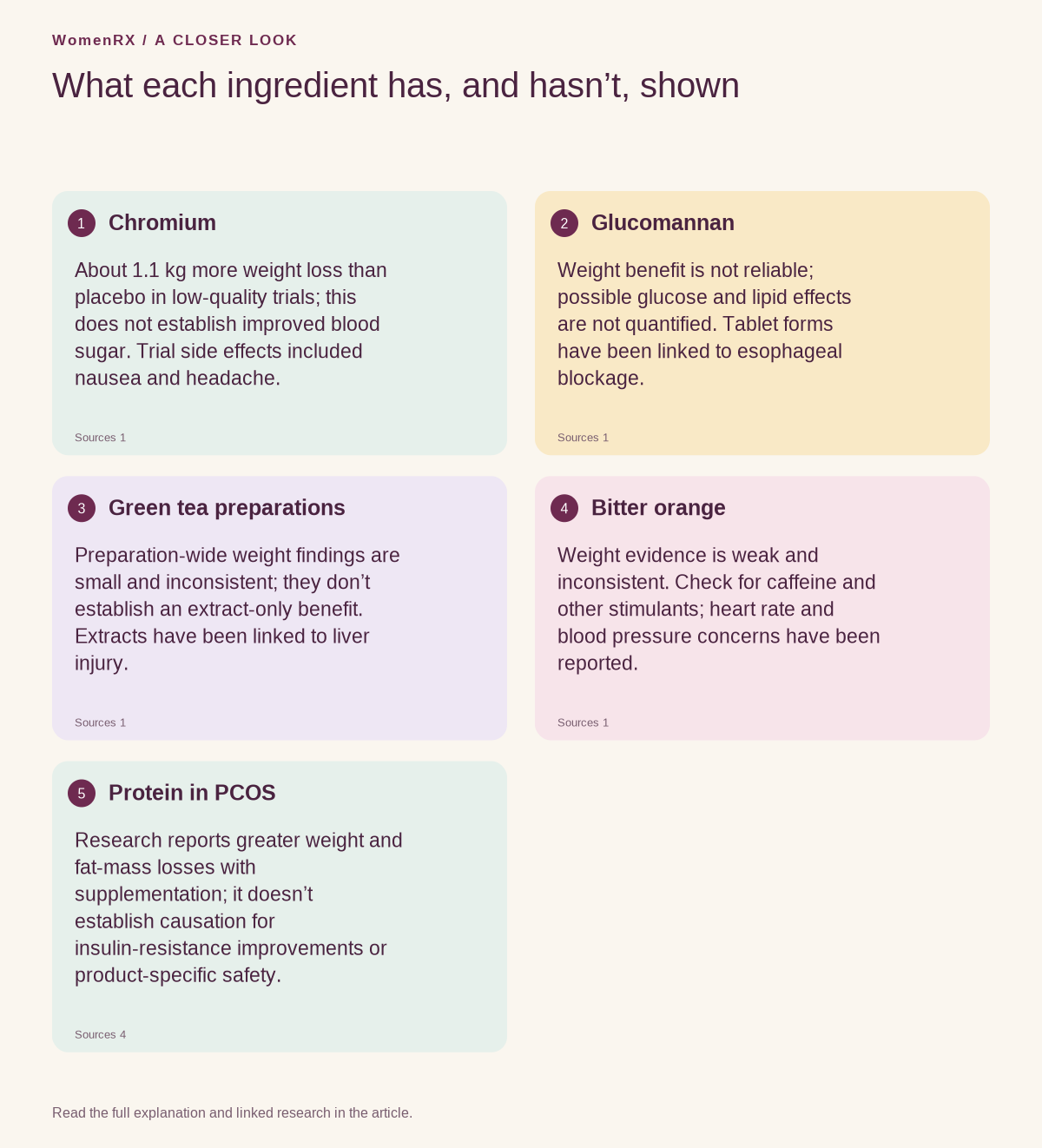
What each ingredient has, and hasn’t, shown
Chromium: About 1.1 kg more weight loss than placebo in low-quality trials; this does not establish improved blood sugar. Trial side effects included nausea and headache.1
Glucomannan: Weight benefit is not reliable; possible glucose and lipid effects are not quantified. Tablet forms have been linked to esophageal blockage.1
Green tea preparations: Preparation-wide weight findings are small and inconsistent; they don’t establish an extract-only benefit. Extracts have been linked to liver injury.1
Bitter orange: Weight evidence is weak and inconsistent. Check for caffeine and other stimulants; heart rate and blood pressure concerns have been reported.1
Protein in PCOS: Research reports greater weight and fat-mass losses with supplementation; it doesn’t establish causation for insulin-resistance improvements or product-specific safety.4
Read the figure as text
Weight findings don’t establish changes in blood sugar, lipids, or blood pressure. Compare the outcome studied and evidence limits, alongside reported safety concerns where evidence is available.- Chromium: About 1.1 kg more weight loss than placebo in low-quality trials; this does not establish improved blood sugar. Trial side effects included nausea and headache.1
- Glucomannan: Weight benefit is not reliable; possible glucose and lipid effects are not quantified. Tablet forms have been linked to esophageal blockage.1
- Green tea preparations: Preparation-wide weight findings are small and inconsistent; they don’t establish an extract-only benefit. Extracts have been linked to liver injury.1
- Bitter orange: Weight evidence is weak and inconsistent. Check for caffeine and other stimulants; heart rate and blood pressure concerns have been reported.1
- Protein in PCOS: Research reports greater weight and fat-mass losses with supplementation; it doesn’t establish causation for insulin-resistance improvements or product-specific safety.4
More questions, answered
If a supplement helps me lose weight, does that mean my metabolic health improved?
Not necessarily. Weight and metabolic risk measures are different; a weight change alone doesn’t show what happened to blood glucose, cholesterol, or blood pressure. Those outcomes need to be assessed directly. 23
Sources you can check
- Dietary Supplements for Weight Loss - Health Professional Fact SheetAccessed 2026-09-25Return to first citation
- Metabolic Syndrome | MedlinePlusAccessed 2026-09-25Return to first citation
- Body Weight: MedlinePlusAccessed 2026-09-25Return to first citation
- Reactive Hypoglycemia: A Trigger for Nutrient-Induced Endocrine and Metabolic Responses in Polycystic Ovary Syndrome.Karakas SE. · Journal of clinical medicine · 2023Return to first citation