Alternatives to Tirzepatide for Weight Management
Semaglutide, several other prescription medicines, structured lifestyle care, and sometimes surgery may be options, but the right comparison depends on your health, goals, and pregnancy plans.
For nonpregnant adults with obesity, the American College of Physicians suggests semaglutide as an alternative to tirzepatide, with phentermine-topiramate, liraglutide, and naltrexone-bupropion among other medication options. The recommendations are conditional, not a universal ranking: benefits, risks, cost, access, health conditions, and preferences all matter. Medication is usually considered alongside lifestyle care, and pregnancy or breastfeeding can change the decision. 4 2
If tirzepatide isn’t a fit, there isn’t one automatic replacement. The 2026 American College of Physicians guideline suggests several alternatives for adults with obesity, but it makes a conditional recommendation and calls for decisions based on individual benefits, harms, access, medical conditions, and preferences. The guideline addresses nonpregnant adults. 4
Start with the reason for switching
The next step depends partly on what “not working” means for you. You might be considering a switch because of side effects, cost or availability, a preference for pills over injections, or a result that doesn’t meet your goals. Those are different trade-offs, and a medicine that suits one situation may not suit another.
If you take tirzepatide for type 2 diabetes, include blood-sugar management in the conversation, not just weight. Weight-management recommendations and diabetes treatment overlap, but a change should account for both goals. 4 6
What the main alternatives look like
Semaglutide is the closest option in the guideline’s recommendation tier: ACP suggests semaglutide and tirzepatide as first-line medicines for nonpregnant adults with obesity. The weight-management formulation is given by weekly injection. Like other medicines in this group, it can cause gastrointestinal side effects. That shared placement does not mean every person will respond the same way or that the medicines are interchangeable for every medical purpose. 4 5
Phentermine-topiramate is an oral, once-daily option that ACP places after semaglutide and tirzepatide for adults with obesity. Pregnancy is a central consideration: the guideline flags teratogenic risk and monthly pregnancy testing, and the 2025 review also identifies a risk of birth defects. It may not be a suitable option for someone who is pregnant or could become pregnant without an appropriate risk-management plan. 4 5
Liraglutide is another injectable option, taken daily for weight management. ACP places it after phentermine-topiramate for adults with obesity, with low-certainty evidence for that recommendation. Its daily injection schedule may matter if you prefer fewer injections, while its gastrointestinal effects are another consideration. 4 5
Naltrexone-bupropion is an oral option. The product information describes morning and evening use, and nausea was a frequent reason for stopping treatment in clinical trials. It also has specific safety considerations: ACP flags suicidal ideation, and the product information warns against use with MAOIs because of a risk of hypertensive reactions. The guideline and review identify other cautions, including seizure history, uncontrolled high blood pressure, and opioid use. 1 4 5
Orlistat is an oral medicine taken with meals that contain fat. The review describes its main trade-off as gastrointestinal effects and the need to consider fat-soluble vitamins. The ACP recommendations summarized here do not list orlistat among their recommended choices for adults with obesity, so it is worth asking how it fits your circumstances rather than assuming it is an equivalent substitute. 4 5
These options have not been ranked here by expected weight loss. Results reported across separate trials are not a direct comparison between medicines, and individual tolerability and response can differ. 5
If your BMI and health conditions affect the options
The ACP guideline treats adults with obesity differently from adults with overweight plus certain health conditions. For adults with a BMI of 27 to under 30 and conditions such as type 2 diabetes, high blood pressure, dyslipidemia, sleep apnea, or cardiovascular disease, it suggests semaglutide or tirzepatide first and liraglutide second. Its recommendation for phentermine-topiramate or naltrexone-bupropion applies to the obesity group, not this overweight-with-conditions group. 4
That distinction is one reason to ask which indication and treatment goal are being considered, rather than comparing medicine names alone. The available recommendations are not a promise of a particular result, and they don’t replace a review of your health conditions, warnings, and preferences. 4
Pregnancy and breastfeeding deserve their own discussion
ACP’s medication recommendations apply to nonpregnant adults. It specifically flags pregnancy precautions with phentermine-topiramate. Pregnancy and breastfeeding precautions are product-specific, so ask about the particular medicine and your circumstances rather than assuming one drug’s guidance applies to another. 4 5
For naltrexone-bupropion, the product information reports that bupropion and its metabolites, as well as naltrexone and a metabolite, are present in human milk. It says available breastfeeding information is limited and calls for weighing the mother’s clinical need against potential effects on the infant; it also says there are no data on effects on milk production. 1
Medication is one part of obesity care
Lifestyle support can include nutrition changes, physical activity, counseling, and support for maintaining changes over time. MedlinePlus describes these approaches as part of obesity care and lists medication and, in some situations, weight-loss procedures or surgery as additional options. If a medicine isn’t suitable, that doesn’t mean the only alternative is to manage alone. 2
A useful discussion might cover: what outcome matters most to you; whether you prefer a pill or injection; which risks or side effects are most relevant to your health; whether you’re pregnant, breastfeeding, or planning pregnancy; and what access and cost look like. ACP recommends considering these factors when starting or switching medication. 4
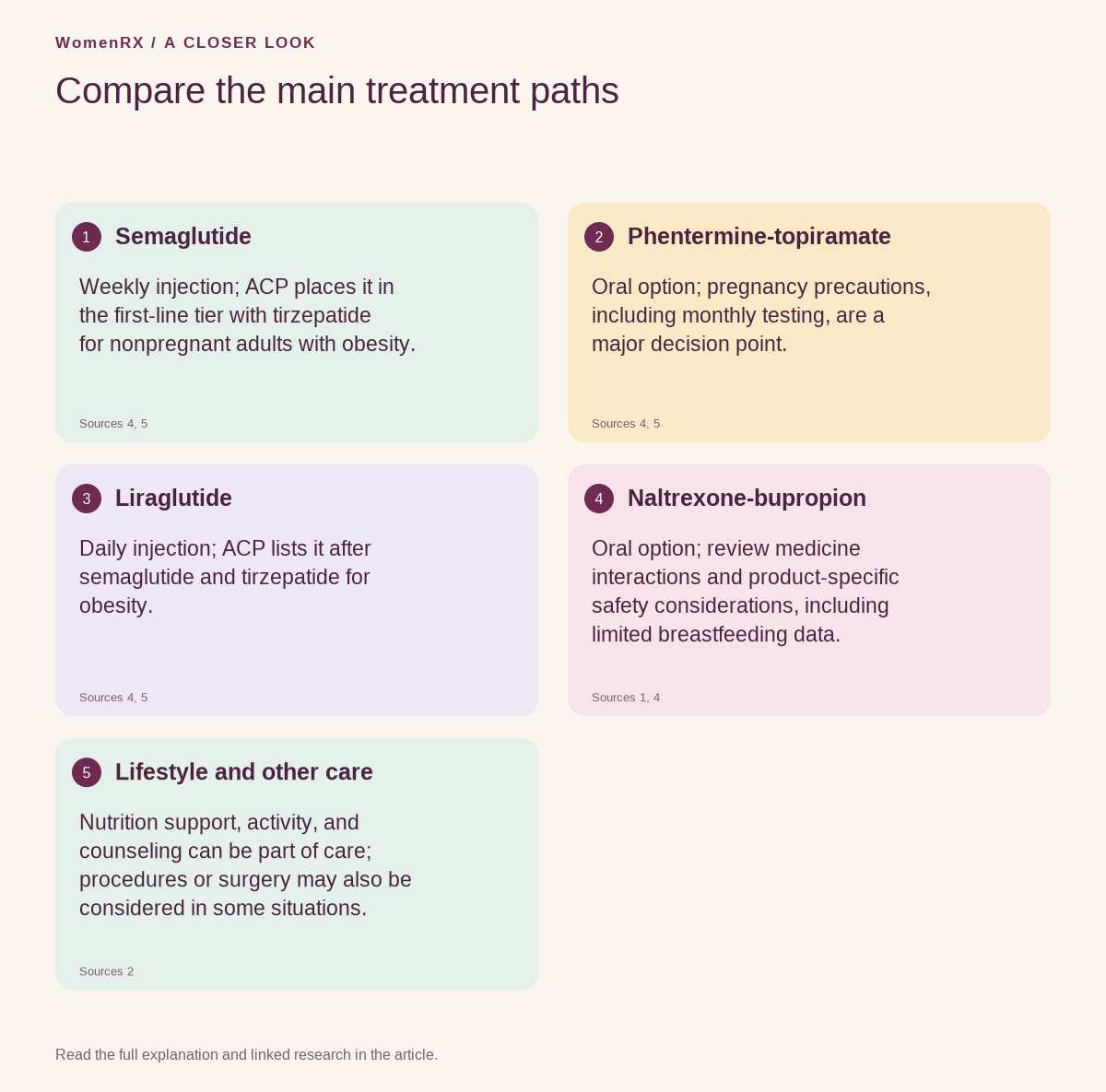
Compare the main treatment paths
Semaglutide: Weekly injection; ACP places it in the first-line tier with tirzepatide for nonpregnant adults with obesity.45
Phentermine-topiramate: Oral option; pregnancy precautions, including monthly testing, are a major decision point.45
Liraglutide: Daily injection; ACP lists it after semaglutide and tirzepatide for obesity.45
Naltrexone-bupropion: Oral option; review medicine interactions and product-specific safety considerations, including limited breastfeeding data.14
Lifestyle and other care: Nutrition support, activity, and counseling can be part of care; procedures or surgery may also be considered in some situations.2
Read the figure as text
These are practical distinctions, not a universal ranking. Which options fit depends on the indication, medical history, reproductive plans, and preferences.- Semaglutide: Weekly injection; ACP places it in the first-line tier with tirzepatide for nonpregnant adults with obesity.45
- Phentermine-topiramate: Oral option; pregnancy precautions, including monthly testing, are a major decision point.45
- Liraglutide: Daily injection; ACP lists it after semaglutide and tirzepatide for obesity.45
- Naltrexone-bupropion: Oral option; review medicine interactions and product-specific safety considerations, including limited breastfeeding data.14
- Lifestyle and other care: Nutrition support, activity, and counseling can be part of care; procedures or surgery may also be considered in some situations.2
More questions, answered
Does the guideline say semaglutide is always the best alternative?
No. ACP places semaglutide in the same first-line tier as tirzepatide for nonpregnant adults with obesity, but its recommendation is conditional. The guideline calls for considering benefits, harms, access, medical conditions, goals, and preferences. 4
Are weight-management and diabetes medicines interchangeable?
Don’t assume they are. If you use tirzepatide for type 2 diabetes, discuss how any change would address both blood sugar and weight-management goals. 4 6
Are weight-loss supplements equivalent alternatives?
No. NIH’s Office of Dietary Supplements notes that evidence for many weight-loss supplement ingredients is limited or inconsistent, and products may have safety concerns or interact with medicines. They are not the same as the prescription options discussed here. 3
Sources you can check
- CONTRAVE EXTENDED-RELEASE (NALTREXONE HYDROCHLORIDE AND BUPROPION HYDROCHLORIDE) TABLET, EXTENDED RELEASE [NALPROPION PHARMACEUTICALS LLC] | US prescribing information and patient instructionsAccessed 2026-09-25Return to first citation
- Obesity: MedlinePlusAccessed 2026-09-25Return to first citation
- Dietary Supplements for Weight Loss - Health Professional Fact SheetAccessed 2026-09-25Return to first citation
- Pharmacologic Treatments With Lifestyle Modifications in Nonpregnant Adults With Overweight or Obesity in Outpatient Settings: A Living Clinical Guideline From the American College of Physicians (April 2026).Qaseem A, Cross JT, Harrod CS, Owens DK, Balk EM, Crandall CJ, Clinical Guidelines Committee of the American College of Physicians, Fitterman N, Gibson M, Lewis J, Mackey K, Miller... · Annals of internal medicine · 2026Return to first citation
- Medical Management of Obesity: A Comprehensive Review of Food and Drug Administration (FDA)-Approved and Investigational Therapies.Raza SS, Zakir Z, Hashmat A, Awan SK, Varrassi G. · Cureus · 2025Return to first citation
- Efficacy of Metabolic and Bariatric Surgery Compared with GLP-1 Receptor Agonist Treatment in Preventing Mortality and Major Adverse Cardiac Events Among Individuals with Obesity and Type 2 Diabetes: A Systematic Review and Meta-analysis.Chadwick J, Sivamani C, Lakshmi S, Baskaran V, N L S, Ayyasamy L, Parasuraman G, Bagepally BS. · Obesity surgery · 2026Return to first citation