Reverse Dieting: What It Can and Can’t Do
Gradually raising your food intake may make a post-diet transition feel more manageable, but it isn’t established as a way to repair metabolism or prevent weight regain.
Reverse dieting means increasing food intake gradually after a restrictive diet. It can be a personal way to ease into a new eating routine, but the cited research doesn’t test whether it restores energy expenditure or protects against regain. A small study found lower energy expenditure after weight loss, while a trial in women tested behavioral support, not a calorie ramp. 2 3
A gradual increase is a strategy, not a metabolic repair
Reverse dieting usually means adding food back in small steps after a period of restriction, sometimes with the aim of raising energy expenditure while limiting weight regain. Those are two different ideas: choosing a gradual transition may help you feel more comfortable changing your eating routine, but that doesn’t establish that the steps repair a slowed metabolism or prevent fat gain.
The cited studies do not test a reverse-dieting plan. They therefore don’t establish whether gradual increases work better than moving directly to an individually appropriate maintenance pattern. A slow ramp can be a personal transition strategy; it isn’t an evidence-established requirement after dieting.
Why weight maintenance can feel different after weight loss
Weight loss can be accompanied by lower energy expenditure. In a small controlled study, researchers compared seven matched groups of three people: one at their usual weight, one recently after weight loss, and one who had maintained a weight reduction of at least 10% for more than a year. Energy expenditure was lower in both weight-reduced groups than in the usual-weight group, and the difference remained in those who had maintained their loss. This study supports the existence of metabolic adaptation after weight loss. It did not test whether a gradual increase reverses that adaptation. 3
That distinction matters. A change in energy expenditure after weight loss does not, by itself, mean your metabolism is broken. And evidence that adaptation occurs is not evidence that a particular calorie-increase schedule fixes it. The study was also small and used tightly controlled conditions, so it cannot tell every woman what her maintenance needs are.
What a maintenance trial in women found
A randomized trial studied 113 women ages 18 to 45 who had lost at least 10% of their body weight. During a 24-week maintenance period, the reported between-group mean difference in weight-loss maintenance was −2.2 kg (95% CI, −3.50 to −0.94), favoring cognitive behavioral therapy (CBT). Estimated energy intake and daily steps also changed differently between groups over time. The trial tested CBT, not reverse dieting, and its results don’t show which behavior caused the difference or whether it lasts beyond the study period. 2
This offers a concrete alternative to focusing only on the speed of increasing intake: behavioral support can be part of a maintenance plan. In this trial, energy-intake estimates declined over time in the CBT group and increased in the control group, while daily steps showed a different pattern between groups. Those findings don’t prescribe a routine, but they give you specific topics to discuss, such as what eating patterns and activity feel sustainable for you. 2
The trial speaks to adult women ages 18 to 45 after substantial weight loss, over a 24-week period. It doesn’t establish that the same approach fits every woman or life stage. Neither this trial nor the energy-expenditure study tells us how to approach eating after restriction if your periods have changed, you’re pregnant or breastfeeding, or you have a history of an eating disorder. Their weight-maintenance findings cannot settle what support is appropriate in those circumstances. 2 3 If you want help shaping a maintenance plan, MedlinePlus describes dietitian support as one option when weight change is recommended. 1
Choosing a transition without a calorie formula
You don’t have to follow a precise reverse-dieting schedule to “repair” your metabolism. If a gradual transition feels easier to manage, it can be a personal preference; the cited findings do not establish that it prevents regain better than another transition. If you’d rather have support with maintenance, consider asking about behavioral support or a dietitian referral, and focus the conversation on a routine that fits your circumstances. 1 2
Separate the plan from the promise
Two plans can both involve eating more after a diet while making very different claims.
| Plan or promise | What it means | What remains unanswered |
|---|---|---|
| “I want a gradual transition” | A preference for changing a routine in steps | Whether those steps suit your circumstances |
| “Small increases will repair my metabolism” | A claim about changing energy expenditure | The cited adaptation study did not test that method. 3 |
| “This schedule will prevent regain” | A claim about long-term weight maintenance | Neither cited study compares reverse-dieting schedules. 23 |
| “I want support with maintenance” | Help with routines and behaviors | One trial in women supports considering behavioral support, without proving every program works. 2 |
Write down what you actually need help with: eating regularly, feeling comfortable with more food, fitting activity into the week, or managing fear of regain. That gives a support conversation a clearer starting point than “fix my metabolism.”
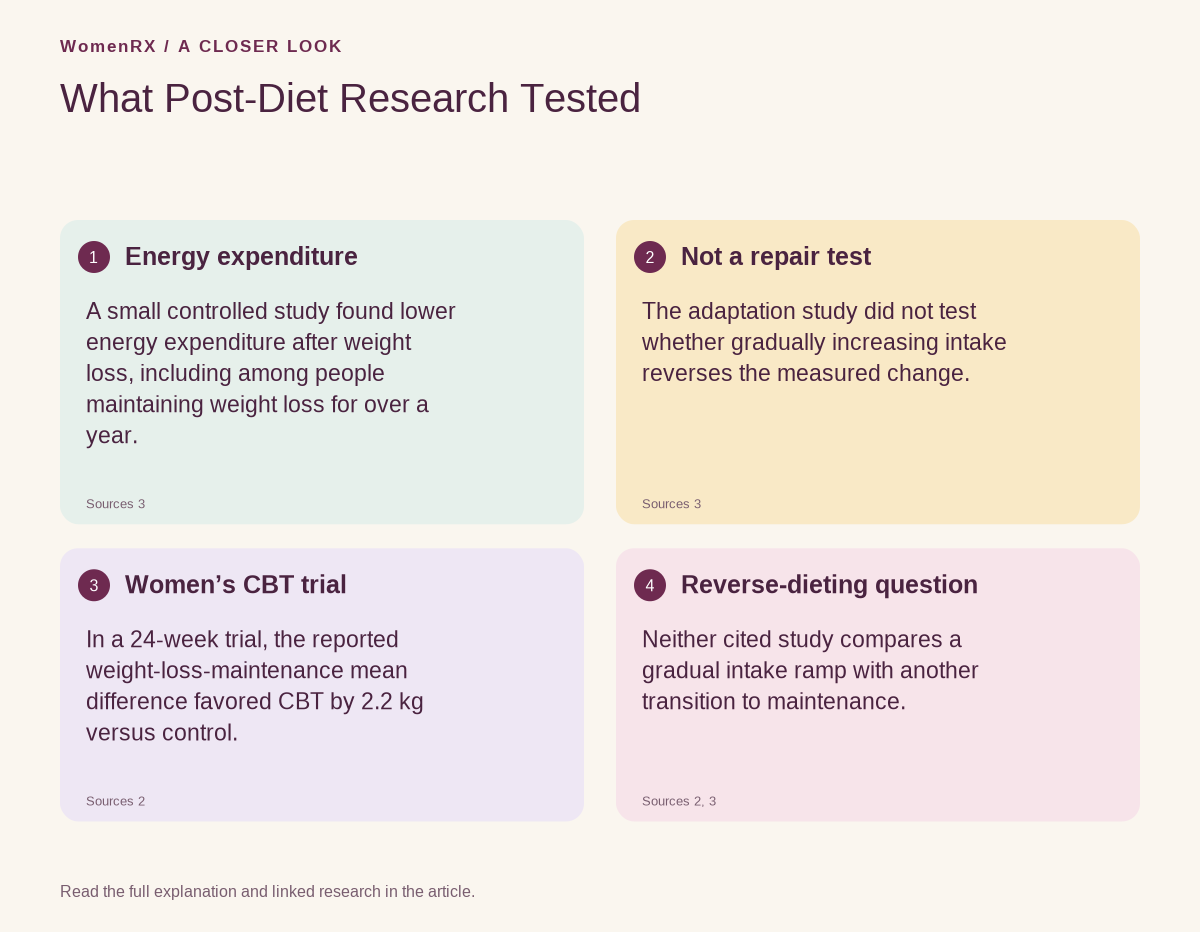
What Post-Diet Research Tested
Energy expenditure: A small controlled study found lower energy expenditure after weight loss, including among people maintaining weight loss for over a year.3
Not a repair test: The adaptation study did not test whether gradually increasing intake reverses the measured change.3
Women’s CBT trial: In a 24-week trial, the reported weight-loss-maintenance mean difference favored CBT by 2.2 kg versus control.2
Reverse-dieting question: Neither cited study compares a gradual intake ramp with another transition to maintenance.23
Read the figure as text
Compare findings on energy expenditure and behavioral support with the distinct, untested question of a gradual calorie ramp.- Energy expenditure: A small controlled study found lower energy expenditure after weight loss, including among people maintaining weight loss for over a year.3
- Not a repair test: The adaptation study did not test whether gradually increasing intake reverses the measured change.3
- Women’s CBT trial: In a 24-week trial, the reported weight-loss-maintenance mean difference favored CBT by 2.2 kg versus control.2
- Reverse-dieting question: Neither cited study compares a gradual intake ramp with another transition to maintenance.23
More questions, answered
Does lower energy expenditure after weight loss mean my metabolism is damaged?
No. A small controlled study found lower energy expenditure among people maintaining weight loss, but it did not establish that metabolism was damaged or test a repair strategy. 3
Is there a gradual calorie-increase schedule I should follow?
The cited studies don’t establish a specific reverse-dieting schedule or show that one works better than another way of transitioning to maintenance. A fixed online formula isn’t required by the evidence described.
Sources you can check
- Body Weight: MedlinePlusAccessed 2026-09-25Return to first citation
- Effects of cognitive behavioral therapy on weight maintenance after successful weight loss in women; a randomized clinical trial.Madjd A, Taylor MA, Delavari A, Malekzadeh R, Macdonald IA, Farshchi HR. · European journal of clinical nutrition · 2020Return to first citation
- Long-term persistence of adaptive thermogenesis in subjects who have maintained a reduced body weight.Rosenbaum M, Hirsch J, Gallagher DA, Leibel RL. · The American journal of clinical nutrition · 2008Return to first citation